Sunday, June 22, 2008: Today's commemorated feasts and saints... 1st SUNDAY AFTER PENTECOST — Tone 8. All Saints. Hieromartyr Eusebius, Bishop of Samosata (380). Martyrs Zeno and his servant, Zenas, of Philadelphia (304). Martyrs Galacteon, Juliana, and Saturninus, of Constantinople. St. Alban, Protomartyr of Britain (ca. 287). Hieromartyr Nicetas of Remesiana (414-420). Martyr Nicetas the Dacian (370-372). St. Grigorie Dascalu, Metropolitan of Walachia (Romania). Therefore whoever confesses Me before men, him I will also confess before My Father who is in heaven. But whoever denies Me before men, him I will also deny before My Father who is in heaven. He who loves father or mother more than Me is not worthy of Me. And he who loves son or daughter more than Me is not worthy of Me. And he who does not take his cross and follow after Me is not worthy of Me. Then Peter answered and said to Him, "See, we have left all and followed You. Therefore what shall we have?" So Jesus said to them, "Assuredly I say to you, that in the regeneration, when the Son of Man sits on the throne of His glory, you who have followed Me will also sit on twelve thrones, judging the twelve tribes of Israel. And everyone who has left houses or brothers or sisters or father or mother or wife or children or lands, for My name's sake, shall receive a hundredfold, and inherit eternal life. But many who are first will be last, and the last first. (Mt `10:32-33, 37-38; 19:27-30) For St John Chrysostom (Homily XXXV) Jesus' command to us that we not love our family more than Him, are first and foremost words of great kindness. They speak to us "just at the point [in our life] where love is most tempted to hinder" us. For this reason Jesus counsels fathers "to greater gentleness and children greater freedom." For parents, and really anyone in authority, this gentleness of spirit is essential lest they "attempt what is impossible" by their unwise assumption "that their love of their children can be rightly compared with their [children's] love of God." Likewise, children (and all those under obedience) must take care lest they give to parents (or those in authority over them) the love that should be given to God alone. Again, as St John says, Jesus "instructs the children not to attempt what is impossible by seeking to make their love of parents greater than their love of God." For children to love their parents as if they were God, or for parents to ask their children to love us as if they were God is more than simply offensive to God. In both cases, we desire either is to desire something that will frustrate us and will lead to the degradation of us and those we so imprudently love. Or, to use Chrysostom's word, it is to desire something which is simply "impossible." Contrary to what we might think it is impossible not because we cannot love each other rightly. No the real impossibility is our attempt to turn love against itself. To attempt this is to ruin "both the beloved himself, and the lover." The thing about love is that it is not only an expression of my heart, love changes my heart. Simply put, I become like what I love AND I become how I love. Both the object of my love and the way in which I express my love shapes my character. For this reason is always tempting to love in small measures, to love in such a way that my heart is never change. It is always tempting for me to love today within the limits of how I loved yesterday, to keep my love small. But a small love is a dying love. If I limit my love, I limit myself. In the final analysis, love that does not give everything, gives nothing. And so Jesus tells His disciples, "he who does not take his cross and follow after Me is not worthy of Me." And so, Chrysostom tells us in the sermon quoted above, Jesus tells us "not even simply to hate" our life. No He commands us "to expose it to war, and to battles, and to slaughters, and blood." In saying this Jesus tells us that discipleship requires from us "not merely that we must stand against death, but also against a violent death; and not violent only, but ignominious too." Speaking of Peter's challenge to Jesus, Chrysostom (Homily LXIV) says Jesus "seems to me here to intimate also the persecutions. For since there were many instances both of fathers urging their sons to ungodliness, and wives their husbands; when they command these things, saith He, let them be neither wives nor parents, even as Paul likewise said, 'But if the unbelieving depart, let him depart.'" ( 1 Cor. 7. 15) This theme of self-sacrifice and martyrdom is precisely what the Church puts before us in the hymnography for today's celebration of the Feast of All Saints. For example, we have the troparion for the day: Clothed as in purple and fine linen with the blood of your Martyrs throughout the world, your Church cries out to you through them, Christ God: Send down your pity on your people; give peace to your commonwealth, and to our souls your great mercy. The fact of the matter is, love will always require of me a willingness to embrace martyrdom. Why? While it is always I who love, while love is always a personal act, always really and truly mine, love is not mine alone. To love is not only bear witness to God, it is also to participate in the life of God. In human words and deeds, our love makes manifest the divine life and this always requires from me that I subordinate my life to God. Among the fathers no one is more aware of what it means to love rightly than as St Augustine of Hippo. And there is no one among the fathers who is as aware of the harm of done by a disordered love. In one of his sermons (Sermon 65A.5), Augustine imagines the following bit of dialog: Let a father say, "Love me." Let a mother say, "Love me." To these words I will say, "Be silent." But isn't what they are asking for just? Shouldn't I give back what I have received? The father says, "I fathered you." The mother says, "I bore you." The father says, "I educated you." The mother says. "I fed you." . . . Let us answer our father and mother when they justly say "love us." Let us answer, "I will love you in Christ, not instead of Christ. You will be with me in Him, but I will not be with you without Him." "But we don't care for Christ," they say. "And I care for Christ more than you. Should I obey the ones who raised me and lose the One Who created me?" The challenge before us is to not without hold our love from others, but to learn to love one another rightly. This will, necessarily it seems, put us in conflict not only with the powerful in this life, but also with those with whom we are most intimate, and (in the final analysis) ourselves. And yet there is no other way to love. To love someone simply according to my own desires or theirs, is to love not the person, but my own fantasy of the person. It is, in other words, to worship an idol of my own creation. Their idols are silver and gold, The work of men's hands. They have mouths, but they do not speak; Eyes they have, but they do not see; They have ears, but they do not hear; Noses they have, but they do not smell; They have hands, but they do not handle; Feet they have, but they do not walk; Nor do they mutter through their throat. Those who make them are like them; So is everyone who trusts in them. (Psalm 115:4-8) I said a moment ago, love is not only self-expressive, it forms us after the image of what we love. As David reminds us in the Psalms, if we love an idol, if we love the works of our own hands, then we will become dead things like them. Our love, if it is to be true and life giving, cannot be small in either its object or our commitment. And isn't this what Christ tells us is the greatest commandments of the Law: "So he answered and said, 'You shall love the LORD your God with all your heart, with all your soul, with all your strength, and with all your mind, and 'your neighbor as yourself.'" (Luke 10:27) In Christ, +Fr Gregory
Sunday, June 22, 2008
Let Not My Love Be Small
Saturday, June 21, 2008
New URL
Koinonia as its own url: palamas.info. It should be all up and running by Monday. I apologize for any outages.
In Christ,
+Fr Gregory
Unless noted otherwise, everything posted here is © 2008 Gregory R Jensen.
Thoughts on Some Recent Comments
The recent posting of an article by Deacon Keith Fournier, ("Is There a Breakthrough in Orthodox and Catholic Relations?") seems to have generated what is, for this blog anyway, quite a stir. If you are so inclined you can read the comments here. Deacon Fournier's article is in response to a suggestion by His All Holiness Ecumenical Patriarch Bartholomew that it might be possible for Eastern Catholics to enter a "dual unity" in which they remain in communion with both Rome and Constantinople ("Orthodox leader suggests "dual unity" for Eastern Catholics"). The comments generated by that post can be read here. As one commentator, John Hogg, has pointed out we have precocious few details as to what His All Holiness does and doesn't mean by this suggestion. All we do have is one rather brief news report. In that report Patriarch Bartholomew comments that "the people at the grass roots have to come together again" even while theologians on both sides still explore the theological differences between the two Churches. While I cannot claim to know what is in the Patriarch's heart, it would seem (in answer to Ilyas Wan Wei Hsien question) that there has been some back away from comments made in a speech at Georgetown University where His All Holiness described the differences between the Catholic and Orthodox Churches as ontological in nature. To the best of my knowledge neither in that speech nor subsequently has anyone offered any clarification of what exactly these differences in being might entail. All of this is to come around to my being in fundamental agreement with the observation made by Michael Skarpa. His words are worth quoting here at length: One of the first steps toward the restoration of unity among us should be a removal of these misunderstandings. That seems straightforward, but it isn't all that simple because many Catholics do not know the Catholic doctrine, and I suppose the same applies to the Orthodox. I suggest that no individual, whether Orthodox or Catholic, can claim that his grasp of the faith of the Church to which he claims to belong, is ipso facto an authentic expression of that faith. (We would make only one and rare exception: the Pope ex cathedra.) We can only make an effort to come closer to an authentic grasp of the faith of the Church, and continuously keep our minds open to a better and deeper understanding of that faith, fully conscious that in that understanding we are not infallible; in other words, we have to be ready humbly to admit a mistake if we realize it, and never rule it out if we do not realize it. So, we are faced with a prospect of trying to grasp the faith of "another party" while not sure of our own; learn from others who themselves are not sure or their own; convey our grasp of our faith to others and make sure that they grasp it in the same way; and they have to make sure that their grasp of our faith is identical to our grasp of it. Not simple as it first appears. Like the Church of Rome, the Orthodox Church believes "in One holy catholic and apostolic church." And again both Churches would argue that "Oneness is an essential, not accidental mark. It is so compelling, that it requires from us to 'inquire not just about the defensibility of union, but even more urgently about the defensibility of remaining separate, for it is not unity that requires justification but the absence of it' (Ratzinger 1982). And so, he concludes Our Lord prayed that we all be one, while the present state of affairs is, evidently, contrary to His will. It is a scandal to the non-Christian and non-believing world, obstacle to spreading His Gospel, and what we believe to be another essential mark of the Church, her universality, catholicity, is less evident than it would be if all those who should belong to her by Baptism were fully integrated into her visible structure. While Catholic and Orthodox Christians disagree about the locus of the Church's unity ("we" think we are the One True Church, "they" think they are), we would, I assume, agree that divisions among Christians is contrary to both the command of Christ and harmful to the Church's evangelical mission. That Catholics think the Orthodox left, and the Orthodox think the Catholics left, is certainly important. But we do not have to agree on that point to nevertheless agree that our lack of unity is unacceptable. Going back to something I mentioned above, we simply do not have sufficient information about the content, and context, of His All Holiness suggestion of the possibility of a dual unity for Eastern Catholics. News reports provide neither a fuller explanation of what His All Holiness has in mind nor are we told what conversations, if any, he has had with Orthodox and Catholic leaders. When I add to this what is often the sorry state of catechetical knowledge among Catholic and Orthodox Christians I wonder what we are REALLY talking about. Reports like these reveal—contrary to what we might wish to believe—that there is no unanimity among the respective faithful of the Catholic and Orthodox Churches on ecumenicism. We disagree not only across traditional lines, but even among ourselves about the question of how the reconciliation of the Churches is to come about. For what I suspect are catechetical and spiritual reasons we suffer from not only rather serious inter-ecclesial divisions and disagreements, but intra-ecclesial ones as well. What I have noticed (and this is true for both Catholic and Orthodox apologists) is that many people assume that when reconciliation between the Churches happens it will look essentially like what we see when an individual is reconciled to one Church or the other. In other words, we assume—wrongly I would suggest—that the Roman Catholic Church reuniting with the Orthodox Church will happen pretty much the way it does when an individual Roman Catholic joins the Orthodox Church. Roman Catholics, I hasten to add, quite often hold to an equally individualistic model—as if the reconciliation of well over 25% of the world's population will be just like what happens at St Sophia Orthodox Church or St Francis of Assisi Catholic Church one Holy Saturday. Folks, whatever it might look like, it probably won't look like that if for no other reason than economy of scale. Finally, whether I am Orthodox or Catholic, need to be careful of setting myself up as the arbiter in these matters. I may agree, I may disagree, but I am not my Church's standard of orthodoxy. The last several days I have been exploring the psychology of polemics and apologetics. One of the points that I am making, and I will develop this more in the coming week, is that theological conversations and disputations are as potentially marred by my passions as any other part of my life. To help me be mindful of my own sinfulness in these conversations, I ask myself what would a third party make of my conversation? If I can't be morally certain that a third party would find me a credible witness to the Gospel it might be better if I remain silent. Again, as always, thank you to everyone for your questions and comments. In Christ, +Fr Gregory
Bishop N. T. Wright on the Colbert Report
New Testament scholar and Anglican Bishop N. T. Wright on the Colbert Report.
Hmmmm, I wonder, any chance of getting an Orthodox bishop on with Colbert?
In all seriousness though, one of the things I found most helpful in Bishop Wright's presentation is not simply the provocative content, but the winsome manner of his presentation. Too often Orthodox Christians are often so serious that we forget that JOY is part of the Gospel.
In Christ,
+Fr Gregory
Unless noted otherwise, everything posted here is © 2008 Gregory R Jensen.
Friday, June 20, 2008
Is There a Breakthrough in Orthodox and Catholic Relations?
By Deacon Keith Fournier
6/20/2008
Catholic Online Has the Patriarch of Constantinople proposed a path toward communion between Eastern Catholics and their Orthodox brethren? Could it be a breakthrough?
WASHINGTON, DC (Catholic Online) – Reports are circulating, in circles which are intensely attuned to the continued warming of relations between the Orthodox and Catholic Churches, of a statement and proposal allegedly made by Patriarch Bartholomew I of Constantinople.
If they are confirmed, it may signal a major move toward communion between Eastern Catholics and their Orthodox Brethren.It may also open the path to dialogue on communion between the Churches even wider.
The Religious Information Service of the Ukraine, associated with the Ukranian Catholic University, was cited as one source for the articles. Another was a German Ecumenical Journal named after the great Bishops Cyril and Methodius.
Both of these sources allege that the Orthodox Patriarch made an unusual gesture toward Eastern Catholic Churches which are in union with Rome, proposing that the members of those Churches somehow "return to Orthodoxy without breaking unity with Rome".
Eastern Catholics actually believe, in some respects, that they have already done just what the Patriarch suggests. They are in full communion with Rome, and therefore with the Chair of Peter, while still remaining faithful to Orthodoxy, in their profession of faith, liturgical worship and practices.Some actually refer to themselves as "Orthodox in Union with Rome". Of course, the Orthodox have not seen it that way at all.Fortunatley, old animosity has often been replaced by a growing desire for restored communion.
Further, it is reported that the Patriarch spoke positively of a similar proposal for a form of "dual unity" made by the Head of the Ukrainian Greek Catholic Church, Archbishop Lubomyr Husar.Does that also suggest a warming in dialogue concerning concepts for a way toward communion?
These same sources indicate that the Patriarch may be proposing an approach to communion which would allow for some sort of "dual communion", the details of which are not clear. Further, that he has suggested that the discussions between the two sister Churches look to the first millennium model of the relationship between Rome and Constantinople for pursuing this model of communion.
The Servant of God John Paul II, wrote regularly of the two Churches, Orthodox and Catholic, as being the "two lungs" of Christianity which must breathe together again in the Third Millennium. He dedicated much of his Pontificate to promoting communion between them.
His successor, Pope Benedict XVI has also dedicated his Pontificate to promoting this communion between East and Western Christianity in the Third Millennium. He has made regular overtures toward the Orthodox Church which have received warm and hopeful responses.
Toward & Away; Against & With
In my last post, I suggested that the Catholic and Orthodox traditions have there are different basic styles of relating to the world. In brief, the Catholic Church's tradition tends to be one that favors a "movement toward" the world. The tradition of the Orthodox Church, on the other hand, is one that values more a "movement away" from the world. In the West, grace perfects nature; in the East, grace is what makes possible the transcendence of nature. Obviously these are overly broad categories and just as obviously one can find easily "Eastern" tendencies in the "West" and "Western" tendencies in the "East." And counter examples exist in both traditions that make a hash of my typology. But be that as it may, the general tendencies are true enough. Though they are different ways of relating to the world, there are not necessarily opposed to each other. Indeed, they can even complement each other. In my own view, one of the greatest values of psychoanalytic thought in general, and Horney's thought in particular, is that it embodies a certain anthropological genius. Psychoanalysis excels in helping us understand how even the noblest of human sentiments and goals can be shot through with self-deception and a desire for self-aggrandizement. For example, and we saw this in yesterday's post, the Catholic "movement toward" the world of person, events and things can easily become mere compliance even as the Orthodox tendency to "move away" can come to embody what Horney calls detachment, or (to use less theologically loaded language) indifference. At least by analogy, faith communities can be as pathologically neurotic as individuals. That said, I think that it is a helpful way to think about East/West Christian relations. Both of these movements, "toward" the world and "away" from the world, I would suggest, can certainly be taken up for the life of the world. Just as a fundamental openness can embody my concern for the good of the world outside the Church, so to can my movement to separate myself from it also be in the service of the life of the world. The tendency of some in both traditions to make rigid and exclusive what should be complementary, but opposite, movements of East and West I think is where much of the conflict arises when we sit down together to discuss the relationship between our respective traditions. Under the best of circumstances, but especially in the absence of any personal relationship, intimacy, and trust, such conversations are anxiety provoking. This is why, as a quick aside, we often discover that face to face conversations between Catholics and Orthodox seem to work so much better than they do on the internet. Absent a personal, human encounter characterized by mutual respect and trust, we tend to fall back on our preferred approach to the world. As the anxiety increases, we become more rigid in our approach. So, for example, the more the Catholic partner move toward the position of his or her Orthodox counterpart, absent a warm human connection between them, the more likely it is that the Orthodox participant will withdraw evoking from the Catholic partner an even more passionate pursuit of common ground. And things, by the way, work the other way around as well. The more the Orthodox "moves away," the more the Catholic partner is likely to "move toward" evoking an even more passionate "movement away" by the Orthodox. If this is beginning to sound like a married couple stuck in a bad relationship, it should because it is. Eventually the toxic mixture of anxiety and frustration leads not simply to a disagreement, but a bitter argument in which truth is often sacrificed for victory. Just as we can see the characteristically Eastern "movement away" among Western Christians, and can see the typically Western "movement toward" among Eastern Christians, so too both traditions have resources that lend themselves to a ratification of the third of Horney's coping mechanism: "movement against." As with the other two movements, the movement against can, and often is, a healthy coping mechanism. There are times when we need to try and understand the one with whom we are in conflict (movement toward). At other times, the best response to conflict is to not let it bother us, to ignore it if you will (movement away). But just as clearly, there are times when must we risk a confrontation with the one with whom we are in conflict. And, just like the other two styles, a movement against can become neurotic. For Horney a neurosis is a compulsion, what St Maximos would call a "passion." Neurosis carries me away robbing me of my freedom to respond. We would also do well to remember that these three styles of coping are not absolute. They are dynamics and are present in different measure, at different times, in the heart of each and every person. Though a particular faith tradition might "fit" with my own style of coping, and regardless of what I tell myself to the contrary, this fit is never absolute. I suspect that so often the bitter conflicts that ignite between Catholic and Orthodox Christians reflect (as I have said before) our own passions. But now we are in a position to understand that we often seek out for ourselves the "blessing" of our respective tradition for those passions. To the degree that I confused my faith tradition with my own preferred style of coping, to that degree I will find intolerable even theologically insignificant divergence from the tradition to which I am neurotically attached. And again as Horney reminds us, my neurosis is ultimately ground in my own self-image. This being so any divergence from my tradition is likely to be taken up by me as a personal attach—and as such evoke from me an aggressive response. Add to this what I see as the official and explicit sanction of my tradition for my preferred coping mechanism, and an otherwise healthy person is likely to lose all sense of balance and perspective. What we need, then, might be a new method of engaging the often conflicted world of persons, events and things that constitute our lives? While the movements toward, against and away are valuable they are insufficient. What might be a fourth, more spiritually and theologically sound means of coping? What is needed is that we learn not simply to move toward, away and against, but also move with each other. It is this, I would suggest, that is really the goal of any ecumenical dialog. Ironically, it is the "movement with," the movement of reconciliation and communion, that is the one that is most often neglected. To be continued… In Christ, +Fr Gregory
Orthodox leader suggests "dual unity" for Eastern Catholics
Image by Stuck in Customs via FlickrConstantinople, Jun. 19, 2008 (CWNews.com) - The Orthodox Patriarch of Constantinople has responded favorably to a suggestion by the head of the Ukrainian Catholic Church for a system of "dual unity" in which Byzantine Catholic churches would be in full communion with both Constantinople and Rome.
Patriarch Bartholomew I of Constantinople welcomed the proposal in an interview with the magazine Cyril and Methodius, the RISU news service reports. The acknowledged leader of the Orthodox world suggested that the "dual unity" approach would produce something akin to the situation of the Christian world in the 1st millennium, before the split between Rome and Constantinople.
Cardinal Lubomyr Husar of Kiev, the Major Archbishop of the Ukrainian Catholic Church-- the largest of the Eastern Catholic churches-- had offered the possibility that Byzantine Catholics might seek communion with the Ecumenical Patriarchate, without giving up their communion with the Holy See. Patriarch Bartholomew expressed distinct interest in the idea, saying that "the mother Church in Constantinople holds the doors open for the return of all her former sons and daughters."
Patriarch Bartholomew acknowledged that a restoration of unity would require study, and important differences would have to be overcome. However, he observed that major steps have already been taken to resolve disagreements-- most importantly the revocation of the mutual decrees of excommunication issued by Rome and Constantinople against each other in 1054.
While Catholic and Orthodox theologians continue their efforts to reach agreement on doctrinal questions, Patriarch Bartholomew said, "the people at the grass roots have to come together again." He pointed to the "dual unity" idea as a possible step toward practical unity.
Cardinal Husar, the Ukrainian Catholic leader, has suggested in the past that the Orthodox and Byzantine Catholics of Ukraine should unite under the leadership of a single patriarch. That provocative suggestion is particularly interesting for two reasons.
First, Byzantine Catholics in Ukraine argued for years-- particularly since emerging vigorously from the shadow of Communist repression-- that the Ukrainian Catholic Church should be accorded the status of a patriarchate. Both the late Pope John Paul II (bio - news) and Pope Benedict XVI (bio - news) have expressed some sympathy for that suggestion. The Byzantine-rite Ukrainian Catholic Church is substantially larger than other Catholic churches that are recognized as patriarchates, including the Maronite, Melkite, Chaldean, Syrian, Armenian and Coptic Catholic churches. However, Kiev is not a historical patriarchal see like Antioch or Alexandria. And the recognition of a Ukrainian Catholic patriarchate would be sure to provoke outrage from the Russian Orthodox Church, which has complained frequently and bitterly about the activities of Byzantine Catholics in Ukraine.
Second, the Orthodox Church in Ukraine is badly split, with three different groups competing for recognition as leaders of the Byzantine faithful. The Ukrainian Orthodox Church- Kiev Patriarchate is led by Patriarch Filaret, who was once acknowledged by Moscow but broke with the Russian Orthodox Church after Ukraine gained political independence. The Ukrainian Orthodox Church- Moscow Patriarchate retains ties to Russian Orthodoxy. The Autocephalous Orthodox Church of Ukraine, smaller than the other two, has frequently sided with the Kiev patriarchate in efforts to form a single, unified Orthodox Church in Ukraine, independent from Moscow.
Thursday, June 19, 2008
Neurosis Isn’t Necessarily Bad
Applying psychological, much less psychoanalytic, constructs to a social group or a tradition is dicey at best. Even when applied to individuals, psychological and psychoanalytic constructs tend to be used reductionistically, that is, they minimize (or even ignore) human freedom. When applied to a social group insights meant to help us understand something of the individual in his or her life situation homogenize a community—it causes us to lose sight of the person for the group. That said, however, there is still something to be said for identifying personality general styles or traits that are favored within a particular social group. Even as "I" have a preference for certain patterns of thought and action, so to do "we" or even "they" seem to reward and discourage particular ways of engaging the world of persons, events and things. Before I go on, it is very important to emphasize that in the context of this post, "world" is used more in an existential and empirical sense and not as a theological construct. "World," here means a social reality and not, as it does in John's Gospel, the creation as fallen and in rebellion against the Creator. Earlier I hinted at the idea that Catholic and Orthodox Christians tend to favor different very broadly defined styles of engaging the world. Jesus toward the end of John's Gospel tells His disciples that we must be in the world, but not of it. Especially since the Second Vatican Council, I the Catholic Church, this has tended to take the form of a fundamental openness toward the world of persons, events and things outside her visible boundaries. For the Orthodox Church, the movement has been somewhat different—even opposite. Orthodoxy favors not a movement toward the social world outside her visible boundaries, but more a movement away from it. Looking around the world of psychology, I think Karen Horney's work of neurosis is helpful here. So before I can look at Catholic and Orthodox polemics, I need to explain a little bit of psychoanalytic theory. For Horney a neurosis is fundamentally a coping mechanism, it is a way of dealing with conflict. As a way of negotiating conflict—both conflicts with environment as well as our inner conflicts—a neurosis isn't necessarily pathological. Only when the neurosis becomes rigid, that is, only when we pursue some needs at the expense of other, equally legitimate needs, do we enter into the world of the pathological. In her work Our Inner Conflicts, Horney identifies three forms of neurosis and the underlying needs that they help us meet. There is a summary on Wikipedia (which I think tends to lump healthy and pathological response to conflict together, so I've edited it for my purposes here): Moving Toward People Moving Against People Moving Away from People Looking through the summary, it is clear that our movements toward, against or away from, others are all attempts to met very specific psychological and social needs. We all of us need both to love and be loved (moving toward), even as there is a legitimate desire for self-sufficiency and independent (moving away). Horney will later summarize these three movements as compliance, aggression and detachment respectively. And again, these only become pathological when they are not appropriately balanced by the other two movements or responses to outer and inner conflict. In my next post, I want to look what seems to me to be the different basic styles of Catholic and Orthodox traditions in relating to the world understood psychologically. In brief, I would suggest that in the main the Catholic Church's tradition tends to be one that favors a 'movement toward" the world. The tradition of the Orthodox Church, on the other hand, is one that values more a "movement away" from the world. In the West, grace perfects nature; in the East, grace is what makes possible the transcendence of nature. Obviously these are overly broad categories. One can find easily counter examples in both traditions. That said, I think that it is a helpful way to think about East/West Christian relations. To be continued… In Christ, +Fr Gregory
Patriarch of Constantinople Proposes Eastern Catholicism's Return to Orthodoxy
Well, I must say, I'm just gob smacked!
So, what does this mean? Can Byzantine Catholics commune at Orthodox celebrations of the Divine Liturgy? Can Orthodox commune with Catholics?
Has His All-Holiness simply declared victory?
Read on...
In Christ,
+Fr Gregory
06/19/2008 Munich (RISU) —In a recent interview with the German ecumenical journal Cyril and Methodius, the Patriarch of the Orthodox Church in Constantinople Bartholomew I invited Eastern Catholic Churches to return to Orthodoxy without breaking unity with Rome. He noted that "the Constantinople Mother-Church keeps the door open for all its sons and daughters." According to the Orthodox hierarch, the form of coexistence of the Byzantine Church and the Roman Church in the 1st century of Christianity should be used as a model of unity. This story was posted by KATH.net on 16 June 2008.
At the same time, the patriarch made positive remarks about the idea of "dual unity" proposed by the head of the Ukrainian Greek Catholic Church, Archbishop Lubomyr Husar). Patriarch Bartholomew I noted in particular that this model would help to overcome the schism between the Churches.
H/T: Josephus Flavius at Byzantine Texas whose own comments are worth repeating here:
I'm rather at a loss for what to say. The Orthodox response to this should be critical and swift. The "points of communion" idea has been mentioned as the article states by the UGCC, but also by the Melkites and Antiochian Orthodox. It was rejected on the ground that all or nothing is a less complicated and more theologically reasoned approach. Understanding that the Orthodox Church does not often speak una voce on the matter of ecumenical efforts could this in fact be the step-by-step methodology that will lead to reunion? I am in favor, but I am sure many are not (some vociferously so).
Unless noted other wise , everything posted here is © 2008 Gregory R Jensen.
Wednesday, June 18, 2008
Sunday, June 15, 2008
On The Feast of Pentecost
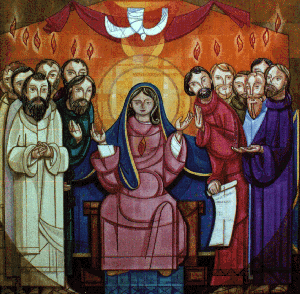
Sunday, June 15, 2008: Today's commemorated feasts and saints... 8th SUNDAY OF PASCHA — Tone 7. PENTECOST — FEAST OF THE HOLY TRINITY. Prophet Amos (8th c., B.C.). St. Jonah, Metropolitan of Moscow (1461). Ven. Gregory and Cassian, Abbots of Avnezhk (Vologdá—1392). Martyrs Vitus, Modestus, and Crescentia, at Lucania (ca. 303). Martyr Dulas of Cilicia (4th c.). St. Dulas the Passion-bearer, of Egypt. St. Jerome (Hieronymus) of Stridonium (420). Translation of the Relics of St. Theodore the Sykeote (ca. 9th c.). Rt. Blv. Lazarus, Prince of Serbia (1389). St. Ephraim, Patriarch of Serbia (14th c.). Bl. Augustine, Bishop of Hippo (430). The "MARIANICA" Icon of the Most-Holy Theotokos. When the Day of Pentecost had fully come, they were all with one accord in one place. And suddenly there came a sound from heaven, as of a rushing mighty wind, and it filled the whole house where they were sitting. Then there appeared to them divided tongues, as of fire, and one sat upon each of them. And they were all filled with the Holy Spirit and began to speak with other tongues, as the Spirit gave them utterance. And there were dwelling in Jerusalem Jews, devout men, from every nation under heaven. And when this sound occurred, the multitude came together, and were confused, because everyone heard them speak in his own language. Then they were all amazed and marveled, saying to one another, "Look, are not all these who speak Galileans? And how is it that we hear, each in our own language in which we were born? Parthians and Medes and Elamites, those dwelling in Mesopotamia, Judea and Cappadocia, Pontus and Asia, Phrygia and Pamphylia, Egypt and the parts of Libya adjoining Cyrene, visitors from Rome, both Jews and proselytes, Cretans and Arabs-we hear them speaking in our own tongues the wonderful works of God. On Pascha the gift of the Holy Spirit is given only to the Apostles, on Pentecost it is given to all the faithful. On this St John Chrysostom says Was it upon the twelve that it came? Not so; but upon the hundred and twenty. . . . Observe now, how there is no longer any occasion for that person to grieve, who was not elected as was Matthias, "And they were all filled," he says; not merely received the grace of the Spirit, but "were filled. And began to speak with other tongues, as the Spirit gave them utterance." It would not have been said, All, the Apostles also being there present, unless the rest also were partakers. For were it not so having above made mention of the Apostles distinctively and by name, he would not now have put them all in one with the rest. For if, where it was only to be mentioned that they were present, he makes mention of the Apostles apart, much more would he have done so in the case here supposed. (Homily on Acts, 4) While acknowledging that their roles are different, for Chrysostom there is no advantage to being, say, one of the Twelve (that is, an apostle) rather than one of the 120 since "all were filled" and not simply the Apostles. In like fashion there is no disadvantage for us who live some 20 centuries after that first Pentecost. To be a Christian, to be baptized and chrismated, means that we don't simply have a "share" of the Holy Spirit, some greater than others. No. In and through the sacraments, and just like the 120 on that first Pentecost, we are each of us filled the Holy Spirit. Again, St John Chrysostom (Homily 12 on Matthew): For in the case of the apostles too, there was a "sound of a mighty wind," (Acts 2:2) and visions of fiery tongues appeared, but not for the apostles' sake, but because of the Jews who were then present. Nevertheless, even though no sensible signs take place, we receive the things that have been once manifested by them. Since the dove itself at that time therefore appeared, that as in place of a finger (so to say) it might point out to them that were present, and to John, the Son of God. Not however merely on this account, but to teach you also, that upon you no less at your baptism the Spirit comes. But since then we have no need of sensible vision, faith sufficing instead of all. For signs are "not for them that believe, but for them that believe not." (1 Corinthians 14:22) One reason I suspect, we are so easily tempted to doubt and disbelief is that we imagine ourselves, I imagine myself, at a disadvantage relative to the Apostles and disciples who actually knew Jesus and experienced that first Pentecost. And so, I rely solely on their faith, on the strength of their testimony, without ever imagining that I can have a faith and a testimony of my own. At Vespers for Pentecost we sing: Blessed art Thou, O Christ our God, who hast revealed the fishermen as most wise by sending down upon them the Holy Spirit: through them Thou didst draw the world into Thy net. 0 Lover of Man, Glory to Thee (Troparion). Wisdom is a gift; so too are faith, hope and love. And these come to us not from the past, but only from above, by the outpouring of the Holy Spirit into our lives. On the Feast of Pentecost we celebrate and affirm that this has happened not simply 20 centuries ago, but here and now, not simply for the 120 then, but for you and me today. But if our celebration is to be anything more than a mere formality we must each of us, as St Seraphim of Savrov reminds us, acquire the Holy Spirit in our own life. This means that the gift of the Holy Spirit must be something that each of us not only desires but actively seeks. How do we do this? When the Most High came down and confused the tongues, he divided the nations. But when he distributed the tongues of fire, he called all to unity. Therefore, with one voice, we glorify the All-Holy Spirit! (Kontakion) If we wish to acquire for ourselves the gift of the Holy Spirit, if we wish to experience the fullness of what we have received, let us go where the Holy Spirit is, let us do what the Holy Spirit does. Taking our cue from the Kontakion, we acquire the gift of the Holy Spirit by our willingness to love others, to forgive and to encourage others. We grow in the Holy Spirit only to the degree that we cooperate in the Spirit's work of reconciling of the whole human family to God the Father in Jesus Christ. To acquire the Holy Spirit let each of us be committed to be a sign and a cause of reconciliation in ways great and small. In Christ, +Fr Gregory![]()
Saturday, June 14, 2008
O Fathers, Where Art Thou?
Gabriel on the blog "Going Along" offers what I think is an insightful critique of how the fathers are often [mis-]used in contemporary Orthodox theology. He puts into words something that I sensed in my conversation with many Orthodox Christians but haven't been quite able to put into words. There is a tendency among Orthodox Christians--both on the "right" and the "left" as he says--to elevate the fathers to the point where they are viewed effectively as themselves revealed . Yes, as Gabriel say, the fathers are godly, but they are godly commentators on revelation and not themselves revealed.
I have reproduced the whole post here, but please go, read what is posted on Gabriel's site and leave a comment there (and here if you would).
In Christ,
+Fr Gregory
I have long held some hard reservations about making any of my posts deal with concrete issues in Orthodox theology. This is an extension of an even deeper reserve when it comes to the Church Fathers themselves. I have long thought that it would be worth the efforts of some enterprising soul to write a comprehensive account called, "The Use and Abuse of the Fathers of the Church in Contemporary Orthodoxy." I think it could be written in a non-polemical manner, charitable to well-meaning missteps, and brutal in exposing what has become a loathsome enterprise of proof-texting and fideism. That this has occurred on both the "right" and the "left" is not surprising since, with the exception of a few current writers, the dark clouds of historicist thinking have crept over Orthodox Patristic (or neo-Patristic) thought. The one "escape" which has been utilized more than proposed and examined is to interpret the Fathers as in no small sense divine, i.e., lift their thought out of the historical context not on the basis that they might have understood themselves to be confronting permanent questions of theology and morals, but on the basis that they were divinized insights which, by virtue of that divinization, renders them ahistorical. This line of interpretation has been put into practice with such Fathers as St. Symeon the New Theologian and even St. Basil the Great, a Father who—right or wrongly—tends to be interpreted in a far less "mystical" manner than St. Symeon. The logic behind this interpretation stems, I believe, from the Church's recognition of these men as Saints. Since saintliness and godliness are coeval, the "natural" extension is that their thought is godly, divine, even revelatory. Some critics of Orthodoxy have pointed out that this line of interpretation collapses the distinction between Biblical Revelation and the interpretation of that Revelation by the Fathers. That critique could be pushed a bit further, I think. At what point does it appear illogical to cease understanding what the Fathers have to say as a "new revelation"? Defenders of Orthodoxy would, of course, reject such a notion just as they reject the Roman Catholic notion of Development of Doctrine. Yet the lines are not clear when the writings of the Fathers take on a revelatory character, when they are deemed authoritative by the Will of God, and seen as the manifestation of supernatural experiences.
I say all of this not to reject the notion that any one Father or all of the Fathers had supernatural experiences. I do not mean to falsely separate their sanctity from their writings as some scholars are wont to do. Yet at the same time it seems too easy, nay, too simplistic, to use their relationship with God as an "escape" from the historicizing of other scholars. The ill effects of this attempted "escape" is the indiscriminate doctrinization of what the Fathers have to say. But nobody who isn't hopelessly naïve can successfully assert anymore that there exists universal agreement on all pertinent problems in the writings of the Fathers. (This is true whether or not one is inclined to exclude "heretics" such as Cyril of Alexandria, Origen, Tertullian, Augustine, Theodoret of Cyrene, etc.) What, then, do we make of these "differences of opinion"? And on what basis can we call them "opinions" if we are already disposed to hold that their writings—all of their writings—come from the inspiration of God? Is it possible that some are rooted in divine experience and some to that fallacious instrument known as human reason? Are the former privileged over the latter? And, assuming this is a privilege worth bestowing, do we have any meaningful way to discern now which writings come from divine experience and which are merely the products of some rationalization, i.e., a working through of problems in a manner that is logical, orderly, and without, apparently, the requisite "mysticism" that may be taken in a spiritually-starved age as proof positive of holy worth? If arbitrariness is not to be extended as a sanctified outcome of the Church's "spiritual theology," then some criterion must exist—be it rational or otherwise. Perhaps the less rational is, the more likely it is to gain purchase.
As convenient as it no doubt is, a "return to the Fathers" is a fairly recent phenomena. The "right" in Orthodoxy may find comfort in the continuity thesis, but the "left" is still fairly certain that for hundreds of years, most ordained priests lived without access to most Patristic texts. (Cf. Triodion of the seventeenth-century Russian Church and the conspicuous absence of St. Gregory Palamas's commemoration.) Whether or not this calls into question the veracity of Holy Tradition in Orthodoxy seems, to me, to be a separate question altogether which ought to be answered in the negative. The only matter worth reflecting on here is the possibility that the Church went on absent a "Patristic consciousness" drawn from the sources themselves but, rather, maintained in other integral ways. The "left" call that nonsense, speaking so often as they do of distortions, interpolations, and that dreaded "Western captivity" (when, of course, the Church itself wasn't ambling through history under a cloud of total darkness). Today's return or, if you will, amplification of the Church's sure Patristic roots (which are, actually, its clear Apostolic roots) should not be lamented. What ought to be questioned is whether or not this has even really begun or, perhaps, if Orthodoxy is still not laboring under a false belief that historicist readings, spiritualized defenses, and more than a taint of triumphalism amounts to the same thing.
Unless other wise noted, everything posted here is © 2007 Gregory R Jensen
Blogrush
I added the Blogrush widget. You can find it on the right hand side toward the bottom
"What Is BlogRush And Why Should I Use It?" you ask. Well, this is how they describe themselves on their web page:
BlogRush is a "Cooperative Syndication Network." It's a network of blogs that run a small "widget" on their pages. Each time this widget is loaded it will contain 5 clickable headlines which are the blog post titles to other users' posts. Clicking on any of these links will open a new browser window and load the blog and full post. Users earn "syndication credits" based on each time their blog loads the widget as well as each time any of their referrals (users that signup after clicking the "add your blog posts" link on the widget) loads the widget. They also earn additional credit based on all the activity through 10 generations of referrals. 1 Syndication Credit = having one of their recent blog post titles served inside the widget on another member's blog.So, please take a look at the Blogrush widget--maybe even click through if you see something interesting. And if you want, why not get the widget for your blog? Hopefully this is an effective, and easy, way to generate new readers and subscribes both for my blog but for yours.
In Christ,
+Fr Gregory
© 2007 Gregory R Jensen
Time Sanctifies Liturgy
Yes, as we saw in the previous essay where we looked at Augustine's theology of time, the heart flits from past (memory) to future (anticipation). Looking beyond the text of Augustine to my own experience, I realize that this flitting about is more often than not done in a passionate manner. Frequently, I look to the past with regret, guilt and shame, even as I look to the future with dread, anxiety and fear. My experience of the past and future are passionate precisely because I do not dwell in the present moment, that curiously timeless time that, or so Augustine implies, participate in Eternity: Liturgy, I would suggest, is our return to the present moment—it is a dwelling, a resting, in the Eternal Now that is Itself the Source of time. Coming as it does from God, to use more classically Eastern language, time is an icon of Eternity. Liturgy, which remember has both a historical and an eschatological pole, is a reflection of time and as such, it too is an icon of Eternity. But, and this I think is the important part of Heschel's and Augustine's theologies of time, it is not liturgy that sanctifies time; it is time that sanctifies liturgy. When we gather as the Church to pray, we have the opportunity to experience time as it is meant to be. As Fr Alexander Schmemann says in his own theological analysis of the sacraments: The Church worship reveals the nature of the creation; as baptism makes manifest the meaning of water, and the Eucharist of food and drink, so too taken as a whole the Church's worship reveals the sacral, indeed sacramental, nature of time. To be continued… In Christ, +Fr GregoryThose two times, . . . , past and future, how are they, when even the past now is not; and the future is not as yet? But should the present be always present, and should it not pass into time past, time truly it could not be, but eternity. If, then, time present -- if it be time -- only comes into existence because it passes into time past, how do we say that even this is, whose cause of being is that it shall not be -- namely, so that we cannot truly say that time is, unless because it tends not to be?
Friday, June 13, 2008
St Augustine on Time
In my last brief essay, I outlined the holiness of time in Rabbi Abraham Heschel's book The Sabbath. Heschel argues that there is in Jewish thought, a hierarchy of holiness in the created order: time sanctifies humanity and it is humanity who subsequently sanctify place. While the sanctity of time, humanity, and place cannot be separated, the primordial created expression of divine holiness belongs to time. Thinking about time as the foundational manifestation of holiness in the created realm allows us to transcend what I see as any division between liturgy as historical and liturgy as eschatological. Neither of these aspects of the Church's liturgical tradition should be dismissed certainly; but neither should we limit our thinking to either of these poles. Rather if, as Heschel argues so eloquently, time is itself sacred we might find profit in thinking of liturgy as itself the epiphany of time's sacred character. Through the ministry of the Church inspired by the Holy Spirit, liturgy makes manifestation in time the Eternal Now of God. St Augustine is helpful here. In the Confessions Books X (where he addresses memory) and XI (where he looks at time itself) Augustine looks at the human experience of time. While this would require a fuller analysis on my part, his analysis suggests to me that the human experience of time, especially through the faculties of memory and anticipation, isonly possible through our participation in divine life. Augustine begins by recounting the argument of those who reject his analysis of the temporal character of creation. They question him: "But if it was the eternal will of God that the creature should be, why was not the creature also from eternity?" He answers them: Those who say these things do not as yet understand Thee, O Thou Wisdom of God, Thou light of souls; not as yet do they understand how these things are made which are made by and in Thee. They even endeavor to comprehend things eternal; but as yet their heart flies about in the past and future motions of things, and is still wavering. Who shall hold it and fix it, that it may rest a little, and by degrees catch the glory of that ever standing eternity, and compare it with the times which never stand, and see that it is incomparable; and that a long time cannot become long, save from the many motions that pass by, which cannot at the same instant be prolonged; but that in the Eternal nothing passes away, but that the whole is present; but no time is wholly present; and let him see that all time past is forced on by the future, and that all the future follows from the past, and that all, both past and future, is created and issues from that which is always present? Who will hold the heart of man, that it may stand still, and see how the still-standing eternity, itself neither future nor past, utters the times future and past? Can my hand accomplish this, or the hand of my mouth by persuasion bring about a thing so great? Time is the creature's experience of Eternity, of the created being participation in the Uncreated. This participation is given to us ontologically (since "to be" for the creature is always only by God's grace and never by nature). While we experience time as a positive (for example as growth), there is a negative element to time as well. Existentially we experience time not simply as grown, but also as dissolution (dispersion of our being as Heidegger argues) or more simply as decay.
Thursday, June 12, 2008
Holiness Not Programs
Reflecting on the possibility of reconciliation between the Orthodox and Catholic Churches one of the most faithful commentators on this blog, Chrys, sent me the following in a private email (which I am quoting here with his permission): On that subject [of the reconciliation between the Orthodox and Catholic Churches], I am not sanguine. There are significant current differences between how the Orthodox approach faith and how Catholics approach faith. In addition to differing assumptions and particular expressions that form the theological understanding of the faith, the approach itself seems fairly different. It seems to me that the list of differences is pretty extensive—though I am not sure which are truly important and which are not. Leaving that for a different day, I would only note that I still firmly believe that IF we are able to raise up truly saintly folks, they will attract others - both inside the Orthodox church and outside - to reconsider how they live and what they believe. My assumption here is rooted in my own experience that living contact with a saint can move us to want to be like him—in a way that all the argumentation in the world cannot—and this desire will necessarily lead us to question who we are, what we are doing and how we are living. In my experience—and I think Scripture gives witness to this—nothing is as powerful as an authentic, living example, someone who shows us what God is like and what life can be like. Historically, these people carry the greatest moral authority to be found. (In fact, I am convinced that some of the respect that we have for the clergy is the result of the trust and respect earned by the saints. This assumes good faith on the part of the parishioner, of course. We hear and see in the saints what can be, what ought to be, and see the priest as the representative of that legacy—if he does nothing to betray that conferred trust. Once someone experiences a betrayal of that trust, however, all clergy thereafter pay for that betrayal.) The authority is so strong that even stories (second-hand experience) can have a significant effect. From what I have read, however, truly transformative power requires living contact. (Makes sense: ours is an incarnational faith, not a propositional one.) As I have often said: transformation is ultimately the result of people not programs. (Programs can only organize and direct the people and their gifts; they can never substitute for them.) In short, though such people may be few, their effect would likely be enough to BEGIN to make a difference (leaven in the bread, as it were) that can eventually lead to reconciliation. Reading what he says, I find myself in fundamental with Chrys' observations. While we have our part to play certainly, reconciliation (whether between Churches, or between the person and God, the members of a community) is a work of the Holy Spirit. We are called therefore to wait upon His initiative. Thinking about this I am reminded of the word of the Prophet Isaiah (40.27-31): Why do you say, O Jacob, And speak, O Israel: "My way is hidden from the LORD, And my just claim is passed over by my God"? Have you not known? Have you not heard? The everlasting God, the LORD, The Creator of the ends of the earth, Neither faints nor is weary. His understanding is unsearchable. He gives power to the weak, And to those who have no might He increases strength. Even the youths shall faint and be weary, And the young men shall utterly fall, But those who wait on the LORD Shall renew their strength; They shall mount up with wings like eagles, They shall run and not be weary, They shall walk and not faint. As always, you comments are not only welcome, but actively sought. In Christ, +Fr Gregory
Romanian Orthodox prelate threatened with excommunication for sharing Communion
Bucharest, Jun. 11, 2008 (CWNews.com) - The Orthodox prelate who shared Communion with Catholics at an Eastern-rite liturgical service in May now could face excommunication from the Romanian Orthodox Church. Orthodox Metropolitan Nicolae Corneanu of Banat joined Romanian Catholic Bishop Alexandru Mesian of Lugoj at the altar on May 25, sharing the Eucharist with the Catholic prelate. His action outraged some Orthodox believers, and the Romanian Orthodox synod announced that Metropolitan Corneanu "may be asked to give an appropriate explanation" at a synod meeting in July. Now another Romanian Orthodox leader, Metropolitan Bartolomeu of Cluj, has introduced a move to excommunicate Metropolitan Corneanu. That proposal will be discussed at the orthodox Synod meeting in early July. The move to excommunicate Metropolitan Corneanu has inflamed new hostility toward Catholics-- and especially Eastern-rite Romanian Catholics-- among Orthodox hard-liners who regard any association with Catholics as suspicious. Critics have also raised heresy charges against the Orthodox Bishop Sofronie of Oradea, who participated in an ecumenical blessing-of-the-water service in January, on the feast of the Baptism of Christ, with his Romanian Catholic counterpart. Metropolitan Corneanu has said that he does not regret joining Catholic bishops in the Divine Liturgy. But the Orthodox prelate has rejected the idea that he is likely to become a Catholic, saying that he is loyal to the Orthodox Church and will accept the consequences of his actions.
Abraham Heschel: The Holiness of Time
When in Genesis God creates the heavens and the earth "The earth was without form, and void; and darkness was on the face of the deep." (1.2) Creation is presented in Genesis not ex nihilo (i.e., from nothing), but rather as a divine ordering of chaos. Slowly, methodically, God brings a shape and form to chaos. As land appears when the waters are set in their place, so to creation emerges from chaos as God brings order to the void. For six days God labors to create and "when were finished" God "on the seventh day God ended His work which He had done, and He rested on the seventh day from all His work which He had done. Then God blessed the seventh day and sanctified it, because in it He rested from all His work which God had created and made." (2.2-3) Rabbi Abraham Joshua Heschel writes in his work The Sabbath that "In a well-composed work of art an idea of outstanding importance is not introduced haphazardly, but, like a king at an official ceremony, it is presented at a moment and in a way that will bring to light its authority and leadership." The Sabbath, the Seventh Day, is Heschel says is just such a kingly idea—it introduces to humanity not the holiness of place, but of time. "This is a radical departure from accustomed religious thinking. The mythical mind would expect that, after heaven and earth have been established, God would create a holy place—a holy mountain or a holy spring—whereupon a sanctuary is to be established. Yet it seems as if to the Bible it is holiness in time, the Sabbath, which comes first." It is only after the holiness of time is proclaimed that God proclaims at Sinai "the sanctity of man." It is only after, as Heschel observes, that we succumb "to the temptation of worshipping a thing, a golden calf, that the erection of a Tabernacle, of holiness in space, was commanded. The sanctity of time came first, the sanctity of man came second, and the sanctity of space last. Time was hallowed by God; space, the Tabernacle, was consecrated by Moses." On the Seventh Day God proclaims the Sabbath: "The meaning of the Sabbath is to celebrate time rather than space. Six days a week we live under the tyranny of things of space; on the Sabbath we try to become attuned to holiness in time. It is a day on which we are called upon to share in what is eternal in time, to turn from the results of creation to the mystery of creation, from the world of creation to the creation of the world." The beauty that we encounter in the Church's worship, in the music, the icons, and the architecture of the church building, are all, I would suggest, the manifestation Eternity in Time. Beauty is the encounter, the experience, in time of the Eternal And if, as Heschel suggests, there is a hierarchy to the sanctity of creation—time, the human, and only finally space—this doesn't mean that we can neglect one in favor of another. To use an image I have used before, the three are nested within each other—space is sanctified by humanity, humanity by time, time by God. Thinking about time as sacred opens up for us new avenues of understanding of the heavy, some have said over, emphasis on liturgy that we see in Orthodox Church. To be continued… In Christ, +Fr Gregory
Wednesday, June 11, 2008
“Sanctify Those Who Love the Beauty of Your House”-Part II
Continuing yesterday's thoughts on the saving character of Beauty… In the catechumen classes at the parish I serve we have been discussing the structure of the Divine Liturgy. This past Sunday we looked at the Prayer of the First Antiphon: Lord, our God, save Your people and bless Your inheritance; protect the whole body of Your Church; sanctify those who love the beauty of Your house; glorify them in return by Your divine power; and do not forsake us who hope in You. As a group our attention was captured by the third petition: "sanctify those who love the beauty of Your house." In the Old Testament especially, God is holy not so much because He possess moral perfection but because He is free. In God to be holy is to be free of all that would limit Him and constrain His will; as with God so to with us, we are called to be free of everything that would compel us to act against our nature and our vocation. Growth in freedom, growth in holiness, requires from me that I love the beauty of God's house. As we talk about this we began, naturally enough, with the beauty of the church building itself and then of the services. Slowly, however, we began to see that God's house is really rather more than simply the church building, the services and the Tradition of the Church. All of creation is the house of God. How, we asked ourselves, can we say that we really love the beauty of the church building on Sunday morning if we our indifferent to the beauty of creation? And, again as we thought about things, how can I say I love the beauty of creation if we are indifferent to the beauty of our neighbor who is created in the image and likeness of God. And if I say that I love the beauty of my neighbor how can I then dismiss my own beauty? Stepping back from our reflections, I mentioned to the catechumens (and other listeners) that what we experience in the church can't be separated from the rest of life. If you will we can think of the experience of beauty in the Church's worship as a preparation for the experience of the beauty of creation. In fact, I suggested, to try and limit beauty to either the Church or creation is a bit like the young man who told me he didn't know much about his girlfriend—they were only seeing each other for sex. To fail to see Beauty, to ignore Beauty, or worse to be indifferent to it, is to be unchaste. God tells the prophet Hosea (1.2): "Go, take yourself a wife of harlotry And children of harlotry, For the land has committed great harlotry By departing from the LORD." To see Beauty only here and not there is to limit God, to deny His holiness and so to deny Him as He Is. Once that is done, then everything else in my life falls into chaos and ugliness. But, to return to Solzhenitsyn, there is a whimsy, unpredictable, unexpected quality to Beauty that makes it such a fit symbol of Divine Grace. Beauty can "soar up," to quote Solzhenitsyn once more, "to that very place" where I turned my back on Truth and Goodness and, once there, "perform the work of all three." In Christ, +Fr Gregory
Tuesday, June 10, 2008
My Blog List & New Print Button
You may have noticed a new section on the right: "My Blog List." These are some of the blogs I read on a regular basis that I thought were worth advertising here.
Why not take a look?
Also, I have added a print button to the posts. To access the bottom click on the post title (for example, "My Blog List & New Print Button") and you will see the print icon at the bottom of the post. The print button will allow you to print a post without all the annoying headers and stuff that comes when you simple use your browsers print command. In addition to the post, you should also get the comments on that post. So please give it a try and let me know what you think.
Thanks!
In Christ,
+Fr Gregory
“Sanctify Those Who Love the Beauty of Your House”-Part I
When people first enter the Orthodox Church they often comment about the beauty of the experience. This happens whether they attend a baptism or wedding, Vespers or Divine Liturgy, or even if they walk into a church. For Orthodox Christians beauty is a key element of the spiritual life. So important is beauty to the Church's spirituality that the 19th century Russian author Fydor Dostoyevsky goes so far as to say, "Beauty will save the world." Another great Russian writer, Aleksandr Solzhenitsyn, in his Nobel prize lecture says of beauty that it bears within itself its own confirmation: concepts which are manufactured out of whole cloth or overstrained will not stand up to being tested in images, will somehow fall apart and turn out to be sickly and pallid and convincing to no one. Works steeped in truth and presenting it to us vividly alive will take hold of us, will attract us to themselves with great power- and no one, ever, even in a later age, will presume to negate them. And so perhaps that old trinity of Truth and Good and Beauty is not just the formal outworn formula it used to seem to us during our heady, materialistic youth. If the crests of these three trees join together, as the investigators and explorers used to affirm, and if the too obvious, too straight branches of Truth and Good are crushed or amputated and cannot reach the light—yet perhaps the whimsical, unpredictable, unexpected branches of Beauty will make their way through and soar up to that very place and in this way perform the work of all three. For Solzhenitsyn Beauty, has he says, "a special quality." Beauty "is absolutely indisputable" and is able to tame even the heart that is "strongly opposed" to it. While a "political speech, an assertive journalistic polemic, a program for organizing society, a philosophical system," might be well constructed and well argued, these are "built upon a mistake, a lie" that often remains "hidden." The "distortion" at their core is not necessarily "immediately . . . visible," and indeed the polemic, the social organizational theory or elements of a philosophical system often are "well constructed and . . . smooth, . . . everything will seem to fit. As a result, we will have "faith in them—yet [in so doing, we have] no faith" at all. "It is vain to affirm," Solzhenitsyn "that which the heart does not confirm." This is not meant to be a defense of relativism, but rather an affirmation that beauty, consonance, harmony, communion (these are, if not synonyms, so closely related that one cannot be understood apart from the others) is the fundamental character of creation because creation reflects the character of God. Unlike polemics, Beauty invites me to come along, to step out of myself; Beauty woes the heart, it inspires me to be more than we are. Like polemics, Beauty can challenge me; it can even break my heart. But again, and unlike polemics, when the beauty of the Beautiful breaks my heart it does so with a certain joyful melancholy which, if I allow the pain to do so, can move me to repent of all that is Ugly, Wicked and False in me. More tomorrow… In Christ, +Fr Gregory
Sunday, June 08, 2008
Superman Song
Crash Test Dummies, "Superman Song":
HT: Steven-Paul at Pithless Thoughts, the Superman Song.
Of this song, Steve writes:
One of the best songs of all time.
For all you superheroes out there.
It makes me weep.
Friday, June 06, 2008
Polemics, Zeal and St Isaac the Syrian
Isaac the Syrian is probably the most eloquent patristic witness for the position I have been sketching out (you can read that post here). The saint writes that "Someone who has actually tasted truth is not contentious for truth. Someone who is considered by people to be zealous for truth has not yet learnt what truth is really like; once he has truly learnt it, he will cease from zealousness on its behalf." [Kephalaia IV.77; The Wisdom Commenting on this passage, David Goa, writes that like relativism, the zealousness that informs our polemical attitude "fail to discern aright what stands under the desire we have for that which is true." Both relativism and zeal, deform our desire for the truth "into an appetite." Once the pursuit of truth becomes an appetite, a passion in patristic terminology, Whatever we come to look at and care about is then forced into conformity with the idea, image, or ritual that we have erected as absolute. We begin to hang all our hopes and dreams on the truth of our chosen framework, our precious absolutes (including the relativists' precious absolute that there is nothing of ultimate value). Our longing is captured by an absolute of our own making. It follows, almost without saying, that once we hang all our hopes and dreams on something that we claim as absolute, it is a short step to hanging all our fears on it as well. In this moment the holy longing of the human heart and mind that lies behind the search for absolutes becomes polluted. Zealousness for the truth frames how we see and understand and reshapes our response to the fragility of the life of the world. Goa continues by observing that the symptom our passionate pursuit of the truth is a need for enemies. My passion (pathos) for the truth can only be sustained insofar as I stand in opposition to someone or something. But this approach is one "that reduces complexity and purpose to frame [my assumed] conclusions." But for the Christian "this is a false start for it begins neither at the heart of human nature or in the presence of God's love" but in fear. Again, Goa: "For St. Isaac, zeal for truth is itself a symptom of a spiritual disease. Or, perhaps, it is a condition that tends to develop at a certain stage in the spiritual life and is itself simply a marker of that stage. It is the spiritual equivalent of adolescence where the young try out all sorts of ideas and actions with the conviction that no one else has ever had these thoughts or feelings and they are exploring them for the first time. How can it be that no one else has ever seen just how important and ultimate these thoughts and feelings are?" There is a sense in which our zealous pursuit of truth "is part of the process of maturation." So when as a spiritual father I see the "zealousness for truth" spoken of by St. Isaac, I understand that it is "a stage in the spiritual development of the person. But just as with adolescence, if the condition persists, spiritual growth is arrested. One is stuck in the adolescent stage of the spiritual life." Christ however calls us to wholeness of being. Part and parcel of this wholeness means that by God's grace and our own efforts "we are freed from the habit of taking refuge in abstract notions of truth. If we taste of truth at every Eucharist we know better. If we taste of truth every time we, like the disciples, find ourselves in Emmaus breaking bread with someone we didn't know we knew, we know better. We know better every time our hearts are moved with compassion." But as I mentioned earlier, polemics, a zealous approach to the truth has a strangle hold on us because we do not wish to grow, to change. Our conversations are polemical because more often than not, our thinking about ourselves is static and rigid. Catholic/Orthodox polemics—at least as we see them in contemporary practice—are only accidentally theological. In the main (and I will address this more in another post) our polemics reflect our own lack of wholeness, of balance, of our own lack of virtue. We are, as I said earlier, neurotic At the risk of misapplying the theory, I will in the next essay explore the different neurotic styles that seem favored by Eastern and Western Christians. To anticipate, Eastern Christians tend to see themselves as standing "against" others, even as Western Christians tend to move "toward." But that for another day.
of Saint Isaac the Syrian, translated by Sebastian Brock, (Fairacres, Oxford: SLG Press Convent of the Incarnation, 1997), p15.]
In Christ,
+Fr Gregory