
While I appreciate why one would say that Orthodox parishes are too bound up with ethnicity, I do not think ethnicity as such is really the problem in most of our parishes. Here in Pittsburgh we have over 100 Orthodox parishes. Almost all of these communities were built by ethnic Greeks, Russians, Serbians, Ukrainians, and Carpatho-Russian who went out an worked hard to involve people in the Church. That they focused on members of their own ethnicity is not necessarily good or bad--it is simply a fact. I'm more comfortable and effective with the unchurched so that's where I put my energy--that's the group God has called me to care for.
Likewise, Greeks (to take one example) cared for other Greeks and, in so doing, fulfilled the commandments of Christ.
Where we have gone wrong is not so much that we are Greek (or Russian, or Serbian, or Ukrainian, or Carpatho-Russian) as we use being Greek (or Russian, or Serbian, or Ukrainian, or Carpatho-Russian) as an excuse to not continue the very work our ancestors in the faith excelled at. Sadly, we'd rather work at being Greek (or Russian, or Serbian, or Ukrainian, or Carpatho-Russian or being American) then being Christian. In a word, we have gotten comfortable with who we are and lost that fire to build new parishes and reconcile people to Christ and His Church.
We have become so concerned with being comfortable (which is really the problem not whether we are Greek or Russian, or Serbian, or Ukrainian, or Carpatho-Russian or American) that have forgotten that we are a Pilgrim People who have in this world no lasting home. Historically, today's ethnic parishes were yesterday's evangelical powerhouses who used what they had to advance the Gospel. Our problem is not that we are Greek (or, well, you get the idea), but that we are cheap. We have lost the sacrificial spirit and commitment to hard work that the proclamation of the Gospel of Jesus Christ requires.
And this is not a problem of ethnicity, but of a poverty of catechesis and spiritual formation (especially of the laity). If today the Greek Orthodox Archdiocese of American committed herself to reconcile even a percentage of those who have drifted away from the Church, we could build 2 or 3 parishes for every one we have know. But for this to happen the laity must know Christ and His Gospel--and this is a question of proper catechesis and intentional spiritual formation for the laity.
God has poured out on all of us great gifts and abilities. What is lacking is not divine grace, but human freedom. People must be taught use their gifts--intellectual, social, cultural and spiritual--for the sake of Christ and His Church.
Again, the problem is not ethnicity as such. Rather is our inability, and sometimes our unwillingness, to put all the gifts we have at the service of the Gospel. From my Greek (and Russian, andSerbian, and Ukrainian, and Carpatho-Russian) friends, I have learned a great deal about how to embody the Gospel in the context of my everyday life: icon corners and fasting, feast day customs and funeral meals, and above all in joy. Are my ethnic Orthodox Christian friends perfect? No far from it in fact--but the same can be said of me.
So what can we do?
"Let us love one another" and the many gifts Christ has given each of us. Then, let us support and encourage one another to use the gifts we've been given generously at the service of the Gospel. When I've seen this done in parish, the community grows. Where this is not done, the community dies, sometimes slowly, sometimes quickly, but die it does.
So, let us live by blessing God for the gifts He has given each of us.
In Christ,
+Fr Gregory
Tuesday, May 29, 2007
Ethnicity and Evangelism


A Catholic/Orthodox Dialog on Formation?

I received the following comment on an earlier post ("The Parish: Mission or Maintenance?"). The author is Sherry W. a contributor to Intentional Disciples and co-director of the Catherine of Siena Institute. I have include Sherry's comment in italics and my response below in normal type.
In Christ,
+Fr Gregory
Sherry W has left a new comment on your post "The Parish: Mission or Maintenance?":
Hi Fr. Gregory: This is Sherry Weddell from the Catherine of Siena Institute. We're delighted that you are raising some of our favorite questions. It would be illuminating to be part of a discussion of our primary mission with an Orthodox group. I'll try to check in to see if anyone has comments or questions that I might respond to.
And my response:
Hi Sherry!
Thanks for your comment and invitation to a conversation. Yes indeed, I think that a Catholic/Orthodox dialog on issue of lay formation would be extremely valuable. Let me start the conversation by articulating four reasons and potential benefits of such a dialog.
First, I think both Churches would profit from seeing the richness of each other's traditions. Not only would this be profit in a positive manner, but I also think that through our shared exposure to the pastoral and formation concerns of each other's tradition we might come to see our own Church's pastoral problems as less overwhelming. Especially important here would be our ability to use the other's tradition as a "control." What I mean by that is when we see the same problems in another tradition we might be able to rule out some factors and have some insights as to possible new solutions.
Second, one phrase used to describe the ministry of Pope John Paul II was/is "friendship ecumenism." I think a conversation about issues of formation and lay ministries would help members of both Churches come to know, love and appreciate each other as brothers and sisters in Christ. A my wife is fond of pointing out, for the first time in over 1,000 years (especially in America) Orthodox Christians and Roman Catholics share not only the same language, but culture, food, political system and often home and hearth. This is an extraordinary blessing and opportunity that cannot be wasted and your offer of a conversation fits quite well with what God has offered our two Sister Churches.
Third, over the years I have noticed that the Orthodox approach to the Gospel is often very helpful for Roman Catholics. When I lived in California, for example, Catholics would often ask me questions about the sacraments (especially Holy Confession) or the Virgin Mary or the Scriptures. Happily, and without fail, all of the Catholics I spoke with walked away much more committed to their Catholic identity. I think the Eastern way of speaking about the Gospel can help Roman Catholics see themselves and their tradition with new and more appreciative eyes--that's been my goal in these conversations anyway.
Fourth and finally, least you think I think we do everything well, let me assure you that one of the things that we Orthodox lack is any systematic approach to the catechetical and spiritual formation of the laity. While this is harmful in all areas of the Church's life, it is especially detrimental to our seminary programs. We simply cannot depend on candidates for holy orders having the same, or really any, catechetical or spiritual formation. So your offer could potentially be of great value to us. It is simply inappropriate for men who don't have a sense of their ministry as laity to be attending seminary. And it is even more inappropriate that they be ordained. We need to teach people how to fulfill their lay vocation and, only then when they have demonstrated that they know what it means to be baptized, should they be allowed to attend seminary. Seminary, for us, is being used to do the catechetical and spiritual formation work that is simply not being done in the parish.
And so now dear readers, what do you think?
Monday, May 28, 2007
Study: College students get an A in narcissism
I offer the following without comment:
NEW YORK — Today’s college students are more narcissistic and self-centered than their predecessors, according to a comprehensive new study by five psychologists who worry that the trend could be harmful to personal relationships and American society.
“We need to stop endlessly repeating ’You’re special’ and having children repeat that back,” said the study’s lead author, professor Jean Twenge of San Diego State University. “Kids are self-centered enough already.”
Read more: Study: College students get an A in narcissism
Committment to Transformation
Here's a comment I left over at Intentional Disciples. I wrote the post a while ago, but I think the information may be of interest to some.
In Christ,
+Fr Gregory
Hi Keith,
Thank you, and to everyone at Intentional Disciples, for your thoughtful and challenging posts.
Regarding the parish council--in the Orthodox Church the council serves an active administrative role in the life of the parish (something that is at best a mixed blessing for the priest). In missions, I've been able to build on this administrative role to have the council work as active participants/leaders in the pastoral life of the parish.
While it can be done, I think based on my own experience anyway, there need to be clearly articulated boundaries and expectations. Again, when it works it is a great joy and blessing. But when it doesn't work it typically doesn't because someone comes on council with an agenda of power and control. When this happens quite literally all hell breaks loose.
From my experience the key seems to be having people on parish council whom(1) the pastor knows from his personal experience of the person in confession, is serious about the spiritual life and (2) this person demonstrates that commitment by actively working to help others discover and exercise their own gifts on behalf of Christ and His Church. As person who doesn't trust the pastor enough to come to confession and/or who doesn't trust his neighbors enough to make room for them to exercise their own gifts, is someone who you don't want on parish council.
Just some thoughts. Keep up the good and Godly work.
In Christ,
+Fr Gregory
The Parish: Mission or Maintenance?
Fr. Michael Sweeney, O.P. and Sherry Anne Weddell have a real good post over at The Catherine of Siena Institute. The begin by quoting Pope John Paul II:“Throw open the doors to Christ!”
They continue:
Pope John Paul II inaugurated his pontificate with this invitation to the world; now he inaugurates a new Christian millennium with the same invitation. And, throughout the Church, we are witnessing a remarkable convergence of signs of renewal of the Church in her mission to the world. The apostolic role of the laity has been resoundingly affirmed and promoted at the highest levels of the Church for the first time in our history. The Holy Father has called the whole Church to re-dedicate all her energies to the new evangelization. Lay Catholics who assume personal responsibility for the Church’s evangelical mission are emerging by the millions all over the globe. A dramatic shift in the historic relationship between clergy and laity is well underway, which has important implications for all Catholic leaders who work with lay people.It is our conviction that, through these historic developments, the Holy Spirit is both illumining and empowering the office of the ordained, and releasing the full vigor of the lay apostolate, for the sake of Christ’s redeeming purposes in the world. But something even more unexpected is happening. As the apostolic gifts and call of the laity have become evident, the apostolic potential of the parish – the one truly universal Catholic institution and the place where ninety-eight percent of Catholics have their only contact with the Church– has also been revealed in a whole new light. No longer can the parish be simply a place where the laity receive the spiritual goods of the Church. If all lay Catholics are apostles to the world as the Church teaches, then the institutions that nourish them must become places of apostolic formation, support, and consultation. The worldwide network of parishes that has sustained the faith of lay Catholics for centuries can and must become primary centers of lay formation and outreach to the world. We would like to explore with you the theological and practical implications of this new challenge.
Interested? Then read the rest here: The Parish: Mission or Maintenance? and please leave your thought.
In Christ,
+Fr Gregory
Listening While Sitting in a Coffee Shop
I love sitting in coffee shops. When I lived in Redding, CA I built a parish by sitting in coffee shop (Sue's Java) 1-2 hours/day 3-5 days a week. I learn an awful lot about people and the community just listening to people and watching them interact with one another.
Having spent almost 11 years now as a priest serving missions parishes and college students, I guess I've developed what might be called a rather eccentric view of the Orthodox Church. Or maybe more accurately, the ministry of the Orthodox Church here in the good ol' US of A. While I think we serve well the people we serve, I fear that we really do not serve all that many of the men and women who are Orthodox. When I look at the vast majority of people who we do not reach because they are not Orthodox, the amount of work facing us is unbelievable.
Looking at things from my own perspective I think that we have allowed ourselves to become rather passive. We are happy to serve those who come to us and meet our expectations. We seem curiously unwilling to allow ourselves to be challenged, to be changed by the needs of others.
The change that comes from serving others as the come to us is not a change in essentials, but priorities. This doesn't mean, as Roman Catholics and Protestants discovered, allowing the world to set the agenda for the Church. Rather, we need to ask ourselves, what are the unmet needs that I see around me?
For example, a few moments ago I heard someone use the phrase "real money." This struck me as an odd phrase since, well, money isn't real is it? It is a culturally agreed upon medium of exchange. Money is inherently artificial, as clear an example of a culturally conditioned object as we might hope to find. Anyone who has had the opportunity to travel to foreign country knows how odd and "unnatural" it can feel to try and buy things with someone else's currency. It just doesn't quite feel right.
And of course is doesn't feel right because I mistake something purely cultural (US currency) as being universal.
Likewise, I can rather easily confuse the parts of the Gospel that feel natural to me (because of the culture in which I was raised or, somewhat more narrowly, my own preferences) with being the whole of the Gospel, or at least the most important parts of the Gospel.
Having lived now in Pittsburgh for the past 4 years, I have been struck with how important buildings seem to be for many Orthodox Christians. Of course church buildings (and what is really "critical," halls) have their role to play. But often the building drives the agenda. Committing ourselves to large buildings means committing ourselves as well to having a community that can sustain financially our large building.
While this isn't necessarily wrong, it does mean that a parish must place a fairly high value on its own long term stability. The easiest way to stability is uniformity--"our people"--in the rather common phrase of Orthodox Christians here in western Pennsylvania. But uniformity means we either ask people to conform to our agenda or we ask them to leave. Again, within limits, this is appropriate--but these limits are not (or should not be) drawn by the need to maintain a building.
I guess what I'm saying is that while I don't want us to do away with buildings, we need to develop additional, more flexible, forms of ministry if we hope to reach even a small percentage of the large numbers of lapsed Orthodox Christians and unchurched out there. What these ministries might look like is unclear to me, but I think the idea of developing means of service and outreach that is not dependent upon a building is exciting and worth investing in financially and personally.
The Apostles were wandering preachers who established communities and moved on. Especially here in America this has proven to be a successful form of ministry and might be worth incorporating more intentionally in the Church's.
Other areas for service are schools, hospitals and counseling agencies. I have often come to appreciate the value of small groups that meet informally in people's homes, or coffee shops, for prayer, study and mutual support. Yes, all of these forms of ministry have their limitations, chief among them is that we can naively, or proudly, assume that they are REAL ministries and the stuff that happens in the parish is, well, not really real.
But this confusion is not limited to informal or non-parochial forms of ministry. We all of us our tempted to assume that what we do with what we all ought to do. It is rather easy to universalize our own prejudices.
What will the future of Orthodox Christian minstry in America look like? I don't know. But I hope that in addition to the good work that takes place in parishes we might see a growth in non-parochial work as well.
In Christ,
+Fr Gregory
Saturday, May 26, 2007
The Gospel Should Be Shared in Love
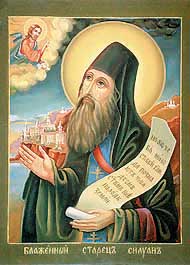
The following passage from the life of St Silouan puts into words some ideas I've been trying to articulate recently. The Saint says it better though.
From Fr Stephen's blog: "Glory to God for All Things":
Father Sophrony’s Saint Silouan of the Athonite:
Father Silouan’s attitude towards those who differed from him was characterized by a sincere desire to see what was good in them, and not to offend them in anything they held sacred. He always remained himself; he was utterly convinced that ’salvation lies in Christ-like humility’, and by virtue of this humility he strove with his whole soul to interpret every man at his best. He found his way to the heart of everyone - to his capacity for loving Christ.
I remember a conversation he had with a certain Archimandrite who was engaged in missionary work. This Archimandrite thought highly of the Staretz [Saint Silouan] and many a time went to see him during his visits to the Holy Mountain. the Staretz asked him what sort of sermons he preached to people. The Archimandrite, who was still young and inexperienced, gesticulated with his hands and swayed his whole body, and replied excitedly,
‘I tell them, Your faith is all wrong, perverted. There is nothing right, and if you don’t repent, there will be no salvation for you.’
The Staretz heard him out, then asked,
‘Tell me, Father Archimandrite, do they believe in the Lord Jesus Christ, that He is the true God?’
‘Yes, that they do believe.’
‘And do they revere the Mother of God?’
‘Yes, but they are not taught properly about her.’
‘And what about the Saints?’
‘Yes they honor them but since they have fallen away from the Church, what saints can they have?’
‘Do they celebrate the Divine Office in their churches? Do they read the Gospels?’
‘Yes, they do have churches and services but if you were to compare their services with ours - how cold and lifeless theirs are!’
‘Father Archimandrite, people feel in their souls when they are doing the proper thing, believing in Jesus Christ, revering the Mother of God and the Saints, whom they call upon in prayer, so if you condemn their faith they will not listen to you…. But if you were to confirm that they were doing well to believe in God and honor the Mother of God and the Saints; that they are right to go to church, and say their prayers at home, read the Divine word, and so on; and then gently point out their mistakes and show them what they ought to amend, then they would listen to you, and the Lord would rejoice over them. And this way by God’s mercy we shall all find salvation…. God is love, and therefore the preaching of His word must always proceed from love. Then both preacher and listener will profit. But if you do nothing but condemn, the soul of the people will not heed you, and no good will come of it.’
Friday, May 25, 2007
And He Descended Into Hell

The pagan, seeing the gold mixed with dross, throws away the treasure because he has no knowledge of how to refine it. The Christian, however, can extract the Divine gold from the dross of suffering and thus add to the wealth of his Christian character. Suffering then becomes assimilable to the soul through the power of the Cross. But to the worldling, it becomes a double-cross; inside as an intellectual complexity incapable of solution, and outside as a violent intrusion and disturbance of one's egotism. The man without faith is no more immune from a cross than the man with faith. The difference is that the Christian has only one Cross, which is so understandable, while the egotist has two crosses, whose names are Rebellion and Suffering. A moment can actually be reached by the Christian when his suffering is felt less and less as coming from the outside, or as being imposed on him, and more and more as a failure to accomplish perfectly within himself the Will of God.
Fulton J. Sheen Three to Get Married
I found the above quote from the late Bishop Fulton Sheen on Dawn Eden's most excellent blog The Dawn Patrol. For those unfamiliar with her work she is well worth reading. Dawn (if I may presume to use her first name) is also the author of The Thrill of the Chaste: Finding Fulfillment While Keeping Your Clothes On which I have not read yet (but I hope to read it this summer).
The above quote from Bishop Sheen caught my attention this morning (I'm trying as I am to write at least once a day to get back into the swing of things for some articles I must to finish. But that's another story...).
There has been some recent theological discussion in Roman Catholic circles about whether Jesus descended into the Hell (with the damned) or into the Hades of the Just (of the Old Testament and pre-Christian world). Those of you interested in the debate might want to start here: Balthasar, Hell, and Heresy: An Exchange over at First Things.
For Orthodox Christians the answer is clear and given to us in the Paschal Homily of St John Chrysostom:
The great mystery of the Christian faith is that Jesus Christ redeems what the world sees as unredeemable. He does not do away with Hell--but He does empty it of those it held captive. In a similar fashion He does not do away with human suffering--He enters into it in every way. The culmination of this is His descent into Hell where human suffering and misery reach their infernal apex. And by entering into our suffering He reveals to us His mercy and love for us.
This means though if we--I--wish to find the mercy and the love of God for me I can't flee from my own suffering, much less my own sinfulness. Instead I must turn around and face my suffering, face my sinfulness. Indeed, I must enter into the depth of my suffering and sinfulness.
What does this mean?
When we turn and face our suffering we discover Christ on the Cross waiting for us and extending to us His mercy, grace, peace and love. Unfortunately for many of us--and I would include myself here--we are unwilling to bear the pain of our own shame, suffering and yes, sinfulness. We want to be loved, but loved not as we are but as we imagine ourselves to be.
Bishop Sheen points out there is no real peace or joy apart from the Cross of Christ. Whatever when we try and make sense of our suffering apart from the Cross we experience instead "an intellectual complexity incapable of solution, and . . . a violent intrusion and disturbance of one's egotism." The way past the double cross of "Rebellion and Suffering" is through the One Cross--but that Cross remains inaccessible to me apart from repentance born of accurate self-knowledge. I will only come to be a whole person by knowing myself wholly as, well, unholy and fragmented.
This kind of self-knowledge is painful for me because it requires a descent into the hell of my own making. Once there I find the Christ who I have betrayed, denied, humiliated and crucified. It is no wonder that some never repentant and that others, having begun the work of repentance, fall by the wayside.
And it also not unexpected that many Christians would try to soften the Gospel of Christ's descent into hell.
Some of this must be done since, as Paul reminds us, we need milk before meat. But sometimes we soften the Gospel because we are ashamed of the Cross. We are ashamed because we refuse to accept responsibility for our own sinfulness, our own complicity in the death of God.
And yet, if we turn inward, if we make our own, unique descent into the hell of our own creating, we will find Christ there to greet us. And greet us He will, not with judgment or shame, but with something more wonderful and terrible, His mercy, peace, love, joy and forgiveness.
In Christ,
+Fr Gregory
I found the above quote from the late Bishop Fulton Sheen on Dawn Eden's most excellent blog The Dawn Patrol. For those unfamiliar with her work she is well worth reading. Dawn (if I may presume to use her first name) is also the author of The Thrill of the Chaste: Finding Fulfillment While Keeping Your Clothes On which I have not read yet (but I hope to read it this summer).
The above quote from Bishop Sheen caught my attention this morning (I'm trying as I am to write at least once a day to get back into the swing of things for some articles I must to finish. But that's another story...).
There has been some recent theological discussion in Roman Catholic circles about whether Jesus descended into the Hell (with the damned) or into the Hades of the Just (of the Old Testament and pre-Christian world). Those of you interested in the debate might want to start here: Balthasar, Hell, and Heresy: An Exchange over at First Things.
For Orthodox Christians the answer is clear and given to us in the Paschal Homily of St John Chrysostom:
By descending into Hell, He made Hell captive.Christ descends into Hell and takes the devil captive and in so doing frees the human community. Whether we wish that freedom or not is what brings me now to Bishop Sheen's comments.
He embittered it when it tasted of His flesh.
And Isaiah, foretelling this, did cry:
Hell, said he, was embittered
When it encountered Thee in the lower regions.
It was embittered, for it was abolished.
It was embittered, for it was mocked.
It was embittered, for it was slain.
It was embittered, for it was overthrown.
It was embittered, for it was fettered in chains.
It took a body, and met God face to face.
It took earth, and encountered Heaven.
It took that which was seen, and fell upon the unseen.
O Death, where is thy sting?
O Hell, where is thy victory?
Christ is risen, and thou art overthrown!
Christ is risen, and the demons are fallen!
Christ is risen, and the angels rejoice!
Christ is risen, and life reigns!
Christ is risen, and not one dead remains in the grave.
For Christ, being risen from the dead,
Is become the first-fruits of those who have fallen asleep.
To Him be glory and dominion
Unto ages of ages.
Amen.
The great mystery of the Christian faith is that Jesus Christ redeems what the world sees as unredeemable. He does not do away with Hell--but He does empty it of those it held captive. In a similar fashion He does not do away with human suffering--He enters into it in every way. The culmination of this is His descent into Hell where human suffering and misery reach their infernal apex. And by entering into our suffering He reveals to us His mercy and love for us.
This means though if we--I--wish to find the mercy and the love of God for me I can't flee from my own suffering, much less my own sinfulness. Instead I must turn around and face my suffering, face my sinfulness. Indeed, I must enter into the depth of my suffering and sinfulness.
What does this mean?
When we turn and face our suffering we discover Christ on the Cross waiting for us and extending to us His mercy, grace, peace and love. Unfortunately for many of us--and I would include myself here--we are unwilling to bear the pain of our own shame, suffering and yes, sinfulness. We want to be loved, but loved not as we are but as we imagine ourselves to be.
Bishop Sheen points out there is no real peace or joy apart from the Cross of Christ. Whatever when we try and make sense of our suffering apart from the Cross we experience instead "an intellectual complexity incapable of solution, and . . . a violent intrusion and disturbance of one's egotism." The way past the double cross of "Rebellion and Suffering" is through the One Cross--but that Cross remains inaccessible to me apart from repentance born of accurate self-knowledge. I will only come to be a whole person by knowing myself wholly as, well, unholy and fragmented.
This kind of self-knowledge is painful for me because it requires a descent into the hell of my own making. Once there I find the Christ who I have betrayed, denied, humiliated and crucified. It is no wonder that some never repentant and that others, having begun the work of repentance, fall by the wayside.
And it also not unexpected that many Christians would try to soften the Gospel of Christ's descent into hell.
Some of this must be done since, as Paul reminds us, we need milk before meat. But sometimes we soften the Gospel because we are ashamed of the Cross. We are ashamed because we refuse to accept responsibility for our own sinfulness, our own complicity in the death of God.
And yet, if we turn inward, if we make our own, unique descent into the hell of our own creating, we will find Christ there to greet us. And greet us He will, not with judgment or shame, but with something more wonderful and terrible, His mercy, peace, love, joy and forgiveness.
In Christ,
+Fr Gregory
Thursday, May 24, 2007
Thoughts on Being A Spiritual Father
Now that I can type again, I have returned to my longstanding habit of sitting in a coffee shop (at the moment the Panera Bread in Monroeville, PA), preferable one with free wifi (yipe!) and a place to plug in my laptop (a Toshiba with a lousy battery thank you very much).
As I write this (and drink my third cup of coffee--I've been up since about 4.30 am) I'm listening to Chris LeDoux (a former Rodeo rider and fine country singer who died too soon). LeDoux sings about his life as a working cowboy and rodeo athlete and as a husband and father. Listening to him it is hard not to think about what it means to be a man and a father. These thoughts are especially poignant for me for a two of reasons in particular.
Recently I learned that a friend from graduate school has left his (Roman Catholic) monastery and the priesthood to marry. I happened upon his website and saw Timothy, his wife and two children. They all look very happy and while I am sad for what my friend has given up (in my Catholic days I thought seriously of joining Timothy's monastery, though God had other plans for me), I am very happy for him and his new life and pray that God grants him every good thing.
Somewhat closer to home, LeDoux's music provides the soundtrack for my thoughts about the various scandals (financial and sexual) currently afflicting the Orthodox Church. I can't help but think that these scandals are part of a broader pattern of misconduct in the Orthodox Church in the US and overseas.
In a recently published book (After Asceticism: Sex, Prayer and Deviant Priests), the author explores the spiritual, psychological and cultural roots of the recent crisis caused by sexually abusive Roman Catholic priests. While the whole book is well worth reading (though it will be a bit of a challenge for those unfamiliar with Thomism and the Thomistic style of analysis), one thing stands out.
The author argues that the role of the father (biological and spiritual) is to see to the well being and safety of his family. In addition to himself being virtuous (specifically courageous, temperent, honest and honorable) he must be committed to being faithful to his wife (or the Church) not only in what he does, but doesn't do, as well as in his imagination and his emotional life. In a word, fathers aren't good fathers unless they are chaste. And chastity is necessary so that the father can both know what the good thing is for his family, but act on the good, even in the face of temptations or opposition.
In the scandals afflicting the Orthodox Church I see little that suggests a true and chaste fatherhood. By that I mean a real commitment to the health and well-being not only of the institution of the Church, but to the People of God (there are some standout examples, like Vladyka JOB in the OCA).
Yes, by all means, let us extend forgiveness and mercy to those clergy and laypeople who have betrayed our trust. But we must also act to protect the whole Body from those who have engaged in misconduct and betrayed the Church's trust.
When we fail to do this we not only betray Christ, we also undermine the faith of the little ones--and I would include here those who have engaged in misconduct and betrayed the Church's trust. The true father--biological or spiritual--is not afraid to protect his wife and children, even at the expense of his own life.
Right now Chris LeDoux is sings his song "Big Love." In it he sings:
You need a man to get lost in with a heart big enough to roam
No more fences for you to look through with your heart caught in a strangle hold
I've got a love full of wide open spaces
I've got a big love wild and free room to grow as big as your dreams
Deep as a river in a raging flood endless as the stars above I've got a big love
When two hearts make a stand together on the solid rock of trust
They could be a million miles from each other and still be side by side in love
I want to love you like that forever
I've got a big love...
You never dreamed you could have all you ever wanted
Darling you can have it with me
I've got a big love...
I got a big love.
Ultimately of course, the Big Love we need, is Christ's love--He's the Big Man. It is only in Him that we can "roam wild and free" with no more fences and with a heart no longer strangled. But we need this also from our bishops and priests and laity as well.
At the risk of being pegged as sentimental, it is only in the Body of Christ that we can hope to find the freedom we need to roam free and to have our "grow as big as our dreams//
Deep as a river in a raging flood endless as the stars above." A real man, a real father, keeps his children safe and secure and provides them with what they need to grow in love and live without free.
I'll give the last word to G.K. Chesterton who (like me) never had biological children, but who has taught me a great deal about being a spiritual father and a priest. He writes in Orthodoxy:
Those countries in Europe which are still influenced by priests, are exactly the countries where there is still singing and dancing and coloured dresses and art in the open-air. Catholic doctrine and discipline may be walls; but they are the walls of a playground. Christianity is the only frame which has preserved the pleasure of Paganism. We might fancy some children playing on the flat grassy top of some tall island in the sea. So long as there was a wall round the cliff's edge they could fling themselves into every frantic game and make the place the noisiest of nurseries. But the walls were knocked down, leaving the naked peril of the precipice. They did not fall over; but when their friends returned to them they were all huddled in terror in the centre of the island; and their song had ceased.Chesterton's right, real fathers build playground walls so that their children can experience true and lasting joy in the face of life's terrors.
In Christ,
+Fr Gregory
Wednesday, May 23, 2007
Credit Where Credit Is Due
Over the last several weeks I have had conversations with a number of people--clergy and laity--about recent converts to the Orthodox Church. One theme that has shown forth is the number of converts who later go on to serve as clergy. For many of us who are converts and clergy we are able to serve effectively precisely because of our formation in our tradition of origin.
For example, in my own case I have been blessed by the time and effort put into my spiritual and intellectual formation by a rather substantial number of Roman Catholic scholars--clergy, religious and lay. These men and women not only taught me the basics of the Christian life, they also fostered in me the habits of intellectual inquiry that eventually lead me to join the Orthodox Church.
Now as a priest for the past 10 years, and as a deacon for 4 years before that, I realize just how valuable my formation by Roman Catholics really is. I have had the opportunity to start three parishes in the Pacific Northwest (an area of the country where 75% of the population has no religious affiliation at all) and a successful college campus ministry program here in Pittsburgh. While all of this was done within the context of the Orthodox Church, this work was possible in large part from what I learned first as an undergraduate and then graduate student at the University of Dallas and later had the opportunity to refine thanks to doctoral students at Duquesne University and my parish and youth work in both Roman and Byzantine Catholic parishes.
The conclusion I draw from my experiences is this: The Orthodox Church, especially here in the US, owes a great deal of our success to the work of Catholic and Protestant seminaries and formation teams. Sadly, this debt not only goes unpaid, it often goes largely unexpressed. In fact, many Orthodox Christians (including converts) seem not only unaware, but even hostile, to the reality that our current success is built on the foundations laid for us in another Christian tradition.
I have to wonder what would the Orthodox Church here in America look like not only without coverts--clergy and laity--but if we excluded those men and women who come to us with our theological and spiritual formation already largely completed for us when we join the Orthodox Church? I am not suggesting that this formation is sufficient, indeed it is not.
But it is also the case that converts often come to Orthodox extremely well prepared. Typically we have a relatively rich spiritual life, a good basic education in the Gospel (and often graduate degrees in theology or divinity), many years of pastoral and/or professional experience
that is applicable to the life of the Church, and a willingness, even a eager joy, to serve. And all of this reflects the work done with us when we were Roman Catholic or Protestant.
How then should the Church respond to this? Frankly, I'm not sure.
As a start though I think we would do well by acknowledging that when we lapse into triumphalism or polemics or when we proselytize among our Western Christian brothers and sisters, we are sinning against justice. The success of the Orthodox Church here in the US, at least in part, reflects the success and hard work of many Western Christian clergy, lay leaders, scholars and seminaries and we much--again in just--acknowledge this. Bottom line, we Orthodox are as strong as we are because we have profited by the good work done by Roman Catholics, Evangelical Christians and Mainline Protestants. It is time to acknowledge this and (at least) say thank you.
So, thank you,
to the Holy Cross Brothers at Notre Dame Prep School in West Haven, CT;
to the faculty at the University of Dallas, Irving, TX;
to the Cistercian Fathers of Our Lady of Dallas Abbey, Irving, TX;
to the the Dominican Fathers of St Albert the Great Prior, Irving, TX;
to the faculty of the Institute of Formative Spirituality, Duquesne University, Pittsburgh PA;
to the Roman Catholic parish of St Edward, Blawnox, PA;
to the Byzantine Catholic Archdiocese of Pittsburgh, Pittsburgh, PA.
To this, and to all who cared for me and my salvation and growth in Christ, thank you not only for what you have done for me, but what you have made it possible for me to do as a lay person, deacon and now priest in the Orthodox Church. I quite literally owe you my life.
In Christ,
+Fr Gregory
Saturday, May 12, 2007
I'm Back
Christ is Risen!
It has been two months (and one day) since I last posted on my blog. In part this was because of the liturgical and pastoral demands of Great Lent as well as being married to a brilliant woman in her last semester of law school (my wife Mary graduates next month, takes the bar in July and starts her new job as a law clerk for a federal judge in August). Mostly though I have not written anything because of nerve damage in my left arm that caused not only numbness in the fingers on that side but a fairly pronounced loss of mobility.
So for the last two months I have not been able to do many of the things I have always taken for granted. I couldn't type, I couldn't run and don't get me started on the joys of trying to open jars or use a knife. Thank God the surgeon was able to repair the damage to my nerves. He took the stitches out on Monday of this week and--again thank God--I have more mobility and less numbness everyday.
So, I'm back!
One of the things I learned during this period of enforced inaction was just how much I have become rather dependent upon doing things--even things that really don't need to be done or done "right now"--in order to feel good about myself. Granted the internal psychological process is a bit more complicated then that, but in the end I sought to ground my self-confidence not in Christ but in my own accomplishments. This is deadly for anyone, but especially for a priest who is called by virtue of his vocation and ordination to point beyond this world and its standards to the Kingdom of God.
Alas many clergy, and again I would include myself here, often fail to remain faithful to our call to be a sign of contradiction (cf. Lk 2:34) within the Church so that, in turn, the Church can be a like sign of contradiction to this world. It is the lose of this prophetic character that I think causes most of the difficulties that we encounter within the Christian community. We simply have forgotten--or worse have never know--that we are called to be a prophetic people who bear witness with our lives to Christ and the Kingdom of Heaven.
In part I would root this loss (at least in Orthodox Christian circles) to poor preaching and even worse catechesis; we simply do not teach people about who they are in Christ. And in part I think the problem is found in our rather lacks attitude towards asceticism. The Apostle Paul writes:
You know that while all the runners in the stadium take part in the race, the award goes to one man. In that case, run so as to win! Athletes deny themselves all sorts of things. They do this to win a crown of leaves that withers, but we a crown that is imperishable. I do not run like a man who loses sight of the finish line. I do not fight as if I were shadowboxing What I do is discipline my own body and master it, for fear that after having preached to others I myself should be rejected (I Cor. 9:24-27).If Paul was concerned that, absent ascetical effort, he would lose his salvation how can it be any different for us? for me?
The great paradox of the Gospel is that it is only through self-denial that I can hope to really hope to become who I am. This paradox reflects the tendency of sinful human beings to reduce our identity to some few aspects of our personality; I am smart; I am a husband; a priest; a Christian. Or for that matter: I am a sinner; I am vain, or proud, or unbelieving.
These are all true of course, at least in varying degrees. But none of these things full expresses who God has called me to be from my mothers womb. The Prophet Isaiah bears witness to the true foundation of human identity and vocation when he writes of the Messiah:
- Listen to me, O coastlands,
- pay attention, you peoples from far away!
- The LORD called me before I was born,
- while I was in my mother's womb he named me.
- He made my mouth like a sharp sword,
- in the shadow of his hand he hid me;
- he made me a polished arrow,
- in his quiver he hid me away.
- And he said to me, "You are my servant,
- Israel, in whom I will be glorified."
- But I said, "I have labored in vain,
- I have spent my strength for nothing and vanity;
- yet surely my cause is with the LORD,
- and my reward with my God."
- And now the LORD says,
- who formed me in the womb to be his servant,
- to bring Jacob back to him,
- and that Israel might be gathered to him,
- for I am honored in the sight of the LORD,
- and my God has become my strength--
- he says,
- "It is too light a thing that you should be my servant
- to raise up the tribes of Jacob
- and to restore the survivors of Israel;
- I will give you as a light to the nations,
- that my salvation may reach to the end of the earth." (49:1-6)
As I said, in our struggle to remain faithful to God and ourselves, the Christian tradition offers us the ascetical life. The goal of asceticism is first self-knowledge. Especially through a life of prayer and fast, we come to know who we are in truth. Following on this, albeit often in a concurrent manner, we learn to express who we are--we learn (and again, ascetically) to be who we are, who God has created us to be.
This adventure of self-discover and self-expression is the hallmark of tradition. And it is in light of how faithful it is to this two fold goal that we can adjudicate the health or validity of any tradition. A tradition need not offer the depth and breath of the Christian tradition to be true. Rather a tradition is true to within the limits and the degree to which it serves human self-discovery and self-expression.
Let me conclude by returning to my recent incapacitation. In this process of fidelity to God, self and tradition, illness has a unique, even privileged, role to play. When we are ill, or when we care for those who are ill, we are offered the opportunity to see just how foolish our are illusions of autonomy and individualism. We do not own our own life--it is given to us as a gift and we are stewards of the life God has given us. But I am not only the steward of my own life, but of my neighbors. The work of fidelity to God and self is not the work of individuals, no matter how virtuous or "Christian." It is a work that we share with one and other and for one another. Anything less, it seems to me, flies in the face not only of what it means to be human, but also reflects a lack of faith in, and fidelity to, the finished work of Jesus Christ to Whom with the Father and the Holy Spirit, be all glory, honor and worship, now and forever and ever. Amen.
In Christ,
+Fr Gregory
Sunday, March 11, 2007
Why Do Catholics Become Evangelicals?
There is much for those of us who are Orthodox to think about in a recent article by Fr. Gerald J. Mendoza, O.P. In a section entitled: "An Operative Theology of Exit: Why Catholics Leave," Fr Mendoza lists 4 reasons why people fall away from the Catholic Church that are directly applicable to the pastoral situation of the Orthodox Church here in the U.S. He writes:
(1) Lack of active participation. Out of 60 million Catholics in 1997 in the U.S., only 25% minimally practiced their faith. In 1999, the National Catholic Reporter conducted a study that showed a general decline in Mass attendance, while at the same time a trend toward more personal autonomy regarding all morals. Without question, the person that does not know his or her faith is unable to defend it or to intelligibly critique it against challenges posed by fundamentalists, and a person who does not actively participate in his or her faith, at a minimum, with regular church attendance, cannot know his or her faith.
(2) Lack of scriptural and theological sophistication. In order to understand “major points of conflict” between fundamentalists and Catholics, the Catholic needs to know his or her Bible and the manner in which Catholic dogma and doctrines are drawn from and complement the scriptures. I suggest—given my own experience in parish ministry—that most Catholics in the pew would be hard-pressed to intelligently distinguish between Gospels, Epistles, and/or Psalms, other than being able to identify which follows which in the Mass. That is, assuming that they regularly attend Eucharistic liturgies, which given the aforementioned statistics regarding Catholic Church attendance, is a huge assumption. This is largely because the Second Vatican Council’s teachings on the Bible, specifically in Verbum Dei, have not been pastorally institutionalized.
(3) Lack of appropriate and effective Catholic catechesis. Related to the lack of Catholics practicing their faith and their lack of scriptural and theological sophistication, is the vacuous state of catechesis in the Catholic Church today. In most parishes, catechesis is limited to those preparing for juvenile or adult initiatory sacraments of baptism, first communion and confirmation. That means that outside of whatever catechesis may be disseminated via the weekend homily—which generally is more practical than catechetical—Church members who are not children or participants in the Rite of Christian Initiation (RCIA) receive no significant catechesis. As a result, most Catholics have a theological sophistication that is stunted at the elementary or junior high school level. For example, as a religious education teacher at a San Antonio parish church, four fifths of the adult class participants in the class did not know what the word, “liturgy” meant.
(4) Anemic parishes and preaching. Evangelical Protestant churches tend to be vibrant, affirming places where people can find good preaching, ministries that feed the soul and warm fellowship and a sense of mission that keeps them coming back. This unfortunately is not happening in far too many Catholic parish churches. Fr. Joseph Wilson of St. Luke Catholic Church in Queens, New York opines that: "I’m sure people drift away for all kinds of reasons, but I think we ought to be especially concerned for people who are turned off by the anemic parish life one finds in so many places in our country. Here in New York City I know of a good number of couples that travel over parish and diocesan boundaries to a parish where they find good worship and teaching. They know something is missing and go out of their way to supply the need. How many more there must be whose faith was simply never nourished in their parishes, and how many there are who end up in ‘Bible churches’ because they find fellowship, scriptural preaching and teaching, and a sense of spirituality they had been lacking. As far as preaching goes, I hear a lot about the abysmal state of Catholic homilies. Part of the problem is that in this age a priest or deacon who teaches something clearly and forthrightly will catch flak for it. Early on in his ministry a homilist should be able to make a few mistakes, find his own gifts as a preacher, learn how to phrase an argument or an example and how to talk about sin. Today, however, in the age where everyone is an expert and all truth is subjective, many people do not want to hear uncomfortable teachings expounded. It becomes very easy to fall back on a feel-good approach to the homily, light on content, long on uplifting anecdotes and the power of positive thinking."
If you interested you can read more: HPR | Why Do Catholics Become Evangelical?
Your comments are invited.
In Christ,
+Fr Gregory

Monday, March 05, 2007
Evangelical Catholicism: Who was Dorothy Day?
Over at Evangelical Catholicism, a thoughtful and inspiring biography of Dorthy Day, the founder of the Catholic Workers Movement. The biography is written by Jim Forrest, of Orthodox Peace Fellowship, and is well worth reading. While there are no doubt that I have my own disagreements with Day (notably, I am not a pacifist and she was), it is hard to read about her life and not question some of my own life decisions. Please take a few moments and read about this inspiring woman.
In Christ,
+Fr Gregory
Read More: Evangelical Catholicism: Who was Dorothy Day?
Sunday, March 04, 2007
The People I Met One Thursday Night Last Fall
This summary is not available. Please click here to view the post.
A Witness to Sanity
Several years ago I asked my bishop, Metropolitan Maximos of the Greek Orthodox Archdiocese, why he participated inecumenical and interfaith discussions. Part of what motivated my question to His Eminence was that his involvement in these matters brought him agreat deal of criticism and even attacks on his character.
These unwarranted assaults came from both those inside and outside the Church. After a moments reflection, His Eminencesaid that as a bishop, and as a Christian, he was morally obliged to be a witness for sanity in an insane world.
The idea of someone being sanitys witness struck me forcefully. At the time I was finishing my doctorate in psychology and religion. I was also working as a mental health counselor. Most of my workday was spent with chronic, institutionalized psychiatric clients. Needlessto say, as a mental health professional I had my own narrow ideas about the nature and causes of insanity.
Typically, the insane person is the one who does not play by our rules, whatever those rules might be. A witness to sanity, at least as His Eminence used the term, is one who calls into question the assumptions of those who rule, of those who are powerful in this world.This is precisely (though not exclusively) what Jesus and the prophets are shown doing throughout the Scriptures.
Unfortunately, in our culture the need tobe a bit skeptical about the rules is the only rule of life that many of us will accept. All too easily skeptics, reformers and revolutionaries can become parasites whose identity comes only through their rejection of others. When a person builds an identity upon rejection, or when a community only knows who it is by whom it refuses to admit, then insanity, both psychological and spiritual, rules in that persons or that community's life.
The truly sane person is the one who, in the words of the Scriptures, welcomes the stranger and cares for widows and orphans. We are all quite easily seduced by a false sense of power and authority. With amazing ease we tell ourselves that we are strong and powerful; that we the captains of our own destinies. As for those who are different or vulnerable, who are sick or suffering, we shun them or, worse, blame them.
At our very core,we are each of us poor; none of us had any decision in the matter of our birth; none of us can even really say that we own our own life. We are each of us absolutely dependent upon the kindness, hospitality and charity of others. No child, for example, is born except by the willingness of a mother to welcome this tiny stranger into the very midst of her body.
The person who bears witness to sanity reminds us of this. A witness to sanity reminds us that we are dependent upon one another and ultimately upon God for our very lives.
But this mutual dependence should not betaken to mean that we are really all the same. Nor does it mean that, deep down, we really all agree. This is simply a cheap and childish way of refusing to love our neighbor. Rather than embrace someone who is different, we simply deny that the differences or disagreements exist. Or if we acknowledge that differences do exist, we say that they do not matter.
But it is not love when we only approveof those who are like us. It is not love when we only welcome those who affirm us or agree with us. The undeniable truth is that we are all different. But it is these differences that make love possible.
In the Orthodox Christian Church wevenerate and call saints those women and men who, among other things, become shining witnesses to sanity and its demands. We can easily forget, because itis convenient for us to do so, that such witnesses have always existed and still exist today. But easier and more convenient still, we can forget that a truly sane life makes demands upon us and upon those around us. This tragic tendency to forgetfulness we call sin.
Against the power of sin there is onlyone response possible: sacrifice. A life can only rightly be described as sane, not to mention loving, when it is a life of sacrifice. Further, this sacrificeis not offered for ones own good. Rather it is offered for the good of others.
Living as a witness to sanity demands that we sacrifice for the sake of those who are different from us. And anything less than this freely offered sacrifice is not worthy of being called sane, much less human or, as His Eminence reminded me, Christian.
In Christ,
+Fr Gregory
Celibacy, Sex and the Single Christian
For most contemporary Christians teaching on sexuality outside of marriage means counseling abstinence, but rarely (if ever) the New Testament challenge to celibacy and life-long virginity.Christians must affirm that while human sexuality is good and from God, as with all of human life after the Fall human sexuality is disordered, and wounded by the powers of sin and death. Maintaining a living awareness and practice of celibacy and life-long virginity helps to keep a balanced, Godly view of human sexuality.
Recently, there has been a great deal of discussion, on both the local and national levels, about the Christian teaching on human sexuality in general,and to homosexuality in particular. Both sides of this debate make some very sound, if very different, points that both the Christian communities and the larger society would do well to keep in mind. Quite appropriately, in this debate, Christians on both sides of the discussion appeal to the Scriptures to buttress their own arguments. Nevertheless, I do think that the New Testament’s active encouragement and advocacy of celibacy and life-long celibacy for those Christians who are able to live this way (see for example, Mt 19.11-12; 1 Cor7.7; 17; 35) is often neglected.
Celibacy and life-long virginity have been a part of the Christian life from the beginning. God becomes Man by the power Holy Spirit,and with the consent of the Virgin Mary (Lk 1.26-83). A celibate, John the Baptist, announces the ministry of Christ (Mt 3.1-12). The Gospel is proclaimed and the Church established throughout the Roman Empire by a celibate, the Apostle Paul. And finally, there is Christ Himself, a celibate Who’s only Bride is the Church. Viewed within the context of the New Testament, and the universal Christian practice of the first 1,000 years, celibacy and life-long virginity are (or should be) a normal part of how at least some members of the Christian community express the gift of sexuality in a God pleasing manner.
Christian contributions to a discussion of human sexuality, and here I would include not only homosexuality, but also teenage pregnancy, AIDS prevention, abortion and our growing divorce rate, generally seem to overlook celibacy and life-long virginity as viable options. At best, Christians will typically counsel premarital sexual abstinence, but rarely (if ever) celibacy and life-long virginity. Sadly, when as Christians we only counsel premarital abstinence, we forsake the fullness of the New Testament’s teaching of sexuality and essentially concede that sexual activity must be part of human life. The idea that one may live a sound, wholesome life as a celibate is simply not apart of the discussion.
Christians must affirm that while human sexuality is good and from God, as with all of human life after the Fall human sexuality is disordered, and wounded by the powers of sin and death (see Rms 6.12-12;7.23). Christians understand, or at least should understand, that all of life, including our sexuality, needs to be brought “into captivity to the obedience of Christ” (see 2 Cor 10.5; see also, Mt 11. 29-30). This must mean much more than simply saying: “We love each other and so this makes it right” or for that matter: “We are married and that makes it right.”
Those who have responded positively to God’s call to live a celibate life serve a prophetic function both in the Body of Christ, and for the world. Maintaining a living awareness and practice of celibacy and life-long virginity helps to keep a balanced view of human sexuality. The presence and practice, the positive teaching and encouragement of a life of celibacy and virginity as viable options within the Church reminds us that human sexuality is only a relative good. Presenting celibacy as a viable option means standing prophetically against a sex drenched and obsessed culture, in which seemingly even Christians have forgotten that when the dead arise “they neither marry nor are given in marriage, but are like angels in heaven” (Mk12:25). More importantly, to hurting men and women, a life of celibacy (which as St. Paul reminds us also includes a life of pray and service to others) can represent a positive, life-affirming alternative to the increasingly confused and destructive messages that our culture gives about human sexuality.
When as Christians we enter into our culture’s debates about any issue, we must in fidelity to Christ, and out of love for our neighbor, present the fullness of the Gospel and not simply those aspects of the Gospel that resonant with our own political or cultural biases. In our current cultural discussions of sexuality, this means more than teaching the merely negative goal of premarital sexual abstinence. Along side of the positive good of Christian marriage, authentic, biblical sound Christian teaching on human sexuality must include a willingness to present a life-long commitment to celibacy and virginity as a legitimate vocation, a true calling from God as relevant today as during the New Testament era. It is in proclaiming the vocational, and ultimately the prophetic dimension of celibacy and life-long virginity, that I think Christians can best make a contribution to our culture’s debates regarding human sexuality.
In Christ,
+Fr Gregory
A Thought Experiment: Converts, Reverts and the Need for Pastoral Change (part III)
“Again, the kingdom of heaven is like a merchant seeking beautiful pearls, who, when he had found one pearl of great price, went and sold all that he had and bought it."
(Mt 13:45-46)
Certainly some Orthodox Christians fall away from laziness or indifference. Some are apostates in the proper sense. But in almost all cases the fact that someone falls away from the Church reflects the failure of other Christians--parents, friends, clergy, etc.--to properly evangelize and/or catechizes the person. Even in those cases where someone has been hurt by a priest or fellow Orthodox Christian, the willingness to walk away from the Church reflects poorly on the pastoral care that person received. While certainly not in all cases, the lapsed Orthodox Christian reason for leaving is in fact the Church herself--or maybe more accurately--the people in Church are the reason he or she has left.
Though it is counter-intuitive to say so, the biggest failing I think is that we who are in the Church do not present the Gospel as valuable. What do I mean by this?
In the parable of the pearl of great price (Mt 13.45-46) , and indeed in the parable of the hidden treasure that we read just before (v. 44), we are told that the Kingdom of God is valuable. It is more valuable then money, it is more valuable then our time, it is more valuable then our labor, it is more valuable even then our reputation in the community--after all, who but a "lunatic" would sell everything he owns in order to buy an empty field?
When the Gospel is presented as just another a part of our cultural heritage (whether that culture is Greek, or Russian, or Arab, or American for that matter) something that we are born into if you will, we do not value it. Why? Because it doesn't cost us anything--we got it for "free" and anything we get for "free" is (literally) of no value since it cost us nothing.
Over the years I have wondered why people join cults--or for that matter, non-canonical, pseudo-Orthodox groups. As a matter of social or religious psychology, people look to these groups for the same reasons they look to the Orthodox Church or the Masons or a bowling league--they are looking for a community. While there are many factors for picking this or that group, I think one very big reason for opting for a cult or a pseudo-Orthodox group is that participating in these organizations carries a (relatively) heavy cost.
Cults will make extraordinary demands on people's time, treasure and talent. Pseudo-Orthodox groups will go so far as to point out that "We are on the margin because we take our faith seriously! We have full services, we fast, we welcome the unwashed and unloved! We are not a social club! Join us and you are a True Orthodox Christian who will be persecuted not simply by the world, but the rest of the Orthodox Church!" Say what you will, but if people are willing to put up with all of that, they most value what they have.
If we wish to encourage lapsed Orthodox Christians to return to the Church, we must demonstrate that the Church is valuable. We do that by (1) making demands of people on their time, treasure and talent and (2) giving a return worth people's investment. Far too many Orthodox Christians approach the Church as if they were "renters" rather then "home owners;" they are "customers," rather then "investors."
If we are serious about encouraging lapsed Orthodox Christians to be reconciled with the Church--to say nothing of encourage non-Orthodox Christians to convert--there must be a cost and a benefit to being Orthodox. If we simply assess cost--that is make demands of people--or of we simply offer a benefit--give them something--we will fail. We have to make the argument that yes, it is good to be Orthodox not only because you get something (salvation), but also because it costs you something (time, treasure, talent, and as I am writing this in the season of the Great Fast, a full stomach--I am hungry all through Lent, even if now and then I "cheat.")
Minimal investment means not only a minimal return, but it is also an acknowledgment that what w are asking people to invest in has very little value either in itself or to us. When we look at what Jesus says in the Gospel about the cost of disciplineship we discover that we cannot follow Jesus unless we are willing to sacrifice everything to follow Him.
Parishes that wish to be successful in reconciling lapsed Orthodox Christians would do well I think to look at mission parishes that are successful in attracting--and retaining--coverts. It is by raising, and not by lowering, the bar for admission or participation that we will be successful. The attendance statistics for Orthodox parishes here in the U.S. would suggest that we must act quickly. The Greek Orthodox Archdiocese is a case in point: We claim 2,000,000 members when in fact we have something more in the neighborhood of 144,000 actual (as distinct from nominal) members--and even this second number would suggest a fairly low level of participation (pledging members, though not necessarily tithing; attendance on some Sundays and major feast days rather then weekly reception of Holy Communion; known to the priest, though not necessarily active in the catechetical, evangelistic or philanthropic life of the Church).
What is called for is raising the cost of participation--while there will always be nominal Christians in the Church (as there must be), to accept nominal Christians as parish council members, Church School teachers, to say nothing of seminarians and candidates for holy orders, is killing us by small cuts. When we hold up as leaders and role models those who invest very little in being Christian we announce to all "who have eyes to see or ears to hear" that the Orthodox Faith is not valuable since it cost so little to be a leader. And again, if it not valuable to those who lead, it won't be valuable to those who are outside the Church.
In my next installment, I hope to flesh out a bit more what I mean that by (1) making demands of people on their time, treasure and talent and (2) giving a return worth people's investment.
In Christ,
+Fr Gregory
p.s., If you stop by and read this, leave a little note please, it is hard to write without knowing who is reading.
+FrG
Saturday, March 03, 2007
What My Site is Worth
According to dnScoop.com this site is worth (drum roll please) just over $1.2 million!
What does this mean in practice? Not much evidently. Text Link Ads assures me that this means that a link on my blog is worth $5/month to some advertiser. If I can interest 8 advertisers in placing their links on my blog, so I am assured, I could generate $40/month in ad revenues.
"Sell the farm Ma! We're movin' to the Big City!"
In Christ,
+Fr Gregory
Friday, March 02, 2007
A Though Experiment: Converts, Reverts and the Need for Pastoral Change (part II)
Reverts set up the same kinds of potential experiences of cognitive dissonances as do the converts. Reverts need to be integrated. And so, like converts, reverts require that the parish as a community change--if for no other reason then because, as with the convert, there is a new person at Liturgy on Sunday morning--and that means all our relationships must change as surely as adding a rock into a stream changes the flow of water.
The Greek Orthodox Archdiocese of America has approximately 500 parishes and (depending on who you asked) 440,000 to 2,000,000 members. The later number is the official number according to the Archdiocese, the former reflects recent sociological research into the number of Orthodox Christians in America (see "How many Eastern Orthodox are there in the USA?") Using the official number, and assuming an average Sunday attendance at Liturgy 0f 500 faithful/parish what do we see?
On any given Sunday there are roughly 250,000 Greek Orthodox Christians attending Liturgy somewhere in the United States. This means that only 12.5% of the potential Greek Orthodox Christians who could be at Liturgy are actually at Liturgy on any given Sunday. Flip that and we see that some 1.75 MILLION (or 87.5%) of the Greek Orthodox community are, for one reason or another, absent from Sunday Liturgy. If only 10% (175,000) were reconciled with the Church, the Sunday average attendance would increase by 70% (or an average of 350 people added to a Sunday congregation of 500). Drop the number of those reconciled to only 1% and you have 17,500 reverts or 35 new Sunday congregants, or approximately a 7% increase in attendance.
But whether the number is 35 or 350, these new people will make significant demands on the congregation--both clergy and laity. Reverts, like converts, tend to invest significantly more personal resources in the Church--but they also make significantly greater demands for pastoral care (for example, Confession, religious education certainly, but also they have a greater interest in evangelism and philanthropic work). Basically, whether the change is from a non-Orthodox background or from a lapsed background, those who are reconciled what to invest more in the life of the church AND see a greater return on that investment then I suspect is typically the case for the majority of the congregation.
The question that I will address in the next installment is this: Given what I see as the rather middling track record on integrating new members, what would it mean pastoral to reconcile to Christ and His Church even a (relatively) small number of lapsed Orthodox? If the integration of converts represents a pastoral challenge that is often not met (one study of Catholic converts, albeit in Australia, suggest that only one third to one half of Catholic converts remain Catholic. See: Caring for New Catholics), what does it mean to integrate someone who we have failed pastorally or personally?
A Though Experiment: Converts, Reverts and the Need for Pastoral Change (part I)
One of my great concerns as a priest is evangelism. This certainly includes helping people raised outside the Orthodox Church be reconciled to her. But especially since I have left the mission fields of the Pacific Northwest and returned to Western Pennsylvania, I have come to understand how much evangelistic work needs to be done among those who, though baptized as Orthodox Christian, are indifferent and even hostile to the Gospel.
The reconciliation of such lapsed Orthodox Christian presents a number of pastoral challenges. I would ask you to join me in a little pastoral "thought experiment" about one of those challenges: The integration of "reverts" (Orthodox Christians reconciled to the Church) into existing parishes.
My own experience as a convert who came to Orthodox with relatively little emotional baggage relative to the parish or the Church would suggest that the Orthodox Church typically does a rather poor job with integrating new members into existing parishes. In large part I think this is because such integration requires conversion not only on the part of the new Orthodox Christian (whether convert or revert), but also a conversion, or at least change, on the part of the parish.
With converts the challenge is that they embody the idea that the Faith is, legitimately, an object of human decision. Converts become Orthodox because they evaluate the truth claims of Orthodox against their own experience. Granted they may appeal to church history or theological reflection. But this does not take away the fact that, whatever the content, they became Orthodox as an act of reason and will.
But if we can choice Orthodoxy, if we can decide for the Gospel, then we can also choice not to be Orthodox, we can decided to not believe the Gospel. In other words, converts don't simply call into question a taken for granted attitude about being a Orthodox Christian, the flatly contradict such an attitude. To the degree that people understand the faith as simply a part of their cultural or family background, something Eternal and static, this can evoke a fair acute sense of cognitive dissonance: The Orthodox Faith can be evaluated and it can be chosen and affirmed for very human reasons. What was facilely professed is now seen as requiring effort, if for no other reason then because room must be made for the convert who shares the cradle Orthodox faith, but not his or her reasons for believing.
Enough for now about converts. My real concern is with reverts, and I will address these group in part II of this post.
In Christ,
+Fr Gregory
Subscribe to:
Comment Feed (RSS)


