Sunday, June 22, 2008: Today's commemorated feasts and saints... 1st SUNDAY AFTER PENTECOST — Tone 8. All Saints. Hieromartyr Eusebius, Bishop of Samosata (380). Martyrs Zeno and his servant, Zenas, of Philadelphia (304). Martyrs Galacteon, Juliana, and Saturninus, of Constantinople. St. Alban, Protomartyr of Britain (ca. 287). Hieromartyr Nicetas of Remesiana (414-420). Martyr Nicetas the Dacian (370-372). St. Grigorie Dascalu, Metropolitan of Walachia (Romania). Therefore whoever confesses Me before men, him I will also confess before My Father who is in heaven. But whoever denies Me before men, him I will also deny before My Father who is in heaven. He who loves father or mother more than Me is not worthy of Me. And he who loves son or daughter more than Me is not worthy of Me. And he who does not take his cross and follow after Me is not worthy of Me. Then Peter answered and said to Him, "See, we have left all and followed You. Therefore what shall we have?" So Jesus said to them, "Assuredly I say to you, that in the regeneration, when the Son of Man sits on the throne of His glory, you who have followed Me will also sit on twelve thrones, judging the twelve tribes of Israel. And everyone who has left houses or brothers or sisters or father or mother or wife or children or lands, for My name's sake, shall receive a hundredfold, and inherit eternal life. But many who are first will be last, and the last first. (Mt `10:32-33, 37-38; 19:27-30) For St John Chrysostom (Homily XXXV) Jesus' command to us that we not love our family more than Him, are first and foremost words of great kindness. They speak to us "just at the point [in our life] where love is most tempted to hinder" us. For this reason Jesus counsels fathers "to greater gentleness and children greater freedom." For parents, and really anyone in authority, this gentleness of spirit is essential lest they "attempt what is impossible" by their unwise assumption "that their love of their children can be rightly compared with their [children's] love of God." Likewise, children (and all those under obedience) must take care lest they give to parents (or those in authority over them) the love that should be given to God alone. Again, as St John says, Jesus "instructs the children not to attempt what is impossible by seeking to make their love of parents greater than their love of God." For children to love their parents as if they were God, or for parents to ask their children to love us as if they were God is more than simply offensive to God. In both cases, we desire either is to desire something that will frustrate us and will lead to the degradation of us and those we so imprudently love. Or, to use Chrysostom's word, it is to desire something which is simply "impossible." Contrary to what we might think it is impossible not because we cannot love each other rightly. No the real impossibility is our attempt to turn love against itself. To attempt this is to ruin "both the beloved himself, and the lover." The thing about love is that it is not only an expression of my heart, love changes my heart. Simply put, I become like what I love AND I become how I love. Both the object of my love and the way in which I express my love shapes my character. For this reason is always tempting to love in small measures, to love in such a way that my heart is never change. It is always tempting for me to love today within the limits of how I loved yesterday, to keep my love small. But a small love is a dying love. If I limit my love, I limit myself. In the final analysis, love that does not give everything, gives nothing. And so Jesus tells His disciples, "he who does not take his cross and follow after Me is not worthy of Me." And so, Chrysostom tells us in the sermon quoted above, Jesus tells us "not even simply to hate" our life. No He commands us "to expose it to war, and to battles, and to slaughters, and blood." In saying this Jesus tells us that discipleship requires from us "not merely that we must stand against death, but also against a violent death; and not violent only, but ignominious too." Speaking of Peter's challenge to Jesus, Chrysostom (Homily LXIV) says Jesus "seems to me here to intimate also the persecutions. For since there were many instances both of fathers urging their sons to ungodliness, and wives their husbands; when they command these things, saith He, let them be neither wives nor parents, even as Paul likewise said, 'But if the unbelieving depart, let him depart.'" ( 1 Cor. 7. 15) This theme of self-sacrifice and martyrdom is precisely what the Church puts before us in the hymnography for today's celebration of the Feast of All Saints. For example, we have the troparion for the day: Clothed as in purple and fine linen with the blood of your Martyrs throughout the world, your Church cries out to you through them, Christ God: Send down your pity on your people; give peace to your commonwealth, and to our souls your great mercy. The fact of the matter is, love will always require of me a willingness to embrace martyrdom. Why? While it is always I who love, while love is always a personal act, always really and truly mine, love is not mine alone. To love is not only bear witness to God, it is also to participate in the life of God. In human words and deeds, our love makes manifest the divine life and this always requires from me that I subordinate my life to God. Among the fathers no one is more aware of what it means to love rightly than as St Augustine of Hippo. And there is no one among the fathers who is as aware of the harm of done by a disordered love. In one of his sermons (Sermon 65A.5), Augustine imagines the following bit of dialog: Let a father say, "Love me." Let a mother say, "Love me." To these words I will say, "Be silent." But isn't what they are asking for just? Shouldn't I give back what I have received? The father says, "I fathered you." The mother says, "I bore you." The father says, "I educated you." The mother says. "I fed you." . . . Let us answer our father and mother when they justly say "love us." Let us answer, "I will love you in Christ, not instead of Christ. You will be with me in Him, but I will not be with you without Him." "But we don't care for Christ," they say. "And I care for Christ more than you. Should I obey the ones who raised me and lose the One Who created me?" The challenge before us is to not without hold our love from others, but to learn to love one another rightly. This will, necessarily it seems, put us in conflict not only with the powerful in this life, but also with those with whom we are most intimate, and (in the final analysis) ourselves. And yet there is no other way to love. To love someone simply according to my own desires or theirs, is to love not the person, but my own fantasy of the person. It is, in other words, to worship an idol of my own creation. Their idols are silver and gold, The work of men's hands. They have mouths, but they do not speak; Eyes they have, but they do not see; They have ears, but they do not hear; Noses they have, but they do not smell; They have hands, but they do not handle; Feet they have, but they do not walk; Nor do they mutter through their throat. Those who make them are like them; So is everyone who trusts in them. (Psalm 115:4-8) I said a moment ago, love is not only self-expressive, it forms us after the image of what we love. As David reminds us in the Psalms, if we love an idol, if we love the works of our own hands, then we will become dead things like them. Our love, if it is to be true and life giving, cannot be small in either its object or our commitment. And isn't this what Christ tells us is the greatest commandments of the Law: "So he answered and said, 'You shall love the LORD your God with all your heart, with all your soul, with all your strength, and with all your mind, and 'your neighbor as yourself.'" (Luke 10:27) In Christ, +Fr Gregory
Sunday, June 22, 2008
Let Not My Love Be Small
Sunday, June 15, 2008
On The Feast of Pentecost
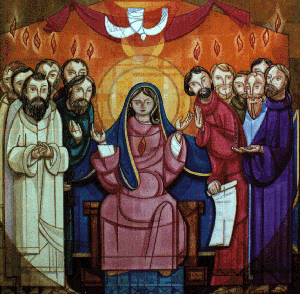
Sunday, June 15, 2008: Today's commemorated feasts and saints... 8th SUNDAY OF PASCHA — Tone 7. PENTECOST — FEAST OF THE HOLY TRINITY. Prophet Amos (8th c., B.C.). St. Jonah, Metropolitan of Moscow (1461). Ven. Gregory and Cassian, Abbots of Avnezhk (Vologdá—1392). Martyrs Vitus, Modestus, and Crescentia, at Lucania (ca. 303). Martyr Dulas of Cilicia (4th c.). St. Dulas the Passion-bearer, of Egypt. St. Jerome (Hieronymus) of Stridonium (420). Translation of the Relics of St. Theodore the Sykeote (ca. 9th c.). Rt. Blv. Lazarus, Prince of Serbia (1389). St. Ephraim, Patriarch of Serbia (14th c.). Bl. Augustine, Bishop of Hippo (430). The "MARIANICA" Icon of the Most-Holy Theotokos. When the Day of Pentecost had fully come, they were all with one accord in one place. And suddenly there came a sound from heaven, as of a rushing mighty wind, and it filled the whole house where they were sitting. Then there appeared to them divided tongues, as of fire, and one sat upon each of them. And they were all filled with the Holy Spirit and began to speak with other tongues, as the Spirit gave them utterance. And there were dwelling in Jerusalem Jews, devout men, from every nation under heaven. And when this sound occurred, the multitude came together, and were confused, because everyone heard them speak in his own language. Then they were all amazed and marveled, saying to one another, "Look, are not all these who speak Galileans? And how is it that we hear, each in our own language in which we were born? Parthians and Medes and Elamites, those dwelling in Mesopotamia, Judea and Cappadocia, Pontus and Asia, Phrygia and Pamphylia, Egypt and the parts of Libya adjoining Cyrene, visitors from Rome, both Jews and proselytes, Cretans and Arabs-we hear them speaking in our own tongues the wonderful works of God. On Pascha the gift of the Holy Spirit is given only to the Apostles, on Pentecost it is given to all the faithful. On this St John Chrysostom says Was it upon the twelve that it came? Not so; but upon the hundred and twenty. . . . Observe now, how there is no longer any occasion for that person to grieve, who was not elected as was Matthias, "And they were all filled," he says; not merely received the grace of the Spirit, but "were filled. And began to speak with other tongues, as the Spirit gave them utterance." It would not have been said, All, the Apostles also being there present, unless the rest also were partakers. For were it not so having above made mention of the Apostles distinctively and by name, he would not now have put them all in one with the rest. For if, where it was only to be mentioned that they were present, he makes mention of the Apostles apart, much more would he have done so in the case here supposed. (Homily on Acts, 4) While acknowledging that their roles are different, for Chrysostom there is no advantage to being, say, one of the Twelve (that is, an apostle) rather than one of the 120 since "all were filled" and not simply the Apostles. In like fashion there is no disadvantage for us who live some 20 centuries after that first Pentecost. To be a Christian, to be baptized and chrismated, means that we don't simply have a "share" of the Holy Spirit, some greater than others. No. In and through the sacraments, and just like the 120 on that first Pentecost, we are each of us filled the Holy Spirit. Again, St John Chrysostom (Homily 12 on Matthew): For in the case of the apostles too, there was a "sound of a mighty wind," (Acts 2:2) and visions of fiery tongues appeared, but not for the apostles' sake, but because of the Jews who were then present. Nevertheless, even though no sensible signs take place, we receive the things that have been once manifested by them. Since the dove itself at that time therefore appeared, that as in place of a finger (so to say) it might point out to them that were present, and to John, the Son of God. Not however merely on this account, but to teach you also, that upon you no less at your baptism the Spirit comes. But since then we have no need of sensible vision, faith sufficing instead of all. For signs are "not for them that believe, but for them that believe not." (1 Corinthians 14:22) One reason I suspect, we are so easily tempted to doubt and disbelief is that we imagine ourselves, I imagine myself, at a disadvantage relative to the Apostles and disciples who actually knew Jesus and experienced that first Pentecost. And so, I rely solely on their faith, on the strength of their testimony, without ever imagining that I can have a faith and a testimony of my own. At Vespers for Pentecost we sing: Blessed art Thou, O Christ our God, who hast revealed the fishermen as most wise by sending down upon them the Holy Spirit: through them Thou didst draw the world into Thy net. 0 Lover of Man, Glory to Thee (Troparion). Wisdom is a gift; so too are faith, hope and love. And these come to us not from the past, but only from above, by the outpouring of the Holy Spirit into our lives. On the Feast of Pentecost we celebrate and affirm that this has happened not simply 20 centuries ago, but here and now, not simply for the 120 then, but for you and me today. But if our celebration is to be anything more than a mere formality we must each of us, as St Seraphim of Savrov reminds us, acquire the Holy Spirit in our own life. This means that the gift of the Holy Spirit must be something that each of us not only desires but actively seeks. How do we do this? When the Most High came down and confused the tongues, he divided the nations. But when he distributed the tongues of fire, he called all to unity. Therefore, with one voice, we glorify the All-Holy Spirit! (Kontakion) If we wish to acquire for ourselves the gift of the Holy Spirit, if we wish to experience the fullness of what we have received, let us go where the Holy Spirit is, let us do what the Holy Spirit does. Taking our cue from the Kontakion, we acquire the gift of the Holy Spirit by our willingness to love others, to forgive and to encourage others. We grow in the Holy Spirit only to the degree that we cooperate in the Spirit's work of reconciling of the whole human family to God the Father in Jesus Christ. To acquire the Holy Spirit let each of us be committed to be a sign and a cause of reconciliation in ways great and small. In Christ, +Fr Gregory![]()
Friday, May 16, 2008
Athens and Jerusalem, part 1
Image via Wikipedia I have received several emails regarding my interviews with the host of "Our Life in Christ," on Ancient Faith Radio (you can download the interviews here and In Christ, +Fr Gregory Christ is Risen! Unlike the historical claims of Christian theology, modern psychology (and really it is more accurate to think in terms of a variety of schools of contemporary psychologies) does not claim to be universally applicable. Under the best of circumstances (as S. suggests) it is a tool. While it can be a helpful tool, its value depends on the skill of the craftsman using it and the needs of the person to whom s/he is responding. In Christ, +Fr Gregory
here). Below is an edited version of an email I wrote in response to one such email.
Dear T. and S.,
Thank you both for your very thoughtful comments and questions.
In response to T's question: "Is psychology necessary?" I would answer "No." But then, strictly speaking, anything that is other than God is also not necessary. This is not me language playing games. Rather it reflects what I think is the Christian faith that all that is not God is contingent upon Him and created by Him out of love and without compulsion. Creation does not add to God, but it does reflect His love.
Because everything created is, by definition, contingent, it is also unnecessary. But unnecessary does not mean unimportant or without value, though the value created being is always relative. This relative value is two-fold:
Right up front, let me say that I am not convinced of the relative superiority in psychological matters of an earlier generation of Christians. How is one to evaluate the proposition that spiritual Fathers, directors or doctors of an earlier era were more effective than contemporary psychologists? First, we need to decide on the standard of comparison and then the measurement instrument. Simply put, even assuming we are comparing apples to apples, we have no way of actually making the determination that one group was more competent then the other.
Like it or not, we live in a world in which psychology has a large role to play. It seems to me that if earlier eras struggled with issues of Christology ours age seems to struggle with anthropological questions (and this includes the nature of the Church). While there are great anthropological insights to be found in the Fathers (and this is a central theme in my own writing and praxis as both a psychologist and a priest), these are not well developed or maybe as well developed systematically. Contemporary psychology, unlike the Fathers, is concerned with the systematic study of human behavior.
If this or that Father was a better natural psychologist then say a given contemporary psychologist, well thank God, but (absent written records) so what? While I can easily imagine, for example, St Basil or St John Chrysostom or St Augustine, as extraordinarily gifted confessors and spiritual directors, they did not leave us the kinds of records that help us understand how they heard confessions. It is a bit like asking if a tree falls in the woods and no one is there to hear it does it make a sound. Yes, and while we know this theoretically, even if we do not know it experientially. And in the spiritual life, experience counts as much, if not more than, theory.
So yes, Chrysostom may very well have been an extraordinary psychologist (and certainly his sermons suggest this), but the Church today does not much profit from his skill. Contemporary psychology, to the degree that the psychologist (be he a researcher or a therapist) is honest can help the Church fill in the lack of anthropological data rooted in experience. In my work, I find a new depth of understanding of Chrysostom's sermons is possible precisely because--as a psychologist--I have some insight into human behavior that remains only implicit in his sermons.
As I think I alluded to in the interview, I did not come to psychology as an Orthodox Christian, much less a priest. Rather it was the other way around, I came as a psychologist to the Orthodox Church and eventually, and again as a psychologist, to the priesthood. This is to say I came looking for something to make up what I found lacking in my experience as a therapist and theoretician (and these days I am more interested in ideas about psychology and psychological theorists more than I am in actually doing therapy--though God knows I do a fair amount of that every week!). A therapist who is honest and committed to really working with and for clients will say that this work is invariably a confrontation with the fact of human contingency—that nothing in the client's life is necessary or of lasting value.
This is grim I realize—but this awareness is where faith begins.
I must first grasp that I do not possess my own life—that autonomy in the radical sense of the word, is not possible. This is so because I live in midst of a web of relationships that are given to me prior to any decision that I make. And, more painful still, it is precisely this web of relationships that exist prior to my free decision that in fact makes my subsequent freedom possible. I am free only to the degree that I first embrace the manifold limitations that make my life possible.
Tracing out the particular limits of a particular human life is what psychology excels at doing. In this sense then, psychology is the science, or maybe better art, that (like philosophy) is concerned with the pre-evangelism stage of human life. Psychology and especially psychotherapy (can) prepare us to receive the Gospel. How? By returning us to an appreciative consideration of our own limits, our own contingency in its ontological and empirical modes (what medieval philosophy refers to as primary and secondary causalities; I am absolutely dependent on God for my existence and relatively dependent upon my patents). Psychology, the other social and human sciences (sociology, anthropology especially) as well as the natural sciences (especially the biological sciences, but also the physical sciences and physics), are concerned with articulated the structures and dynamics of this secondary causality.
In this regard theology and the Church need modern psychology. Not need in an absolute sense to be sure, but certainly in a relative sense. For this reason I would assert that especially for pastors to ignore contemporary psychology is not only harmful but irresponsible. For all its shortcoming and limitations (and I am intimately familiar with these), modern psychology add insights about the human condition that the Fathers did not, at least not explicitly, have.
Implicit within the question of the use of modern psychology is a certain forgetfulness of the importance of our attending to the particular human person and the concrete community. Answering the questions "What use is contemporary psychology for Christians?" is not possible theoretically, but only personally. I think the examples that S. raises are good ones—I know as a priest that I have often encountered situations in the life of the Church in which my background as a psychologist has been extremely helpful. But, as I often tell my brother priests, being a psychologist doesn't make me more objective or a better priest, but simply a priest who has a different bias and a different set of skills. There are situations where an appeal to the Fathers will simply not move us forward. Granted those situations may very well be in the minority, but well, those are the situations within which God seems to call me to minister.
Finally, what I have found to be the best approach to the questions you raise T. is to seek not integration or hegemony, but reconciliation between the insights of the Fathers and contemporary psychology. As I said above, your questions do not admit to easy theoretical answers—but they can be answered personally.
In all humility I think that the work I do is consonant with the work the Fathers did in their time. These men and women of Christ, committed as they were to Him, the Gospel, and the life of the Church, entered into a conversation with Greek philosophy. At times they embraced pagan philosophy as a manifestation of divine wisdom. At other times they rejected it as demonic. It is as a result of that conversation however, that we have the great theological works of the first centuries.
In a similar fashion, and with the hope that I too will grow in holiness as a result, I have my conversation with contemporary psychology. Some of what I find is life giving and some is death dealing. But what is most important is not how this or that conversation or debate is resolved, but how struggle with the issues raised by the conversation between the two parts of my life transforms me. The questions you raised are important one, but their answer is given vocationally and not theoretically. In this, I would suggest, the questions you raise about contemporary psychology's relationship to the Church are no different the questions raised in an earlier age about the role that pagan philosophy and literature ought to play in the life of the Church.
Wednesday, April 16, 2008
Shamed No More: The Triumphant Entrance of Christ
Sunday, April 20, 2008: ENTRY OF OUR LORD INTO JERUSALEM (Palm Sunday). Ven. Theodore Trichinas ("the Hair-shirt Wearer"), Hermit, near Constantinople. Ven. Alexander, Abbot of Oshevensk (1479). Child Martyr Gabriel of Bialystok (1690). Ss. Gregory (593) and Anastasius the Sinaite (599), Patriarchs of Antioch. Ven. Anastasius, Abbot of Sinai (695).
Then, six days before the Passover, Jesus came to Bethany, where Lazarus was who had been dead, whom He had raised from the dead. There they made Him a supper; and Martha served, but Lazarus was one of those who sat at the table with Him. Then Mary took a pound of very costly oil of spikenard, anointed the feet of Jesus, and wiped His feet with her hair. And the house was filled with the fragrance of the oil. But one of His disciples, Judas Iscariot, Simon's son, who would betray Him, said,Why was this fragrant oil not sold for three hundred denarii and given to the poor? This he said, not that he cared for the poor, but because he was a thief, and had the money box; and he used to take what was put in it. But Jesus said, "Let her alone; she has kept this for the day of My burial. For the poor you have with you always, but Me you do not have always. Now a great many of the Jews knew that He was there; and they came, not for Jesus' sake only, but that they might also see Lazarus, whom He had raised from the dead. But the chief priests plotted to put Lazarus to death also, because on account of him many of the Jews went away and believed in Jesus. The next day a great multitude that had come to the feast, when they heard that Jesus was coming to Jerusalem, took branches of palm trees and went out to meet Him, and cried out: Hosanna! 'Blessed is He who comes in the name of the LORD!' The King of Israel!" Then Jesus, when He had found a young donkey, sat on it; as it is written:
Fear not, daughter of Zion; Behold, your King is coming, Sitting on a donkey's colt."
Reading the sermons of St John Chrysostom it is hard for understand why he seems to be so marginal to the theological life of the Church. His work us especially important for those of us who are interested in reflecting on the pastoral life of the Christian community. Chrysostom's sermon (Homily LXVI) on John 12 is a case in point.
St John begins with his usual forthrightness: "As wealth is wont to hurl into destruction those who are not heedful, so also is power; the first leads into covetousness, the second into pride." He then proceeds to examine the events recounted in the Gospel passage for Palm Sunday.
See, for instance, how the subject multitude of the Jews is sound, and their rulers corrupt; for that the first of these believed Christ, the Evangelists continually assert, saying, that "many of the multitude believed on Him" (Jn 7: 31, 48); but they who were of the rulers, believed not. And they themselves say, not the multitude, "Hath any of the rulers believed on Him?" But what saith one? "The multitude who know not God are accursed" (Jn 7: 49); the believers they call accursed, and themselves the slayers, wise.
The unwillingness of the rulers to accept the Christ reflects not such much a lack of faith, but the presence of pride and a desire to hold on to the power that they have acquired. Where the majority saw a reason for belief, for example, in the raising of Lazarus from the dead by Jesus, those who coveted power saw a pressing need to "kill Lazarus." By an act of human power these men hope to be able to overcome the power of God in their midst.
The rulers had Chrysostom says at least contrived grounds "to slay Christ." After all "He broke the Sabbath," and "He made Himself equal to the Father," and He represented a threat to Roman rule. But "what charge had they against Lazarus that they sought to kill him? Is the having received a benefit a crime? See thou how murderous is their will?" It is here that Chrysostom diagnosis the illness that afflicts many in the Church: I see God's bestow of blessing on my neighbor as somehow an affront to me.
And the greater the miracle, the greater seems to be my anger and jealousy.
Yet He had worked many miracles; but none exasperated them so much as this one, not the paralytic, not the blind. For this was more wonderful in its nature, and was wrought after many others, and it was a strange thing to see one, who had been dead four days, walking and speaking.
The malice I feel toward my neighbor reflects my deeper animosity toward God Himself. The great temptation of any who have power and authority is first to try and "to draw away the multitudes." And when I fail at this, when it is clear that I can find "no fault" with Christ, what choice do I have but to kill the one who Christ has blessed?
Since then the charge which they continually brought against Him was removed, and the miracle was evident, they hasten to murder. So that they would have done the same in the case of the blind man, had it not been in their power to find fault respecting the Sabbath. Besides, that man was of no note, and they cast him out of the temple; but Lazarus was a person of distinction, as is clear, since many came to comfort his sisters; and the miracle was done in the sight of all, and most marvelously. On which account all ran to see. This then stung them, that while the feast was going on, all should leave it and go to Bethany. They set their hand therefore to kill him, and thought they were not daring anything, so murderous were they. On this account the8 Law at its commencement opens with this, "Thou shall not kill" (Ex. xx. 13); and the Prophet brings this charge against them, "Their hands are full of blood." (Is 1,15).
And when even this fails? When I am unable to kill the one who Christ has blessed?
Murder to be murder need not slay the body. Jesus makes this clear in the Gospel when He tells us "do not fear those who kill the body but cannot kill the soul. But rather fear Him who is able to destroy both soul and body in hell" (Mt 10.28). Commenting on this passage St Augustine tells (LXV Ben) us that in saying this Jesus teaches us "in fearing not to fear, and in not fearing to fear. " He continues
See where He advised us not to fear. See now where He advised us to fear. "But," says he, "fear Him who has power to destroy both body and soul in hell." Let us fear therefore, that we may not fear. Fear seems to be allied to cowardice: seems to be the character of the weak, not the strong. But see what says the Scripture, "The fear of the Lord is the hope of strength." Let us then fear, that we may not fear; that is, let us fear prudently, that we may not fear vainly. The holy Martyrs on the occasion of whose solemnity this lesson was read out of the Gospel, in fearing, feared not; because in fearing God, they did not regard men.
As the events of Great and Holy Week make clear, what the rulers of the Jews feared was Roman power and authority. And what the rulers feared as well was the loss of their own power and authority if they lost Roman favor. Like all who acquisition of power has given birth to pride, what I fear is not God but human opinion.
This plays itself concretely in human communities through shaming.
We get an example of this is Judas' criticism of the woman who anointed Jesus' feet with myrrh; "Why was this fragrant oil not sold for three hundred denarii and given to the poor?" Here we can see the power of shame. Shame minimizing the good we have done by contrasting it negatively with the good that we do not do.
Human life being what it is, every good thing that we do necessarily leaves a myriad of other equally good, or even better, things undone. And how can it be otherwise? We are creatures, we are finite and so our power to do the good is always and everywhere limited. Shame exploits human finitude, human limitations. And it does so in such a way as to cause us to turn against our own humanity—the shameful of shame is that it cause us to reject our own humanity, to condemn ourselves not for our sinfulness, but our creatureliness. (As an aside, it is not unexpected that shame is often associated with sex. Our sex, our being male or female, is intrinsic to our identity. While sex does not exhaust human identity, it is still foundational to that identity.)
Like Judas, those who exercise power in a shaming fashion do so not simply for their own profit, but for a profit that comes at the expense of others. "This he [Judas] said, not that he cared for the poor, but because he was a thief, and had the money box; and he used to take what was put in it." Shame is the consequence of those in power using their power to exploit us in our weakness. And again, because we are creatures, because we do not possess our one existence but receive it each moment as a free gift, we are all of us weak and so vulnerable to exploitation by others.
Given as well that to be human is to be a relational being our vulnerability is global. Because our absolute dependence upon God is incarnated as a relative dependence upon other human beings, shame remains a universal aberrant possibility in human relationships.
For many of us, sadly, the Christian life is often a life of shame, of turning toward the gift of our own life and humanity not with gratitude, but disdain or even despair. Like the woman in the Gospel, the gift we have received from God and which in gratitude we return to Him, is often greeted with self-serving contempt by those around us. Especially when that contempt comes from a Christian brother or sister, or worse still a father or mother in Christ, the wound is unimaginably deep and painful.
It is worth noting that the Gospel story of Christ's triumphal entrance into Jerusalem embraces not simply the political, but also the personal. Yes, Jesus challenges the authority, the power and the pride of the political and religious rulers of this world. But He also makes manifest that same challenge in the midst of the more ordinary, homey relationship that make up our everyday life. Jesus challenges not simply the powerful of this world, but the human heart out of which that attachment to power arises.
It is worth remembering that even as we are all vulnerable to shame, we are all of us also tempted to shame others. The vulnerability that shame exploits is shared—we are all of us able to wound as well as to be wounded. The Gospel that embraces says "For as many of you as were baptized into Christ have put on Christ. There is neither Jew nor Greek, there is neither slave nor free, there is neither male nor female; for you are all one in Christ Jesus," (Gal 3:27-28) finds its opposite number in our shared sinfulness. In sin there is also "Jew nor Greek, there is neither slave nor free, there is neither male nor female." But where in Christ this opens us the Infinite God and to each, sin closes us in on ourselves and so to God and to our neighbor.
The divine response to sin's toxic mixture power, pride, shame that exploits human ontological and psychological vulnerabilities is to come to us in humility, "Sitting on a donkey's colt." It is because of the humility of God that we are able to live without free. As Chrysostom reminds us, unlike kings of this world who are "the most part . . . unjust and covetous kind of men," our God is "meek and gentle."
The powerful of this world, and this includes at moments each of us, cannot see this. In my sinfulness, in my love of power, I am offended by, a King Who suffers and is betrayed. It simply cannot be this way for Him, but only because I do not wish it to be this way for me.
But the Kingdom that Jesus comes to announce is not of this world. It is an eschatological Kingdom that, by its very natures, comes as gift and so confounds all human attempts at power and control. It is, humanly speaking, a powerless Kingdom. And paradoxically it is in its powerlessness that the true power of the Kingdom of God is revealed.
St. John Chrysostom says "I call Him King, because I see Him crucified: it belongs to the King to die for His subjects." On Palm Sunday, on His Triumphal Entry into Jerusalem, Jesus reveals Himself as the King Who has come to die for His subjects. And in so doing He puts to death our sinfulness and liberates us from the grip of shame that gives pride its real authority in our life.
In Christ,
+Fr Gregory