
And this brings me back to where I began, the mystery of friendship transformed.
Just as in the Liturgy bread and wine, “the fruit of the vine and work of human hands,” are transformed to become the Body and Blood of Christ, human friendships can also be transformed by God's grace into something of eternal beauty and importance. But, and again as with bread and wine, these friendships must be properly formed. They must be real and healthy friendships just as the Eucharist must begin as real bread and real wine. At it best priestly ministry grows out of life long friendships transformed by grace. So to, I would argue, with the internal life of the Church and our Christian witness in the public square. Anything less then ministry, and ecclesiastical life and evangelistic outreach ground in wholesome friendships slowly transformed by divine grace is unworthy of Christ and of the humanity He shares with us.
I have seen my own relationship with Christ and my friends transformed by their ordinations and my own.
If we do not love each other, how can the world believe we love it? And if we do not love the world for whom Christ suffered and died, how can we say that we are love Him or our true to ourselves?
But the real question now is this, how will we proceed?
In Christ,
+Fr Gregory
Showing posts with label Orthodox Church. Show all posts
Showing posts with label Orthodox Church. Show all posts
Thursday, June 25, 2009
Friendship and The Church's Witness, part 4


Wednesday, June 24, 2009
Friendship and The Church's Witness, part 3
 Image via Wikipedia
More troubling to me however is a more recent phenomenon.
Largely as a result of an influx of converts to the Orthodox Church, we have seen clergy and parishes that are markedly sectarian and anti-intellectual. In this second case, for all that the community might be a buzz of liturgical activity (in English of course!) and adult education classes and sermons that quote (often out of context) the Father, we see people working zealously to exclude (and condemn) anything “Western.”
In both cases the kenotic character of out witness is sacrificed in order that we might preserve our “special” quality of being Greek or Russian or somehow above or outside the cultural currents and debates that afflict our Catholic, Protestant, Evangelical and non-Christian fellow citizens. At the risk of offending, no matter how we are told by Old World hierarchs or monastic elders that it is so, no matter how many quotes we marshal from patristic or monastic authors “Turn on, tune out and drop in,” is not the Gospel of Jesus Christ and Him crucified and risen from the dead.
His Beatitude's words about the episcopal ministry are, I think, applicable as well to Christians and even the American people as a whole. He says,
No bishop of the Orthodox Church works alone; each is sustained and aided by a structure, developed over centuries, and implemented in any given place in accordance with the realities of the life which God gives us. This structure has to be capable of existing in a very wide range of different circumstances, as evidenced by the history of the Church. There have been times of plenty and times of famine, times during which political systems have been friendly and supportive, and others when they have been downright hostile and injurious to everything for which the Light of the Gospel eternally shines. As these changes have occurred, the Church has found the need to make laws and rulings, to protect the integrity of the life of Church under all circumstances. These rulings, or Canons, are a treasure-house of experience, which enlivens and enlightens each new situation which the Church, in Her life, faces in every age.
Likewise, and within our own areas of concern, as Orthodox Christians and American citizens, we are all of us sustained social structures both ecclesiastical and cultural, and by personal, economic and political relationships, that have developed over centuries. We are none of us is alone not matter what the reigning ideology of radical individualism might say or what, because of our own emotional and spiritual wounds we might believe about ourselves. In one sense at least, we are all of us cultural and ecclesiastical free riders, and thank God for it since who among us could recreate centuries of human creativity?
In Christ,
+Fr Gregory
![Reblog this post [with Zemanta]](http://img.zemanta.com/reblog_e.png?x-id=2d7ed367-fb5f-41d7-9650-fb5570e164ce)
Tuesday, June 23, 2009
Friendship and The Church's Witness, part 2
It is always tempting to reduce the proclamation of the Gospel to an exercise of power—spiritual, moral, social or political. More easily then I prefer to acknowledge, I find myself thinking that because what I am proclaiming is of lasting, even eternal, significance, I can be indifferent, and if need be hostile, to what is of only transitory or of passing value. After all, “The good,” as some have said, “is the enemy of the perfect.”
Well, no it isn't—the good is just that, good and just as we ought not to sacrifice what is best in our pursuit of a lesser good so too we ought not to sacrifice a lesser good in pursuit of a greater. When we do this—and this happens frequently in ways great and small—we commit an act of violence. The violence that afflicts the human soul and divides the human community arise precisely out of my willingness to sacrifice one good for another.
In the public square we often see this in the debates about abortion. A woman's freedom, her physical or emotional health are often allowed to trump her unborn child's right to life. All are good, but we justify an act of violence by our willingness to accept the sacrifice of some goods in the pursuit of others.
Or, to take another example, think about the pursuit of material progress. Yes, many of us are better off materially then any time in human history. And while there still are people in wretched poverty, as a whole humanity is better off. We have more to eat and we live longer and while these are both good things to be sure, they are good things that often come by our willingness to sacrifice other goods such as community or even the Gospel.
Christianity in the public square must, I think, proceed by way kenosis, a self-emptying witness patterned after the incarnation of the Son of God (see Philippians 2). His Beatitude place this kenotic witness at the heart of the vocation of the Orthodox Church of America. He goes on to argue that it is this self-emptying witness that is the way not only toward Orthodox unity in America, but also at the center of the Church's evangelistic witness and engagement of America and her people. In his own words: “It is the task of the Church in this country not only to offer the life of the Orthodox Church to the American people, but also to bring to the practice of Orthodoxy all that is best, all that is valiant, all that is most noble, in our American life.” As I have suggested before, at the heart of our witness to Christ and the Gospel is a reciprocity in which we embraces not only each other but the surrounding culture.
But this raises for me a question: How has our witness be characterized by kenotic reciprocity?
In Christ,
+Fr Gregory
![Reblog this post [with Zemanta]](http://img.zemanta.com/reblog_e.png?x-id=d502b3e7-3dca-4aec-b49c-61df9fcbb89a)
Monday, June 22, 2009
Friendship and The Church's Witness, part 1
Over the years any number of my classmates, acquaintances or friends (and now SHOCKINGLY! former students) be ordained as deacons, priests and (in two cases) bishops (one Catholic, one Orthodox). Often men I have known since we were together in college are now serving as clergy and it always catches me a bit of guard when I see them vested and standing before God the Father at Christ's Holy Altar.
The Gospel brought with it a great innovation, if I may use that word, in humanity's religious nature. Religion, the spiritual life, was transformed “downward” from something extraordinary to something ordinary. In Greece and other titular Orthodox countries, it was not uncommon to see the village priest at work during the week as a cobbler or at some other trade. His daily labor was not a political statement as was the “worker-priest” movement among Catholic priests in France during the 1950's. It was not, as with the worker-priests, at attempt to reconnect the daily life of the faithful with the Church, but rather simply a playing out of the life of the Church. While not universal, there is still an intimacy between clergy and faithful in the Orthodox Church that a Catholic friend of mine describes (appreciatively) as almost medieval.
The joy of the Church in America is that because of our relatively small numbers and poverty, we have retained, or maybe recaptured, that intimacy. Our parishes tend to be small and our clergy married. While small congregations are common in the Protestant world (both Mainline and Evangelical), these are by and large non-sacramental communities and they have (or so I imagine based on my conversations with my Protestant friends) a different ethos, or feel, about them.
My point here is not to compare Orthodox parochial life to Protestant, but rather is meant as an introduction to my thoughts about an address recently given by His Beatitude Metropolitan Jonah, Primate of the Orthodox Church in America. Given the title, “The 1917 Council and Tomos:
St Tikhon’s Vision Then and Now,” it is forgivable if American Christians (including I dare say, many Orthodox Christians) might dismiss His Beatitude's address as having little any application to their own situation.
But as is often the case in our spiritual life, on another, deeper level, I think there is much to in the talk not only for Orthodox Christians (who are after all the His Beatitude's audience) but also Christians in other traditions and indeed for women and men of good will who are interested in the place of religion in the public square.
We will tomorrow look at that talk and see what, if anything, it might say for the Church's life and witness.
In Christ,
+Fr Gregory
Wednesday, April 15, 2009
Response of the Archons of the Ecumenical Patiarchate in American to Metropolitan JONAH

Archon News
Statement of the Order of Saint Andrew, Archons of the Ecumenical Patriarchate in America
New York, NY
4/15/2009
4/15/2009
The Order of Saint Andrew, Archons of the Ecumenical Patriarchate, laymen who are deeply devoted to the Great Church of Christ and dedicated to the protection, defense and the mission of the Ecumenical Patriarchate of Constantinople, take this occasion to raise serious concerns and questions over the recent public remarks made by the Primate of the OCA during a Pan-Orthodox Vespers (April 5th) in Dallas, Texas. We do so sorrowfully, not only because the Church is now in the midst of Holy Week, but because the reason for our doing results from language that is unworthy of any ecclesiastical setting. Nevertheless, to be an Archon is to have a special concern and interest to protect and promote the Ecumenical Patriarchate, its mission, and the person of His All Holiness Ecumenical Patriarch Bartholomew. Therefore, we can not and must not refrain from speaking the truth in love, even though the moment is not the best.
For those who have seen the video that has been widely circulated on the Internet, or have read the transcript that is still on an OCA website, it is immediately apparent that inappropriate language, to say the least, is used against the Ecumenical Patriarchate. Consider this phrase:
There's one solution that's being proposed in which we all submit to Constantinople. We all submit to a foreign patriarchate where all decisions will be made there. Where we will have no say in the decisions that are made, we will have no say in our own destiny and we surrender the freedom that we have embraced as American Orthodox Christians to a patriarch that is still under Islamic domination.
Who has proposed any kind of subjugation to Constantinople? No one! The fact is that all of the Autocephalous Primates agreed in Constantinople on October 12, 2008 that there should be a swift healing of every canonical anomaly that has arisen from historical circumstances and pastoral requirements, such as in the so-called Orthodox Diaspora, with a view to overcoming every possible influence that is foreign to Orthodox ecclesiology (Article 13, ii). This statement was signed by all the recognized Autocephalous Primates or their Official Representatives. Metropolitan Jonah's statements demonstrate not only a lack of knowledge and of discretion; they demonstrate something which is plainly foreign to Orthodox ecclesiology.
To maintain that we, Americans, cannot ... be controlled by people who have never heard a word of English much less would allow a word of English to be spoken in the liturgy. We can't allow our church to be controlled by people who have no appreciation of our culture and have to bow to the Turkish Islamic authorities, is an erroneous, irresponsible statement in any public setting, much less a liturgical service. The fact is that Ecumenical Patriarch Bartholomew speaks six languages, and had a wonderful conversation with the President of the United States in English two days after this inflammatory remark! Furthermore, when the Heads of the Autocephalous Churches celebrated the Holy Liturgy together last October 12th in the Patriarchal Cathedral of St. George, there was an abundance of tongues used, recalling the Day of Pentecost.
Finally, we, Archons of the Great Church of Christ, must register our concern and pain over the general tone of the Metropolitan's remarks as insulting. When a statement is made, speaking personally about the Ecumenical Patriarch: if we wanted the Pope we'd be under the real one, it is not possible for the Order of Archons to be silent. This kind of disrespect is beneath any Christian. And we must also ask how a phrase like, Communists who now call themselves Democrats, does not cast aspersions on the very Nation whose martyred Church, the Patriarchate of Moscow, created the OCA in the first place?
As we are in the midst of Holy Days, when we all apply ourselves more vigorously to prayer and fasting, as we strive to follow Christ on His Way to the Cross and His Glorious Resurrection, we hope that Metropolitan Jonah will publicly retract his ill-considered remarks. While we rejoice that all things are forgiven in the Resurrection, as Orthodox Christians and as Archons of the Ecumenical Patriarchate, we will continue to be vigilant and express our grave concerns whenever such injustices as these are committed. May God grant to us all the strength and will to work for peaceable, reasonable relationships within His Holy Church, so that the Message of the Holy Gospel may shine forth.
Friday, March 27, 2009
OCL responds to the EP talk at Holy Cross | AOI Observer
Some thoughts about a recent speech at Holy Cross School of Theology from the American Orthodox Institute blog. Your comments are, of course, welcome (but please, keep them charitable, by which I mean gentle.)
In Christ,
+Fr Gregory
George Michalopulos, Orthodox Christian Laity board member and frequent contributor to the AOI blog, penned the official OCL response to Arch. Elpidophoros Lambriniadis recent talk at AOI. Original article is posted on the OCL website.
An OCL Board Member Responds to the Message of Chief Secretary of The Holy and Sacred Synod of the Ecumenical Patriarchate
George Michalopulos
March 25, 2009 - the Feast of the Annunciation
I. Introduction: An Archimandrite Speaks
Recently, a certain archimandrite, the Very Rev Dr Elpidophoros Lambriniadis, spoke at Holy Cross School of Theology in Brookline, Massachusetts. His position is one of auxiliary professor at this seminary but his formal title is “Chief Secretary of the Holy and Sacred Synod.” His remarks thus were more than the observations of a mere academic; indeed he stated from the outset that they were authorized by the Ecumenical Patriarch himself and “with the consent” of Archbishop Demetrios, the primate of the Greek archdiocese.
What began as astute observations of American Orthodoxy by a highly educated clergyman-scholar quickly descended into vituperation, slander against other jurisdictions, and almost total ignorance of America. Moreover, his understanding of canon law and Byzantine history itself was questionable. It is unknown whether this was deliberate or merely the result of ignorance. At best, this willful twisting of history can be viewed as Phanariote propaganda, which like all good propaganda uses words and ideas for some higher purpose. The purpose of this reply is not only to identify that which is propagandistic, but to point out the severe internal and logical contradictions contained therein.
It has been reported that several of those who attended his lecture left in disgust in the midst of his speech and that of those who remained, disgruntled comments were audible upon the completion of his oration. The following day, during a private meeting with the faculty of Holy Cross, clear disagreements were enunciated towards him and his views. Others have pointed out in the interim that his speech should be viewed by many as the intellectual case (such as it is) of the Phanar regarding the claims it will press at the upcoming “Pan-Orthodox Synod” which is in the planning stages at present. Given his standing at the Phanar, his speech deserves serious consideration. More importantly, as seen within the turmoil of the GOA in the aftermath of the Ligonier Conference in 1994, the Phanar’s capabilities for mischief cannot be underestimated. (Henceforth, for purposes of brevity, I will refer to Archimandrite Lambrianides as “the speaker” and his remarks as “the speech.”
Read the rest here: OCL responds to the EP about Holy Cross talk.
![Reblog this post [with Zemanta]](http://img.zemanta.com/reblog_e.png?x-id=0a54c59d-2250-4f40-ae09-4b21bdf99d4a)
Thursday, March 19, 2009
Guest Post: Comments on the Archimandrite's talk
 Image via Wikipedia
As Chrys, and other Orthodox respondents have pointed out, the Archimandrite's arguments for the primacy of the Ecumenical Patriarch are at least as applicable to Rome as to Constantinople. Given the rather lukewarm response of the EP to the great moral challenges of our age in favor of a rather poorly thought out participation in the environmental movement, I have to agree with Chrys, "he demonstrates NO effort to understand the arguments of those whom he believes are critics of the claims of the Patriarch." As I've said before, it is not enough to simply argue that your opponents are wrong--you must actually respond to the concerns that motivate their arguments. In his talk Fr Elpidophoros has not done this--he has not engaged his critics even as the EP has not engaged those (both outside and inside the Orthodox Church) who reject traditional Christian moral teaching.
So with that, let me now give the stage over to Chrys and your comments.
In Christ,
+Fr Gregory
The Archimandrite makes a provocative if unconvincing argument. Many of his observations about American culture ring true, which makes for a good beginning and builds some good will.
He argues that ethnic separatism is wrong. Agreed: philetism is a heresy. He then makes the potentially contradictory claim that we should maintain - or at least not be detached from - our culture of origin. He gives particular weight to what he claims is a broadly understood Hellenism, but in fact serves to demand deference to a very particular culture. He claims to value the American experience but then criticizes both the local parish and the "corrective" Athonite monastic movement in the US. (I wonder how the monks on Mt. Athos would respond to these comments.) He demonstrates an appreciation for the contributions of the laity in the US but then asserts a very high view of primacy. It is a view of primacy that would seem to erase or at least significantly diminish any notion of conciliarity. (So much for the wonderful work of Zizioulas and others.) In fact, so far as I can see, there is no good reason given in his argument to stop at Constantinople; the logic chain leads as well - if not better - to Rome. At the end of his address, he quotes the Patriarch of Antioch as something of a proof. Unfortunately it is not a proof, merely an illustration. Quoting St. Ignatios of Antioch would have been much more compelling - but, as I understand the saint's comments about the (local) bishop would have much better served those with whom the Archimandrite disagrees than his own position.
That said, he demonstrates NO effort to understand the arguments of those whom he believes are critics of the claims of the Patriarch. And here we come to the purpose of his talk. The intensity of his disagreement with critics frequently substitutes a zealous demeanor and unyielding demands for carefully considered data. His tone exceeds the quality of his argument and suggests some desperation.
As a result, his attacks rarely addresses the central claims of "the critics." He seems to simply dismiss them for not subscribing to his quasi-papal view. His claim that his view is the traditional and essential view begs the question; no real evidence is offered. Worse, he often resorts to ad hominem attacks that do no credit to his arguments and unfortunately contradict the Christian character that he should, in his official role at least, embody.
He makes some claims that don't square with my understanding of history - but I may be wrong. It is my understanding that most of the autocephalous Churches often "took" their status without the blessing of Constantinople. Either way, the notion that the Patriach finally granted Alexandria such status in 2002 only serves to undermine his purpose further. That it took 1900+ years surely serves his critics' purposes, not his. (Either that, of the Church in the US can look forward to official blessing for self-rule sometime in the year 3800.)
He argument ultimately seeks to establish that the health of the Church here depends upon its deference to the Patriarch. Obedience is often a great source of blessing, but that argument is not offered. In the end, the "patrimony" that he claims is intrinsic to the Patriarch of Constantinople alone is not demonstrated - at least in his presentation. He claims that it is essential to the life of the American parish, but does not convincingly demonstrate how. The purpose, however, is clear enough: America should not consider self-governance. (Which is ironic since this is what America is known for and, as the "empire" of the current age, would seem to be have the standing upon which both Old Rome and New Rome asserted their preeminence.) Indeed, he seems so intent on defending the idea of the value of the Patriarch that he fails to address the seemingly transparent reason for his urgency -- which is that the opposite is actually true. It is rather the Patriarch who is desperately dependent on the US for political and financial support.
In the end, his effort to assert the claims of Constantinople and (uncharitably) silence the growing American Church's desire for increasing self-governance are more urgent than considered, more demanded than demonstrated. And for that, he may have done his cause far more harm than good.
![Reblog this post [with Zemanta]](http://img.zemanta.com/reblog_e.png?x-id=88ae326c-133c-420d-943c-b6f236534ef8)
Wednesday, March 18, 2009
The Orthodox Christian Fort Sumter?
Below is a talk given in the Chapel of the Holy Cross Greek Orthodox School of Theology, Brookline, MA March 16, 2009 by the Very Reverend Archimandrite Dr. Elpidophoros Lambriniadis, Chief Secretary of the Holy and Sacred Synod. The talk is titled, "Challenges of Orthodoxy in America And the Role of the Ecumenical Patriarchate," and was posted on the web site of Greek American News.com.
Please take the time to read the whole talk. It is, not to put too fine a point on it, it grieves me more than I can say to hear a representative of the Ecumenical throne would speak with such condescension. Personally,I am deeply hurt and offended by Fr Elpidophor's ad hominem argument against Metropolitan JONAH (who he consistently calls JONAS).
While Father makes several good points about the state of the Orthodox Church in the US, I will have to refrain from criticizing his argument lest I sin against charity.
While the talk is long, I encourage you to read all of what Fr Elpidophor has to say and draw what conclusions you do.
In Christ,
+Fr Gregory
Reverend Protopresbyter Nicholas Triantafyllou, President,
Reverend Protopresbyter Thomas Fitzgerald, Dean of the School of Theology,
Reverend and Esteemed Members of the Faculty and staff,
Dear Students,
It is an exceptional honor and a great joy for me to be here today, among you, with the blessing and permission of His All Holiness the Ecumenical Patriarch and the consent of His Eminence the Archbishop of America, in order to share with you some thoughts regarding the present condition of Orthodoxy in America and our Ecumenical Patriarchate's position towards it.
You have, my brothers and sisters, the privilege to be citizens of a country which determines to a great extent the fate of many people on our planet; a country where pioneering technologies as well as ideas and philosophies have been discovered and disseminated. The cultural peculiarities and characteristics of the United States find also a reflection in, as it is only natural, and exercise an influence on the religious communities of this country. It is far from accidental that none of the "traditional" religions (coming either from Europe or elsewhere), remained the same once they were replanted on American soil.
The same change can be of course observed in the case of Orthodoxy, whose appearance and development in America was influenced by certain indeterminable factors.
The first and main challenge that American Orthodoxy faces is that it has been developed in a region which, from an administrative and technical point, is that of diaspora. By the term "diaspora" we indicate that region whose ecclesiastical jurisdiction is been unfortunately claimed by a variety of "Mother" Churches, which wish to maintain their pastoral care over their respective flocks, comprised by the people who, over the years, immigrated to the superpower called USA.
In this way, the Orthodox faithful in America became organized according to their national origin and not according to the canon law of the Orthodox Church—that is, they organized themselves not in accordance with the principles of Orthodox ecclesiology which dictates that neither national origin, nor the history of a group's appearance in a particular region but rather the canonical taxis and the perennial praxis of the Church, as codified by the Ecumenical Councils, has the ultimate authority.
According to such ecclesiological principles, in any given region there can be one and only one bishop who shepherds the Orthodox faithful, regardless of any nationalistic distinction. It was, however, the very opposite scenario that took place in America and today one observes the challenging deplorable condition where a number of bishops claim pastoral responsibility for the same geographic region.
A second challenge of the Church in America is that it was brought here by people who left their homelands at a time that these homelands were economically underdeveloped. Economic immigration created, from the very first moment, the need for these people to assimilate to their adopted land in order to achieve, as soon as possible, the high living standards of the privileged Americans and therefore to enjoy the fruits of the American dream. Towards that goal, they changed their names, they put an emphasis on the English language in every aspect of their lives, and at last they succeeded in becoming true American citizens, holding ever higher positions in the financial, commercial, academic, artistic and political life of this country. The negative aspect of this strong emphasis on cultural assimilation was the consideration of the faithfulness in one's cultural background as an impediment to the progress and success in the American society. Thus, the complexes of an alleged inferior nationality or class that, in order to enjoy the fruits of the American dream, is supposed to eradicate any bond to its distinctive culture.
The third challenge of Orthodoxy in America concerns the manner of its ecclesiastical organization. The Orthodox faithful organized themselves in communities of lay people, who, in turn, became identified with the ecclesiastical community in the manner of the traditional organization of Christian communities. Thus, the parish (κοινότητα) being now governed by lay elected members, builds its own Church, school and other such institutions, and provides the priest's salary. Such communal organization improves, as it is right and desirable, the role of laity in Church administration, and increases the sense of responsibility and participation in the life of the Church, offering thus the change to the Church to profit of its talented and able parishioners. On the other hand, however, four very concrete dangers lurk behind such a communal organization of the local Church:
a) That the priest might become alienated from his administrative duties, and from being the spiritual leader of the parish would become a clerk of the parish council,
b) That the parishioners would find it difficult to comprehend the rules according to which the Church is governed and instead they would follow their own secular reasoning,
c) That the structures of the parish would become influenced by the prevalent Protestant models and thus they would replicate and imitate practices that are foreign to the Spirit of Orthodoxy, and
d) That the parishes would degenerate into nothing more than membership clubs, invested with some ecclesiastical resemblance.
As you all know, one of the secrets for the success of the American miracle in its financial, political and technological aspects was precisely its desire to detach itself from the traditional models of the old world, its ability to break free from the established norms, its willingness to question whatever was considered as given or beyond any criticism. As it might have been expected, these tendencies soon found an expression within the life of the Church, sometimes in more extreme ways, other times in more temperate ways. Thus, soon Orthodox clergymen became indistinguishable from the clergy of other denominations, choirs in the western style were adopted, the liturgical tradition became more and more impoverished by being limited only to the bare essentials, etc.
Against that gradual secularization of Orthodoxy in America, a reaction soon made its appearance in the form of a number of rapidly spreading monasteries of an Athonite influence, characterized by ultraconservative tendencies, attached to the letter of the law, and reacting to any form of relationship with other Christian denominations. All of this is nothing but the manifestation of the intense thirst for a lost spirituality and a liturgical richness of which the Orthodox people of America have been for very long now deprived, forced, as they were, to embrace the Church only in the form of a sterile social activism.
The traits of the American clergy today also appear to undergo certain differences.
The secularization of the parish life, as described above, fails to inspire young men and to cultivate in them the religious vocation, so that tomorrow's pastors would be part of the very flesh of today's parish. That vacuum in clerical vocation is covered by candidates who, being unusually older than what was perceived the standard age, have already on their shoulders the domestic burden of a family. Thus they struggle to obtain the necessary degree that would secure for them among others the society's respect.
Another great number of candidates to the priesthood come from converts, who possess little, if any, familiarity with the Orthodox experience and they are usually characterized by their overzealous behavior and mentality. It is of interest that the converts who become ordained into priesthood represent a disproportionally greater percentage than the converts among the faithful. The result of this disanalogous representation is that, more often than not, convert priest shepherd flocks who are bearers of some cultural tradition, but because their pastors either lack the necessary familiarity with that tradition or even consciously oppose it, they succeed in devaluing and gradually eradicating those cultural elements that have been the expression of the parishes that they serve.
It is particularly saddening that the crisis in priestly vocation has decreased dramatically the number but also the quality of celibate priests, who one day will be assigned with the responsibility of governing this Church. Lack of spirituality makes the monastic ideal incomprehensible and unattractive especially among the youth (with the exception, of course, of the aforementioned monastic communities with their own peculiarities).
Having attempted this general evaluation of the American Orthodoxy, allow me to consider briefly the Holy Archdiocese of America, this most important eparchy of the Ecumenical Throne.
The image we depicted above in rough brushstrokes holds also true for the Archdiocese. Thanks to the selfless dedication of our immigrants and under the protection of the first See in the Orthodox world, a strong Archdiocese was created that, in time, reached a level of maturity and excellence and it is today the pride of the Church of Constantinople. The Archdiocese took advantage of the possibilities that a deeply democratic, meritocratic and progressive state, like the United States, was able to offer, in order that the Orthodox faith of our fathers take root deep in the American land.
To this effect, the active participation of the lay element was, as we have seen, very important. We believe that the younger generations of the omogeneia are free of the past's prejudices and complexes, according to which, if you wish to succeed in America you have to forget your cultural patrimony and your language in order to be left naked, so to speak, in the thorny desert of the Wild West. Today's omogeneia has overcome that denial and has come to understand that the secret of the American civilization's success does not lie in the obliteration of one's cultural background but rather in the free and harmonious co-existence of people and races who have come to this hospitable land seeking a life in freedom, in faith and in dignity. Our cultural heritage and our national conscience is not, by any means, an obstacle for our progress and for the successful witness to our faith, especially insofar as ecumenicity (οἰκουμενικότης) is the heart of Hellenism and by definition alien to any form of nationalism or cultural chauvinism.
The Holy Archdiocese of America under the Ecumenical Patriarchate is the most organized, well-structured and successful presence of Orthodoxy today. This is not accidental. This success was not achieved by foregoing its cultural identity. It was not achieved by ignoring the sacred canons and the decisions of the Ecumenical Councils. It was not achieved by succumbing to the temptation of secularism. It was not achieved by imprisoning itself in the darkness of the extreme fundamentalism, nationalism and sterile denial.
Precisely because the Holy Archdiocese of America occupies such an esteemed position in this country we are obliged to offer a self-criticism but also to defend ourselves against the unjust accusations that target this jurisdiction of the Ecumenical Patriarchate.
Examining, then, ourselves, I believe that we ought to be more careful towards the easiness with which we are ready to abandon our Hellenism, both as language and as tradition. As we have already said, it is nothing but a myth the opinion that Hellenism is an obstacle to the creative and successful incorporation in the American reality. Hellenism is identified with its ecumenical character and for that reason it can never be nationalistic for both of its manifestations, its culture and its Orthodox faith are concepts that transcend the boundaries of the national.
I do not support the opinion that we can today oblige everyone to speak Greek, but I think that we have to offer that possibility to those who so desire, to learn Greek in well organized schools, by talented teachers. I think that we owe our children the possibility of choice. We owe to our culture the obliteration of contempt for a language that expressed the Gospel and became the vehicle for the most subtle meanings in the articulation of the dogma by the founders of our faith and Fathers of Christianity.
I do not support the opinion that the services here in America should be done exclusively in Greek. Simply I do not understand how it is possible that any priest of the Archdiocese might not be able to serve in both languages. It is not understandable how an institution of higher education cannot manage to teach its students a language, even in the time span of four years!
My brothers and sisters, I am not one of them who believe that there is a sacred language (lingua sacra) for the Church. I just wonder why in every Theological School in the world the students are expected to learn the Biblical languages, and it is only in our School of the Greek Orthodox Archdiocese of America that such a requirement seems anachronistic, nationalistic or conservative.
Speaking now of your Theological School, do you think that the Church's expectation that the graduates of this School know theology, canon law, Byzantine music, be able to celebrate the service of matins, vespers and the sacraments, be able to preach the Word of God and instruct our youth in the catechism is unreasonable or excessive?
My dear brothers and sisters, allow me now to return to the problem of the diaspora and the jurisdictional diversity that one observes in the USA.
First of all, allow me to remind you that the term "diaspora" is a technical term denoting those regions that lie beyond the borders of the local autocephalous Churches. It does not mean that the Orthodox people who dwell in these regions live there temporally, as misleadingly it was argued by His Eminence Phillip in a recent article ("The Word"). According to the 28th Canon of the 4th Ecumenical Council one of the prerogatives of the Ecumenical Patriarch is precisely His jurisdiction exactly over these regions, which lie beyond the predescribed borders of the local Churches. The canon in question uses the technical term "barbaric" in order to denote these lands, since it was precisely referring to the unknown lands beyond the orbit of the Roman Empire.
On account of this canon, the Ecumenical Patriarchate has suffered the unfair and unjust criticism of two American Orthodox Hierarchs: Metropolitan Phillip and the newly elected Metropolitan Jonas.
It is my duty to refute the injustice directed against the Mother Church of Constantinople for the sake of historical truth and for the sake of moral conscience.
Metropolitan Jonas, while he was still an abbot, in one of his speeches presented what he called "a monastic perspective" on the subject "Episcopacy, Primacy and the Mother Churches". In the chapter on autocephaly and primacy he claims that "there is no effective overarching primacy in the Orthodox Church." He seems to be in opposition to the institution of the Ecumenical Patriarchate, because he considers that such an institution "is based on primacy over an empire-wide synod" and that this "has long become unrealistic." What surprised me the most in this "monastic perspective" of His Eminence Jonas was the claim that allegedly "now only the Greek ethnic Churches and few others recognize the Ecumenical Patriarchate to be what it claims to be." It is indeed saddening the ignorance of this Hierarch not only on account of History and canonical order but even on account of the current state of affairs. How is it possible that he ignores that there is no Church that does not recognize the Ecumenical Patriarchate? Perhaps he is carried away by the fact that the ecclesial schema over which he presides and which has been claimed as "autocephalous" in rampant violation of every sense of canonicity, is not recognized but by few Churches and it is not included in the diptychs of the Church.
Please allow me, by way of illustration, to sample a few other points of the same article that should not remain unanswered.
Metropolitan Jonas claims that in America "there is no common expression of unity that supersedes ethnic linguistic and cultural divisions." Does His Eminence ignore the fact that under the canonical jurisdiction of the Ecumenical Patriarchate in America belong Greeks, Palestinians, Albanians, Ukrainians and Carpathorussians? Is this not proof enough of a common structure that supersedes ethnic and cultural divisions? Does he imply perhaps that SCOBA either constitutes a common expression of unity that supersedes such divisions?
The most provocative of his claims is that which asserts that with the formation of the so-called OCA "the presence of any other jurisdiction on American territory becomes uncanonical, and membership in the Synod of the Orthodox Church in America becomes the criterion of canonicity of all bishops in America." It is perhaps a sign of our times that he who violated the holy canons par excellence, the most uncanonically claimed as allegedly autocephalous, makes now himself the criterion of canonicity and vitiates the canonical hierarchs as uncanonical. O tempora, o mores!
Instead of acknowledging the mercifulness of the other Patriarchates which, in spite the uncanonical status of the so-called OCA, accept it in communion, its representatives choose to subject them to such an unfair treatment that contributes nothing to the common cause of Orthodox unity. I would be interested to hear an explanation from His Eminence in response to the question "How will the so-called OCA contribute to our common Orthodox witness in diaspora by electing bishops holding titles which already exist for the same city". Especially our Ecumenical Patriarchate not only is it not "unable to lead" as most unfortunately Metropolitan Jonas claims, but already since last October (in order to limit myself to the most recent example) has launched under the presidency of His All Holiness the process for the convocation of the Holy and Great Synod. I am not sure whether His Eminence, upon his ordination to the episcopacy, refused to put on the vestments of a bishop, which he, in the same article, and while he was still an abbot, had called as unfitting to the real nature of the arch-pastorship (p. 11).
Let me add that the refusal to recognize primacy within the Orthodox Church, a primacy that necessarily cannot but be embodied by a primus (that is by a bishop who has the prerogative of being the first among his fellow bishops) constitutes nothing less than heresy. It cannot be accepted, as often it is said, that the unity among the Orthodox Churches is safeguarded by either a common norm of faith and worship or by the Ecumenical Council as an institution. Both of these factors are impersonal while in our Orthodox theology the principle of unity is always a person. Indeed, in the level of the Holy Trinity the principle of unity is not the divine essence but the Person of the Father ("Monarchy" of the Father), at the ecclesiological level of the local Church the principle of unity is not the presbyterium or the common worship of the Christians but the person of the Bishop, so to in the Pan-Orthodox level the principle of unity cannot be an idea nor an institution but it needs to be, if we are to be consistent with our theology, a person.
The second article that I have to mention here is that of His Eminence the Antiochean Metropolitan Phillip under the title "Canon 28 of the 4th Ecumenical Council—Relevant or Irrelevant Today?"
Metropolitan Phillip begins his argument with an entirely anti-theological distinction of the holy canons into three categories 1) dogmatic, 2) contextual and, 3) "dead".
I would like to know in which of these three categories, following his reasoning, His Eminence would classify the canons of the Ecumenical Councils that demarcate the jurisdictions of the ancient Patriarchates. Are they "contextual"—subject, as it is, to change? Does His Eminence believe that in this way he serves the unity among Orthodox, by subjugating the holy and divine canons under the circumstantial judgment of some bishop?
Based on the above distinction, and although he accepts that canon 28 of the 4th Ecumenical Council is not "dead" (since there is so much debate about it), he affirms that indeed it gives certain prerogatives to the Ecumenical Patriarch, on the other hand, however, he claims that this happened for secular and political reasons that have nothing to do with today's state of affairs. Implicitly and yet all too clearly, Metropolitan Phillip implies that the prerogatives of the Ecumenical Patriarch can be doubted. The question then is: does His Eminence know of any Church whose status (Patriarchal or Autocephalous) were not decided according to the historical conditions that they were current at the time? Or, does His Eminence know of any Church that has received its status on the basis of theological reasons exclusively? Every administrative decision of an Ecumenical Council is equally respected to perpetuity together with its dogmatic decisions. Imagine the consequences for the Orthodox Church if we begin to re-evalutate the status of each local Church!
The correct interpretation of canon 28 is considered by His Eminence as "novelty", by invoking only sources of the 20th century, while it has been scientifically established already by the late Metropolitan of Sardeis Maximos the uninterrupted application of the canon in question during the history of the Church of Constantinople.
The question, my brothers and sisters, is rather simple:
If Constantinople was not given that prerogative by canon 28, how was she able to grant autocephalies and patriarchal dignities to the Churches of Russia, Serbia, Romania, Bulgaria, Georgia, Czech Lands and Slovakia, Poland and Albania? Under the provision of which canon did Constantinople give the right of jurisdiction over the remaining of Africa to the Patriarchate of Alexandria in 2002?
And if the Ecumenical Patriarchate has not granted the Patriarchate of Moscow the privilege to bestow autocephaly as it pleases it, then what gives it the right to do so on the expense of the Orthodox unity?
Summarizing my lecture, I wish to call your attention to the following points:
1. The Ecumenical Patriarchate is a Church that undergoes martyrdom, a Church that often has received unfair criticism, especially by those Churches which were most richly benefited by it. At no point, the spirit of nationalism took hold of the Ecumenical Patriarchate because that is incompatible with the concepts of Hellenism and Ecumenicity (ecumenical character) as well as with the Christian Orthodox faith. The proof of this emerges in the most decisive manner throughout the 17 centuries of its history, during which it never Hellenized, not even attempted to Hellenize the nations to which it gave through its apostolic missions the undying light of Christ. What better example than the Slavic tribes which owe even their alphabet to the Thessalonian brothers Cyril and Methodios. I, who speak to you tonight, although I am an Antiochean from my maternal side, nevertheless I serve as the Chief-Secretary of the Holy and Sacred Synod of the Church of Constantinople.
2. The Ecumenical Patriarchate neither had nor has territorial claims against the sister Orthodox Churches. That truth is testified by the fact that, although the Patriarchates of the East were virtually destroyed during the difficult times of the 17th and 18th centuries, nevertheless, the Patriarchate of Constantinople was taking the care to have a Patriarch elected for those Patriarchates, supporting their primates in every possible way.
3. The submission of the diaspora to the Ecumenical Patriarchate does not mean either Hellenization or violation of the canonical order, because it is only in this way that both the letter and the spirit of the decisions of the Ecumenical Councils is respected. The Mother Church knows, however, that such a submission is difficult to be accomplished under the present historical conditions. For this reason, and by employing the principle of economy, it was suggested and it has now become accepted in Pan-Orthodox level, that there will be local Pan-Orthodox Episcopal Assemblies in the diaspora (like SCOBA in the US). The principle of presidency is followed, namely the representative of the Ecumenical Patriarchate presides over these Episcopal Assemblies in order to preserve the necessary element of canonicity.
As you surely know, last October the Ecumenical Patriarchate summoned in Constantinople a Synaxis of the Primates of the Orthodox Churches. The Primates accepted the proposal of Patriarch Bartholomew to move ahead with the Pan-Orthodox preparatory meetings, within 2009, so that the Holy and Great Synod of the Orthodox Church take place as soon as possible. For the record, please note that this decision was reached thanks to the concession on behalf of the Ecumenical Patriarchate which accepted that the Autonomous Churches will no longer be invited as to avoid the thorny problem of the Church of Estonia in the relations between Constantinople and Moscow.
4. With regards to the United States, the submission to the First Throne of the Church, that is, to the Ecumenical Patriarchate is not only fitting with the American society and mentality but also it opens up the horizons of possibilities for this much-promising region, which is capable of becoming an example of Pan-Orthodox unity and witness.
The Mother Church of Constantinople safeguards for the Orthodox Church in America those provisions that are needed for further progress and maturity in Christ.
Please allow me to conclude with the phrase of His Beatitude Ignatios Patriarch of Antioch during last October's Synaxis of the Primates at the Phanar: "In the Orthodox Church we have one primus and he is the Patriarch of Constantinople."
Thank you for your attention.
Friday, December 05, 2008
Memory Eternal: Russian Orthodox Church Patriarch Alexy II dies

May the Lord our God make his memory eternal!
In Christ,
+Fr Gregory
MOSCOW (AP) — The Russian Orthodox Church says its Patriarch Alexy II has died.
The church says the 79-year-old died at his residence outside Moscow on Friday. It did not give the cause of death, but the patriarch had long suffered from a heart ailment.
The outspoken patriarch had led the world's biggest Orthodox church since 1990, presiding over a flock that by most estimates numbers two-thirds of Russia's population of 142 million.
![Reblog this post [with Zemanta]](http://img.zemanta.com/reblog_e.png?x-id=a5c525eb-2d08-43c7-ae38-d94098c95ba3)
Monday, November 24, 2008
Thoughts on the New Metropolitan
My respect and affection for Metropolitan Jonah are both deep and sincere (we served together in northern CA for about 7 years--he was a frequent visitor to my home when I was in Redding and I a frequent visitor to St John's Monastery).
That said, I think that--whatever his many gifts, Metropolitan Jonah can't make things right in the OCA on his own. As I said at the beginning of the OCA mess, we are wrong to think the problems facing the Church are just the result of a few bad apples. Likewise, the road to spiritual, pastoral and financial health is one that requires we all take responsibility for the life of the Church and commit ourselves personally to Christ and the Gospel.
We run into problems when we forget that our calling, our vocation given to us in baptism, is to proclaim Christ and Him crucified--we are all of us apostles and evangelists of the Good News and not of Orthodoxy as such. The tradition of the Orthodox Church--Liturgy, theology, icons, and asceticism--is not an end in itself--rather it is the context out of which we proclaim the Gospel.
I think of late we have heard too much about Orthodoxy and too little of Christ and the Gospel. Kerygma and Dogma are not opposed, as St Basil the Great reminds us--but neither are they the same thing. For all the converts we've received and new churches and monasteries that we've built, our focus has been too inward--too much of dogma--and too little outward--preaching the kerygma:
"Go into all the world and proclaim the good news to the whole creation" (Mk. 16:15).
"God decided, through the foolishness of our proclamation to save those who believe" (1 Cor. 1:21).
"We proclaim Christ crucified" (1 Cor. 1:23).
"For we do not proclaim ourselves; we proclaim Jesus Christ as Lord" (2 Cor. 4:5).
We will undermine our own hope in His Beatitude, and worse we will betray Christ, if we fall back into our old habits of being focused on ourselves and our own needs. We should by all means root ourselves ever more firmly in the Tradition of the Church but only so we can move with boldness and proclaim the Gospel. Again, we have spent too much time preaching Orthodoxy and too little Christ and Him crucified.
We ought not to make the mistake of preaching Jonah and not Jesus.
In Christ,
+Fr Gregory
![Reblog this post [with Zemanta]](http://img.zemanta.com/reblog_e.png?x-id=7bab9681-1fb5-434c-ae4b-a3b9eb0f36c5)
Monday, September 22, 2008
Thoughts on our Recent Dialog
Thank you to all for your comments. I would please remind everyone—as I have some privately—that charity and respect for others are not optional here. Reading through the various comments, I do not think I have anything to add to the comments offered. This is especially the case in those offered by Chrys and Sherry. The "Called & Gifted" workshop is certainly not without its own challenges. But it is worth noting, I think, that this kind of practical exchange between Catholic and Orthodox Christians—especially on the grassroots level—has a long history. This is especially so in Russia, Eastern Europe and the Middle East. To take but one example, no less venerable an Orthodox saints than Nicodemus of the Holy Mountain and Theophan the Recluse offered their own version of the Roman Catholic text Unseen Warfare: The Spiritual Combat and Path to Paradise of Lorenzo Scupoli. And of course there is the defense of St Augustine by Blessed Seraphim Rose of Platina. It seems to me that in any conversation between Catholics and Orthodox, both sides must exercise great care that we hold ourselves above the polemics of the Reformation/Counter-Reformation era. This is something, I must point out in the strongest possible terms, that historically voices on both sides have failed to do. It is somewhat ironic, to me at least, that in the contemporary Orthodox theology, some of the most strongly polemic voiced sentiments, at least in the Russian tradition, are found in the anti-scholastic passages of the works of J. Meyendoroff, A. Schmemann and V. Lossky. What makes this ironic is that these men are often characterized by self-professed Traditionalists in the Orthodox Church as liberals (or if you rather, modernists). Orthodox theology—including the theological scholarship of the men I just referenced—would be much the poorer it seems to me without the work of such Catholic scholars as H. von Balthasar, H. de Lubuc, and L. Bouyer who in leading the return of Catholic theology to the Fathers also made possible a like return among the Orthodox. Finally, and unless I miss my guess all, or at least most, of those who have commented on the "Called & Gifted" workshop are ourselves converts to either Catholicism or Orthodoxy. One great temptation, especially I must say frankly and directly for those who were not well ground in the Great Tradition prior to their becoming Orthodox or Catholic, is to assume wrongly that the Catholic or Orthodox incarnation that, by God's grace they have found, exhausts that the Great Tradition. If, as a matter of faith, we hold that one expression (East or West, Greek or Latin) is theologically normative, we may not reasonably assume as a consequence that normative equals exhaustive. It does not. Let me go further and say that neither tradition is exhaustive in its articulation of the Gospel. And, likewise, we cannot understand either the Western or Eastern expression of the Great Tradition separate from, much less in opposition to, the other. If East and West have grown apart in recent years, this separation does not undo our shared historical foundation. Much less does schism undo over 1,000 years of communion anymore than my sin undoes the grace given me in Baptism. Acknowledging as we do baptism in each other's community, reminds us that there exists between us a real, if imperfect, communion. And, even if we argue that baptism is absent in other tradition, we would do well—or so it seems to me—to remember that we have put on Christ in Whom God has joined Himself to all humanity. Vested now in the grace of Holy Baptism, having been incorporated into the Body of Christ, I have then also, and with my Lord, been joined in Him to those He has already united Himself to in the Incarnation. If I really believe that I am in Christ, then, in Christ, I am also already joined, as is He, personally to the whole human family. Who then am I to say by my words or deeds that I would refuse this gift from the hands of my Lord and the Master of my life? In Christ, +Fr Gregory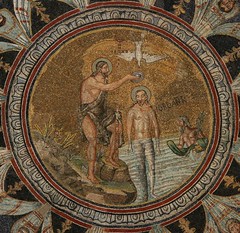 Image by Sacred Destinations via Flickr
St Theophan's work, to take another quick example, is noteworthy for his incorporation into an Orthodox spiritual context of the decidedly Counter-Reformation theme from Catholic spirituality of the dark night of the soul/spirit (San Juan de la Cruz).
![Reblog this post [with Zemanta]](http://img.zemanta.com/reblog_b.png?x-id=55540ba4-ecd8-4873-a3c7-b9a8c11d1713)
Saturday, July 12, 2008
The Gospel, Secularism and the American Experiment-part II
In For the Life of the World Even Schmemann argues that when looked from the point of view phenomenology of religion (Religionswissenschaft), the world is sacramental in character—a means not simply of knowledge about God, but the place of a real encounter with God. For Schmemann, as for the Fathers and the Scriptures, the world points beyond itself to God Who is both the Creator and Goal of creation (including human beings). For this reason, even understood broadly, worship, to the degree that it is true worship, reveals to us God, creation and humanity. The key here is the adjective true in true worship. It is not simply any worship, but only worship that is—whatever its other differences—in fundamental agreement with Christian worship's "the intuition and experience of the world as an 'epiphany' of God." (p. 120) And so, a few pages later he writes: "It is indeed extremely important for us to remember that the uniqueness, the newness of Christian worship is not that it has no continuity with worship 'in general,' . . . but that in Christ this very continuity is fulfilled, receives its ultimate and truly new significance so as to truly bring all 'natural' worship to an end." (p. 122) There is then for Schmemann (as there is for the Fathers and the Scriptures) a notion of "natural law." Not a natural law that is divorced from faith—a law known by naked reason divorced from faith—but one which can nevertheless be grasped (to return to Murray) by "the careful inquires" those men and women who, even if they are not Christians, are people of good will and who live lives that are "wise and honest." (p. 118) The argument that Schmemann makes against secularism is very much a "natural law" argument. Secularism, to repeat what I quoted in the previous post, "emphatically negates . . . the sacramentality" of humanity and the world and substitutes in place of the givenness of a sacramentality world, a view of the Christian worship that sees worship as an expression of human desire/need and as such subject to human manipulation. Returning to the question of government, as part of the creation, there is a sacramental character to the human person. The tripartite character of the American experiment, "a free people under a limited government, guided by law and ultimately under the sovereignty of God," is I think a humble acknowledgement of the sacramentality of the human person. This is not to suggest that democracy is the only form of government that respects the inherent dignity of the human. Indeed, it is not to suggest that democracy in general, or American democracy in particular, does so flawlessly. Returning to Murray: " The American Proposition ["that all men are created equal and endowed by their Creator with certain unalienable rights"] is at once doctrinal and practical, a theorem and a problem. It is an affirmation and also an intention. It presents itself as a coherent structure of thought that lays claim to intellectual assent; it also present itself as an organized political project that aims at historical success. Our Fathers asserted it and most ably argued it; they also undertook to "work it out," and they signally succeeded." (p. xi) That being said, Murray reminds us that the practical, "historical success" of the tripartite character of the American experiment "is never to be taken for granted, nor can it come to some absolute term; and any given measure of success demands enlargement of penalty of instant decline." (p. xi) Giving Orthodox critics here and abroad their due, does America seems to be flirting with the penalty of instant decline. American failure does not invalidate the truthfulness of the tripartite anthropology at the heart of the American experiment. I would go further. There is a fundamental computability ("continuity" to use Schmemman's term) between Orthodox theological anthropology and American political anthropology. I would argue that it is the vocation of Orthodox Christians in America to articulate a critical and appreciative response to American political anthropology. Part of this means developing practically a style of Church governance and pastoral care that reflects the providential convergence of our theological vision of the person and the American experiment. For example, I trust people to live their lives. I trust the people in my parish live their lives and administer the parish with minimal interference or direction from me. In the absence of evidence to the contrary, or their invitation, I trust people not only in "in fear and trembling" but also mutual love, respect and affection, to meet the demands made on them by of their vocations. Unless there is some compelling reason—a clear indication that someone has rejected the sovereignty of God or they ask me a question—I stay out of their lives. The genius of the American experiment is practical. its offers us a balanced, humble vision for the use of authority. Yes, in its inception, that vision of authority's use was political; it just as applicable to the exercise of pastoral and administrative authority in the Church. The question is not monarchy or democracy, but between the humble service and protection of human freedom and dignity, on the one hand, or the exploitation and degradation of the human on the other. As a theoretical matter, I can imagine a king or tsar defending the inherent dignity of all people, even as I can imagine a democracy, a priest, a bishop or a parish council failing to do so. In all cases it seems to me the key is the theoretical, practical and joyful acceptance The question now becomes for me as an Orthodox Christian, am I willing to take up the challenge laid at my feet by the American experiment? In Christ, +Fr Gregory
the freedom of all men and women. Further this must be embodied by the willingness on those in authority to exercise self-restraint in the authority of their office and to submit themselves to the demands of natural law.
Friday, July 11, 2008
The Gospel, Secularism and the American Experiment-part I
So, based on the number and quality of the comments, it seems that there is great interest (here at least) in the social teaching of the Church. Thank you all for your comments and observations. I find them very helpful in clarifying my own thinking on the issue we are addressing. Let me offer some reflections A common thread in most discussion about the relationship between church and state is the tacit--and at times not so tacit--assumption that the American experiment is a secular, anti-religious, and even anti-Christian movement. While certainly this was, and in many ways still is, the case in the French system of government it is not the case in America. Yes, there is a strong strain of secularism in American culture—but an argument could be made that this represents a deviation from the founding principles. No, America was not founded on the Gospel—and certainly we are not an "Orthodox" nation—but strictly speak no government is, or for that matter needs to be so founded. Nations are called Orthodox or Christian only by analogy or as a reflection of an openness to the Gospel or (most crudely) because of the majority (or at least a plurality) of its citizens are Christian of one sort or another. For Orthodox, the idea of America and American culture as secular (in a pejorative sense), that it is anti-Christian and harmful to our Christian faith, is something popularized but Fr Alexander Schmemann. He argues, quite eloquently and convincingly, that secularism "is above all a negation of worship. I stress: --not of God's existence, not of some kind of transcendence and therefore some kind of religion. If secularism in theological terms in a heresy, it is primarily a heresy about man. It is a negation of man as a worshiping being, as homo adorans: the one for whom worship is the essential act which both 'posits' his humanity and fulfills it. It is the rejection as ontologically and epistemologically 'decisive,' of the words which 'always, everywhere and for all' were the true 'epiphany' of man's relation to God, to the world and to himself." (For the Life of the World, p. 118) For Schmemann, secularism an anthropological heresy (remembering that heresy always implies a choice). At its core it denies that the worship of the Triune God is the act that both reveals and fulfills human nature (i.e., worship is both an act of ontological & epistemological self-revelation and self-realization). Further, it is a rejection of the idea that worship is the privileged means (again both ontological and epistemological) by which the communion of God, creation and humanity are realized. Implicit within this view of secularism is a rejection of the position of those, "quite numerous today, who consciously or unconsciously reduce Christianity to either intellectual ('future of belief') or socio-ethical ('Christian service to the world') categories and who therefore think it must be possible to find not only some kind of accommodation, but even a deeper harmony between our 'secular age' on the one hand and worship in the other hand." (pp. 118-119) While his description of secularism is insightful, as often happens with his work, his use of the concept as a lens through which to see American culture is heavy handed. Yes, secularism is a central theme in American culture but, as the work of Fr John Courtney Murray, We Hold These Truths: Catholic Reflections on the American Proposition, suggests secularism as Schmemann uses the term is not an inherent part of that ensemble of founding truths that "command the structure and the courses of the political-economic system of the United State." (p. 106) Commenting on Murray's work in the forward to We Hold These Truths, Walter J Burghardt, S.J., writes that "Reduced to its skeleton," the American model affirms as foundational the importance of "a free people under a limited government, guided by law and ultimately under the sovereignty of God." (pp. vii-viii) If, as Schmemann and Murray each in his own way suggests, we have become fragmented as a society, it is because (as Murray points out) it is because we have lost that founding consensus. So, to take but one example, "the American university [has] long since bade a quiet goodbye to the whole notion of an American consensus, as implying that there are truths that we hold in common, and a natural law that makes known to all of us the structure of the moral universe in such wise that all of us are bound by it to a common obedience." (p. 40) In this, I fear, many Orthodox Christian—having read, but misunderstood—not only Schmemann's criticisms of America, but also the Father and indeed the Scriptures themselves, argue rather on the side of disintegration. What do I mean? I will in my next post, return to Schmemann's For the Life of the World to answer the question I've just posed.

Tuesday, July 08, 2008
The Benefits of a Familial/Cultural Basis of Faith
As I argued in an earlier post, we need to exercise caution in our interpretation and application of the statistical findings of the Pew Charitable Trust, The U.S. Religious Landscape Survey. What the findings suggest to me is that for many, and indeed most, the locus of one's identity as an Orthodox Christian is found more in family and culture than in one's participation in the liturgical life of the Church. This is not, I hesitant to add, to invalidate, much less reject, a familial/cultural rather than a liturgical basis and expression of the faith. To do so is not only to go beyond the empirical evidence, it also I think fails to appreciate the unique strengths of a familial/cultural basis and expression of the faith. It also fails to recognize the weaknesses inherent in a more liturgically based and expressed faith. Finally, it causes us to overlook the paradox that often what we assume is a liturgical faith is markedly individualistic in nature contrary to what those who stress the primacy of liturgy would have us believe, and what in fact they believe about their own praxis. In this post, however, I will focus primarily on the strengths and weakness of a familial/cultural basis and expression of faith.
Reflecting on his own initial experience of the uniquely American approach to Christianity that the PCT suggests is now very much the approach of American Orthodox Christians, Berger writes "I encountered this world of the mainline almost immediately upon coming to America not long after World War II. I was young, very poor, European and Lutheran, and wartime desperations had shaped my social and religious sensibilities. America constituted an immense liberation from all this, a deeply satisfying experience of normality. The Protestant world I met fully represented the same normality. It was thoroughly identified with American culture, sensible, tolerant, far removed from the Kierkegaardian extremism that had up to then defined Christianity for me." But for all his relief, nevertheless, he concludes, "It is hardly surprising that I had difficulties coming to terms with it."
For Americans—and this includes Orthodox Christians—their religious life is characterized by pragmaticism and tolerance on the one hand, and a suspicion of extremisms of any sort. So we see in the survey that as with the majority of Americans (68%) the majority of Orthodox Christians (68%) would say that there is MORE than one true way to interpret the teachings of the Orthodox faith. Likewise, and again like most Americans (70%), the majority of Orthodox Christians (72%) believe that many religions, and not just the Orthodox faith, can lead to eternal life. For all that Orthodox Christian argue among ourselves about the Americanization of the Church, statistically it would seem that this has already happened. In our beliefs and practices, Orthodox Christians are as American as any other religious group.
Adaption to American culture has not only been in the general adoption of tolerance for other religions. Educationally and economically, Orthodoxy has also done quite well in America. For example, the Orthodox Church is a young church in terms of the age of faithful. The majority of the Church (54%) is under 50 (17% are between 18-29 years old, 38% are between 30-49, 27% are between 50-64 and 17% are over 65 years old). Educational, most of the Orthodox Church have gone to college (Some college: 28%; College graduate: 18%; Post-graduate: 18%). In fact on average. Orthodox Christians graduate college and go on to post-graduate education in greater numbers than most of those surveyed (Some college: 23%; College graduate: 16%; Post-graduate: 11% ). Unsurprisingly given our relative educational accomplishments, we do as well, if not better economically than most of those surveyed:
Income Distribution
| ||
Orthodox Christian
| National Average
| |
Less than $30,000
| 20%
| 31%
|
$30,000-$49,999
| 24%
| 22%
|
$50,000-$74,999
| 16%
| 17%
|
$75,000-$99,000
| 13%
| 13%
|
100,000+
| 28%
| 18%
|
By a number of measures, the Orthodox Church has successfully adapted to the American context. In large part, I would suggest, that success reflects the familial/cultural basis and expression of the faith. That said it is important to remember that successful adaption is always only relative. Adaption is never absolute and so Orthodox success in an American context means that—as with mainline Protestants—this success carries with it risks as well as rewards.
Again Berger: "America, despite its many faults, has been a remarkable moral experiment in human history; but America is not and never can be the kingdom of God. In other words, the key issue here is the transcendence of Christian faith: the kingdom of God is not of this world, and any attempt to make it so undermines the very foundation of the gospel." He continues:
What has changed is not the symbiotic church-society relationship of mainline Protestantism; rather, what has changed is the character of the society, more specifically of the middle-class society and culture that is the natural habitat of the Protestant churches. This change is, more or less accurately, formulated by the so-called New Class hypothesis. In America (and, incidentally, in all other advanced capitalist societies) the middle class has split. Whereas previously there was one (though internally stratified) middle class, there now are two middle classes (also internally stratified). There is the old middle class, the traditional bourgeoisie, centered in the business community and the old professions. But there is also a new middle class, based on the production and distribution of symbolic knowledge, whose members are the increasingly large number of people occupied with education, the media of mass communication; therapy in all its forms, the advocacy and administration of well-being, social justice and personal lifestyles. Many of these people are on the public payroll, employed in all the bureaucracies of the modern welfare, redistributive and regulatory state; many others, while working in private-sector institutions, are heavily dependent on state subsidies. This new middle class, inevitably, has strong, vested interests; equally inevitably, it has developed its own subculture. In. other words, as is the case with every rising class (Marx has taught this well), what is at work here is a combination of class interest and class culture.

Thursday, June 26, 2008
Lies, Damn Lies, and Statistics
Mark Twain in "Chapters from My Autobiography," popularized the saying that serves as the title for this post: "Figures often beguile me particularly when I have the arranging of them myself; in which case the remark attributed to Disraeli would often apply with justice and force: 'There are three kinds of lies: lies, damned lies, and statistics.'" Twain's comments come to my mind as I thought about the recent report on religious observance in America published by the Pew Charitable Trust, The U.S. Religious Landscape Survey. Let me first say that I think that statistical studies can be of great value in helping researchers see patterns in human behavior, for example, that are not immediately apparent. As with ever tool, however, statistical research can only do what it can do. One of the limitations of something like the recent Pew Charitable Trust survey (PCTS) is that while it allows us to compare different religious groups in some areas (specifically behavioral), it does a rather spotty job in helping us understand the thinking that may, or may not, underlie and motivate that behavior. So, for example, according to the PCTS roughly one third (34%) of Orthodox Christians report attend church on an at least weekly basis. Looking at the survey this is less than the national average of all religions (39%) and indeed less than Evangelical Christians (58%), members of historic black churches (59%), Catholics (42%), Jehovah Witnesses (82%) and Mormons (75%). At least in terms of weekly church attendance Orthodox Christians are on a par with mainline Protestants (also 34%). The only people less active on a weekly basis in their religious tradition are "Other Christians" (27%), Jews (16%), Buddhist (17%), Hindus (24%), Other Faiths (14%) and the religious unaffiliated (5%). To understand what these statistics mean for the pastoral life of the Orthodox Church we would need to know whether or not Orthodox weekly participation in services has increased or decreased over long term. Given the similarity between Orthodox Christian and Mainline Protestant attendance, I would suspect that our attendance rates have in fact gone done as they have for most Mainline Protestant communities. Even with historical information we would next have to ask why Orthodox Christians participate at the levels that they do. The survey question that sought to determine the importance of religion in a person's life tells us that 87% of Orthodox Christians surveyed report that religion (and here I am assuming this means the Orthodox faith) is very important (56%) or somewhat important (31%) in their lives. There first thing that should be apparent is the huge gap between the percentage of Orthodox Christians who say that their faith is important to them (87%) and the number of Orthodox Christians who attend Liturgy on at least a weekly basis (34%). Whatever else their faith might mean to them, it does not necessarily embrace the regular participation in the liturgical life of the Church. Based on my own pastoral experience (which until fairly recently was primarily within the Greek Orthodox Archdiocese of America) I would be hesitant to conclude that for most, or even many, Orthodox Christians religion is a private or individual matter. Rather I would wonder if the locus of religious life rather than being the Church's liturgical worship is not rather the nuclear and extended families and culture. In such a social context, a context I hasten to add the PCTS does not explore, religious commitment is less a matter of What I Do and more Who We Are. My own pastoral experience seems to bear this out. Based on my admittedly more limited experience with non-Greek Orthodox Christians as well as my conversations with Orthodox and Byzantine Catholic clergy and faithful, what I would term a familial/cultural orientation is more common in Eastern Christianity than among most Evangelical Christians. The work of sociologist Peter Berger offers us some insight here to what this data might mean for the pastoral life of the Orthodox Church. Berger argues that society—be it a religious society such as the Church, or a secular society, such as US culture, is both an objective and a subjective reality. Together with Brigitte Berger and Hansfried Kellner The Homeless Mind, Berger is interested in the explication of "the relationships between certain institutional processes . . . and certain constellations of consciousness" (p. 97). To accomplish this task they introduce two constructs, package and carrier. A "package" is a specific mode of consciousness. For example, "it is probably safe to assume that people working on complicated machinery in a factory should not go into trances." Consequently, training people to work in a factory demands that one cultivate in them "an anti-trance attitude [while] on the job." To do this, one must structure the work situation so that not going into a trance is both possible and desirable. For this to happen one needs a very specific "carrier," of consciousness; carriers lend credibility to various "packages" of consciousness. "Put differently, any kind of consciousness is plausible only in particular social circumstances." (pp. 16, 17) Looked at in terms of packages and carriers, I would suggest that, at least in America, many Orthodox Christians are more similar to mainline Protestants than Evangelical Christians in their approach to religion. It is not liturgy, and the participation in liturgy, that lends credibility to one's identity or self-awareness as an Orthodox Christian. Rather, for many, indeed most, it is family and culture that lends credibility to one's identity as an Orthodox Christian. In my next few posts I want to draw out more fully the implications of family and culture rather than liturgy as the carrier of a person's self-image as an Orthodox Christian. In Christ, +Fr Gregory

Subscribe to:
Comment Feed (RSS)


