Ah well, at least it is something.
In Christ,
+Fr Gregory

My blog is worth $3,951.78.
How much is your blog worth?


Ah well, at least it is something.
In Christ,
+Fr Gregory
My blog is worth $3,951.78.
How much is your blog worth?
Friday and Saturday of last week I went to the Called & Gifted Workshop at St Rose of Lima Catholic Church in Perrysburg, OH. With the workshop very much in mind, I in the sermon on Sunday morning, I sketched out some of the themes that caught my attention. Since I have a good relationship with the people at St Nicholas Greek Orthodox Cathedral in Pittsburgh (where I served yesterday), I was interested to see how, okay, if, anyone would respond to the sermon.
Providentially the readings for the day (Galatians 2:16-20 and Mark 8:34-38; 9:1) were in line with the theme I developed: That God has called us all to be saints. Our becoming saints is dependent upon two graces (and here I borrow shamelessly from the Called & Gifted Workshop). First, there is the grace we receive in baptism that liberates us from the tyranny of the devil. Second, and along with the grace of redemption, God has given us gifts so that we can share in Christ's redemption of our neighbor. It is in and through our fidelity not only to the redemptive grace of baptism, but also the unique gifts given to us for the salvation of the world, that we grow in holiness. In other words, saints are Christians who are faithful to their unique calling from God.
After Liturgy I spoke with a half a dozen people who were genuinely excited about the vision I laid out in the sermon (hopefully they will follow up with an email to the Catherine of Siena Institute about participating themselves in a Called & Gifted workshop).
On the drive home I had a chance to think some about some of the pastoral implications of basing parish work in the charism that God pours out in our lives. At first blush I can imagine a parish priest taking umbrage at this suggestions since, not unreasonably, it might be inferred that this is NOT happening in our parishes. While not an unreason conclusion, this is not what I am implying--or at least not what I am implying without qualifications.
What often happens is that while we are more than willing to make use of the gifts people bring to the parish, it is not the gifts that drive our interest. If it were then we would commit ourselves to the disinterested work of helping people develop these gifts.
Instead we typically see a person's gifts in light of a "to do" list of tasks that the priest or the parish council or the "pillars of the community" see as important. More often then not these tasks are not only important, but essential to the life of the community. But when these tasks become the lens through which we see ourselves, our community and the people God brings to us, we try and fit people into pre-deterimined slots. Again, these "slots" more often then not represent real needs in the community--and that is the problem.
Our to do list very easily lends itself to becoming a "temptation of the right hand." As we grow in the spiritual life we discover with evermore clarity that the real source of temptation is our attract to lesser goods at the expense of greater goods. All too easily I can allow the real needs of the parish to be both the baseline and goal of parish ministry.
When this happens ministry, for all the evident success, remains external. Relative to what it could be at least, ministry remains superficial and does not result in the transformation of the person or the community. A task oriented approach tends to overlook the new opportunities that God is bring us in and through the gifts He has granted to members of the community. Since God's gifts to you, don't fit my pastoral agenda for the community, I simply don't notice what God is doing in your life (and by implication in mine).
Worse still, I may very well notice what God has given you to do and I actively try and marginalize, or even prevent, that work. I am tempted to do this because that work disrupts my plans for the parish. In any gathering of clergy it is not unknown to hear at least one or two priests praise someone's zeal and gifts and then in the very next breath let out a long heartfelt sigh and wish: "If only he wasn't so insistent."
Let me suggest another approach.
First we ought not to deny that there are tasks that need to be done for the parish to survive, much less grow. But rather then letting these tasks set the agenda, what if we were to ask this: "Looking at the gifts God has given us in one another, what ought we to be about?" The real resources of the parish are the gifts God has given each of us and the ministries those gifts make possible.
For example, after Liturgy yesterday I spoke to an attorney who is often asked to serve on parish council. This is hardly unreasonable, especially from a task oriented approach to parish life. But her real gift and joy is teaching church school. Here's this VERY successful attorney who is willing to serve on parish council, but who loves teaching preschool kids.
Looking simply at tasks and skill sets brings about a situation in which we ask someone to do something which they are competent in, but which brings them no real joy. And the real joy that they could have (and remember like despair, joy is infectious) is left unrealized.
By looking at tasks and skill sets not only does the community lose a joyful church school teacher, but there is yet another joyless person on parish council. Not only that, by not asking what are the gifts that God has give people, we fail to see in our midst the man or woman for whom serving on the parish would really be a joyful experience.
In my experience at least, nothing breeds resentment in a community like stifling the possibility of joyful participation and service. But in the gifts He has given each of us, God has already planted the seeds of joy in His parish. Our task, as clergy and laity, is to recognize and nurture those gifts so that joy might abound.
So I am not misunderstood let me say it again. Yes, there are tasks that must be done in the parish, the diocese, and for that matter the family, on the job, and in our personal lives. We have to work, we must be productive and effective in what we do.
But productivity and efficiency are not ends in themselves. God has brought us men and women who can be joyfully productive and efficient in the fulfilling of the tasks necessary for the life of the community. But to discover these people requires that we focus not on our own very narrow list of "jobs to be done," but rather "on the gifts God has given us" in the lives of the members of the parish.
One of the great challenges of being a sinner is that we, I, tend to want to live on the surface. I like living on the surface--I want to live according to the short list of the objectively good things I subjectively call good. This what I think the desert fathers were critical of in their condemnation of living by the senses, or being sensual, or living a life of comfort and pleasure.
I cannot, not make use of my senses, and remember Jesus restored sight to the blind. Nor can I not enjoy the good things that God has given me, since to fail to enjoy them means that I fail to see their goodness and beauty.
But what I can do, and should do, is not allow my life to be driven by the senses or pleasure. Or, to return to our theme, I can resist the temptation to live according to my own agenda as mine and instead follow God as He leads me through the people He brings into my life.
For the parish this means letting go of a task oriented approach to the life of the community and being obedient to God through the gifts He has given us.
One of the presenters at the Called & Gifted workshop, Fr Mike, O.P., writes this morning Intentional Disciples a few words in support of zealotry that are applicable here:
I wonder if the most Orthodox parishes, if most Orthodox Christians, can find in themselves the courage, the faith, hope, and love, needed to be as Fr Mike writes, passionate and unencumbered disciples of Jesus Christ.
We can't be zealous in following Christ simply because he can help us lead a fulfilling life, or because he can help free us from attachments that screw up our priorities and make us addicted. We can be filled with zeal in following him only if we believe he is truly God incarnate, the sole Way, Truth and Life. While that zeal and full commitment might be preached differently in different cultures (and inculturation is a key point among many theologians working in non-Western cultures), the starting point is always Jesus, and not the culture [or my short list of what I think the parish needs].
I would propose that it might well be the postmodern West that will be the most opposed to the kind of zeal called for in the Scriptures, and the western consumer-oriented culture in which it might be the most difficult in which to be a passionate - and unencumbered - disciple of Jesus.
The poor, meek, sorrowful, persecuted for the sake of Jesus are blessed precisely because they are not attached to things, status, and good feelings, but are attached to Jesus, for whom they willingly suffer persecution. This is a kind of zeal that is seldom found within Catholic [or Orthodox] Christianity these days. We reserve such singlemindedness to the saints.But what if we no longer reserved singlemindness to the saints--or, and this is betterm what if we ourselves worked to become such singleminded saints?
Catholics formally gift holy relics to Orthodox church

The following is a guest post from, Chrys, one of the more frequent commentators on this blog. Chrys sent me the original privately a while ago and I encouraged him to allow me to post it here--he has finally agreed!
You may or may not agree with everything that he says, though I happen to be fundamental agreement with his analysis. As always, I would welcome your comments and/or observations. Also if anyone would like to offer a guest post, I would be edger to consider what you have to say for inclusion here.
In Christ,
+Fr Gregory
One of this year’s Greek Orthodox Sunday School themes is “Saving the Earth.”
It is important to recognize that stewardship is a critical element of our discipleship. In fact, I would suggest that “gardening” is actually a central motif in the Bible, emblematic of our calling to serve God in the cultivation of and care for the earth. (Indeed, it may be for this reason that Jesus is mistaken for the gardener after His resurrection.)
Even so, the focus is egregiously misplaced. I would argue that – especially for children – it is more important to focus on those basic resources that they MUST always use (their time, energies and bodies) rather than those that they can not yet (and may never directly) use – “the earth’s resources.”
Worse, by reducing stewardship to "saving the earth" – especially in this political climate and for those who can have little to do with the actual use of it – the Church ignores the foundational components of true stewardship in the service of what strikes me as little more than propaganda.
This strikes a particularly sore point with me. It appears to be the case of the Church once again abandoning its critical role in the transfiguration of the Universe (!) for the sake of a misbegotten, self-congratulatory and all-too-passing trend. Misplaced priorities are to expected from the confused, the insecure and the foolish -- but not from the Church, which has been given a truly cosmic role to play.
Beyond the abandonment of the ultimate for the transitory, the clergy commit other errors. This is inevitable whenever anyone speaks outside of their area of expertise – a folly apparently not reserved to
Worse by far are the economic admonishments. While most of our understanding of the environment may not exceed popular assumptions, ignorance of simple economics is difficult to excuse. Take, for instance, the oft-repeated belief that
If our enlightened anointed would even briefly review history, they would discover that free exchange within a reasonably well-regulated market has produced a boon to mankind - quite apart from the intentions of the participants. (This, by the way, is the real meaning of Adam Smith's "invisible hand.") It was Ford who made transportation available to the masses – which allowed city streets to be rid of the stench and filth left by that other popular form of transportation: horses. It was Rockefeller and what became Standard Oil that made cheap oil available so the poor could affordably heat their homes. Not only did this prevent the poor from freezing, but it also saved the whales from extinction since it was their oil that had been the primary source of heat prior to kerosene. It was
Consider our tribal ancestors. As P.J. O’Rourke noted, the basket maker could not kill his meat very well with his baskets. The spear maker could not carry his meat well with his spears. When each is free to exchange what he has for something he values more, ALL are made richer, made more productive and are thus better able to meet his families' needs. It is not a zero-sum game. By rewarding those who offer the greatest value to their neighbors – that is, by blessing their neighbors in the way the neighbors actually need and want, all are blessed. In this way the market actually creates wealth. By structuring the world in such a way that man can bless himself and his family only by blessing his neighbor, God has devised the perfect system to teach even those with dim moral lights how they should behave. Adam Smith saw this in 1776. Incredibly enough, most of our “educated” leaders remain blind to it still.
Indeed, our moral betters would tell us that this is not so because it is not perfectly so. (The requirement of perfection is a curious standard since perfection can be found nowhere; it does, however, permit the user to universally "justify" his intervention.) They tell us that it is they who care more for the earth and its limited resources. Self-regard aside, what have they actually done? Do they, in fact, care more? I would argue that they have confused intentions with effects. In its ultimate form, the result is self-flattery bordering on delusion.
For example, who REALLY cares more about the state of the world’s forests - the academics or the paper mills? If all the trees are destroyed, the mills are out of work. Not surprisingly the Paper Companies pour millions into the cultivation and maintenance of the forests. By focus and practice, they are the real experts. Do they have an agenda? Certainly: the perpetual profitability of their business. Does the "disinterested" academic have agenda? Certainly: the identification of a need or crisis or novel understanding upon which to justify and built his career. The academic, who has no "skin in the game," may be completely wrong, but his career will be over and done before the damage is felt. The company, on the other hand, is designed to exist beyond that and must live with the consequences. The livelihoods of all involved in the company depend upon a healthy outcome.
We see this everyday on the “street” level. The neighborhoods that are well cared for are privately owned. If you want to see wanton destruction of property, visit a government housing project or a college dorm. If one receives no meaningful value from the improvement of a thing or incurs no meaningful cost to maintain it, there is little incentive to expend the energy needed to be "care-full" with it. Thomas Merton pointed to the monastery bicycle as the perfect example of “un-invested” neglect.
Yet enlightened elite flatter themselves for their good intentions while judging harshly others whose motives may not match their own. Experience exposes the emptiness of this posture. Whenever people become sufficiently concerned about their environment that they are willing to actually pay for it, there are myriad enterprises willing and able to use their ingenuity to create solutions – whether that involves “green” buildings, fuel-efficient planes (Boeing), reclaiming a strip mine or simply reclaiming a front lawn. Creative, entrepreneurial energies do far, far more to provide real, meaningful solutions than the best intentions of the next “live aid” concert with its massive carbon footprint.
On a purely practical level, then, I am irritated by clergy who major in motives but ignore effects. (Somehow I do not think this would pass muster when it comes time to raise money to pay the Church’s bills.) I am troubled by clergy who focus on matters for which they are ill-equipped. But the offense that is especially egregious arises when these same clergy abandon their great gift and high calling to grasp at momentary "relevance." For IF I am a Christian pastor, then I should know that the REAL cause of global destruction is not a particular market, economic system or cultural phenomenon. I should know that the REAL solution is not a series of “green” behaviors. As simply a “mere” Christian, I should know that the REAL cause of environmental distress is . . . sin. If I claim any theological insight into life at all, I should understand that the "root cause" of these recurring concerns (whatever the form of the crisis “du jour”) is really sin. It astounds me that those who would claim the right to lead the faithful could be unaware of this – all the more so since it takes real effort to miss (or avoid) what Scripture clearly says:
"For the creation was subjected to futility—not willingly, but because of Him who subjected it—in the hope that the creation itself will also be set free from the bondage of corruption into the glorious freedom of God's children. For we know that the whole creation has been groaning together with labor pains until now. And not only that, but we ourselves who have the Spirit as the first fruits —we also groan within ourselves, eagerly waiting for adoption, the redemption of our bodies." (Romans 8:20-23)
Had they taken their calling as Christians more seriously, our "leaders" would see that the real cause of the “corruption” of the earth lies in sin and the real solution depends upon holiness – which is, in fact, (or so I am told) within their proper area of expertise!
If only more Christians – especially clergy – would simply be more “Christian” in their analysis of issues of the moment. By stooping to popular political agendas (for which they are very poorly qualified), by trying to be “relevant,” they trade their glorious inheritance for a mess of pottage. Since, as Oscar Wilde put it, they “can resist everything except temptation,” it appears that my children may learn how to "save the earth" but not themselves. I would rather that they learn how to save themselves and then, as St. Seraphim said, thousands around them will be saved. Indeed, the cosmos will be saved if St. Maximos is correct. Presumably this includes the earth.
Some Greek Orthodox links on the environment:
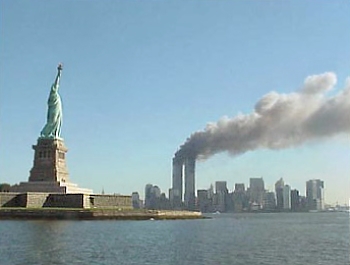 On September 11, 2001 my wife and I were living in Redding, CA.
That morning as I was getting ready to start my day, my phone rang and one of my parishioners, Chris Pearson, was on the other end. He told me to turn on the news because a plane had just crashed into the Twin Towers. I turned on the t.v. just in time to see the second plane crash.
I had a psychology class to teach that Thursday morning so, after calling my wife who was at a conference in San Diego to make sure she was alright (because all air travel was canceled, she would have to stay there for several days), I went off to the college.
As I recall, people were understandably upset, angry and confused. Mostly though folks were scared. The president of the college canceled classes for the day but asked the faculty to go to our classrooms and lecture halls to be there for the students.
Like the faculty and staff, many of my students were upset--some scared. But mostly they were angry. A number of students had seen early news reports from the Middle East. In the video they saw people dancing in the streets and firing guns into the air to celebrate the attack on the U.S.
At this point it wasn't clear who had launched the attack--the reports of the attack on the Pentagon and the crash of Flight 93 were just coming in--but some of the students (correctly it turned out) blamed Islamic terrorists. For my own part, I urged caution in the lack of evidence and reminded the students that the Oklahoma bombing had been perpetrated by an American.
In all my years of teaching this was the first, and only, time students dropped my class after the first week. I lost a fair number of students that week.
After class I again called my wife in San Diego to see how she was doing. While scared, she and her colleagues were safe (for those who aren't aware, San Diego has a number of military bases that might very well have been targets had this been the start of a conventional war).
Over the next few hours and days, I kept a lonely vigil in my church. I said Trisagion services for those who lost their lives in the attacks and asked God to bring peace.
While the events of that day were horrible, we later learned that they were less horrible then we all initially feared.
Again and again on that day people asked me what I thought about what we were hearing on the news. And every time I said the same thing, I have no frame of reference for this many deaths (the early reports put the death toll at over 5,000) killed in this way.
It happened that on 9/11 I was in the process of writing an essay for the local newspaper the following week (though it ended up not appearing until October 6th). Looking back on what I wrote, I am less then impressed with my attempts at being even handed, it feels now to me like well-intentioned, but nevertheless an inappropriate example of moral equivalence.
Mechanically, the essay is also unimpressive; my syntax isn't very good, my analysis and argument are weak. I'm not really sure what, if anything, was the point I was trying to make beyond the fact that now that war had come to us we need to pursue justice, but avoid revenge. How that was to be done is totally absent from the piece.
My essay ended in this way:
I think that war in some form or another is now tragically unavoidable. As is best in our character as Americans, we have chosen not to allow the forces of chaos, violence and terror to prevail. To combat evil we have chosen to place ourselves between the terrorists and their future victims. We ought not to debase the sacrifice that many of us will make with warmongering cries for a justice untempered with mercy. If we wish to be a Christian nation, "let us seek peace and pursue it" (Psalm 34:14); let us temper our desire for justice with mercy, "For judgment is without mercy to the one who has shown no mercy. Mercy triumphs over judgment" (James 2:13); and let us find it within ourselves to forgive our enemies, as Christ forgave us even as we crucified him (see Luke 23:34).
With malice toward none, with charity for all, with firmness in the right as God gives us to see the right, let us strive on to finish the work we are in, to bind up the nation's wounds, to care for him who shall have borne the battle and for his widow and his orphan, to do all which may achieve and cherish a just and lasting peace among ourselves and with all nations.

How hard and painful does this appear! The Lord has required that "whoever will come after him must deny himself." But what He commands is neither hard nor painful when He Himself helps us in such a way so that the very thing He requires may be accomplished. . . . For whatever seems hard in what is enjoined, love makes easy.Not just to modern ears do Augustine's words sound odd. How can it be easy to bear our cross--after all if it is easy it can't be a cross, right?
This precept by which we are enjoined to lose our life does not mean a person should kill himself, which would be an unforgivable crime, but it does mean that one should kill that in oneself which is unduly attached to the earthly, which makes one take inordinate pleasure in this present life to the neglect of the life to come. This is the meaning of "shall hate this life" and "shall lose it." Embedded in the same admonition he speaks openly of the profit of gaining one's life when He says: "He that loses his life in this world shall find it unto eternal life.Augustine writes this well before the Reformation, much less the Puritan movement or stereotypical sober Calvinists, or Janesists, or phlegmatic 19th century monastic obsessed Russians (I mention these simply to be fair). From very early on, Christians have been tempted to avoid following Jesus Christ.
This morning I served Orthros & Liturgy at St Nicholas Greek Orthodox Cathedral in Pittsburgh, PA. I have a rather soft spot in my heart for the Cathedral community--I was ordained to the holy priesthood there on their feast day (St Nicholas, 6 December) in, well, let's just say awhile ago and the dean (Fr Sarantos Serviou) community has always been very welcoming to both my wife Mary and I. In addition for the 18 months before we left Pittsburgh, St Nicholas was also the home of the OCF group I served as chaplain. The students and I would meet on Wednesday morning at 7am for Divine Liturgy and Thursday evenings at 7.30pm for Vespers and Bible study. During Great Lent, since we don't celebrate the Divine Liturgy on weekdays, the students would come on Friday mornings (again at 7.00am!!) for Liturgy of the Pre-Sanctified Gifts (Vesper and Holy Communion).
So all in all, St Nicholas Cathedral has played a significant role in my ministry as an Orthodox priest and i am looking forward to spending the next few weeks with them while Fr Serviou is on vacation in Greece.
As I was driving in to Pittsburgh this morning from Youngstown, I was listening America Public Media's radio program Speaking of Faith. The guest on this mornings program was Conservative rabbi Sharon Brous, who spoke about (according to the program's web site) "the world and meaning of the approaching Jewish High Holy Days — from the new year of Rosh Hashanah through Yom Kippur's rituals of atonement — a span of ten days known as the Days of Awe."
My guess is that Rabbi Brous and I would disagree on, oh any number of things. But what we would agree on was her profound insight that--amidst the "big story" of salvation history--we ought not lose sight of the many "little stories" that come in between the big, life changing events that we tend to remember.
So while it is import for Christian, in my own case, to remain always faithful to Christ, the quality of my fidelity is questionable if, for example, I can't treat the people I meet on a daily basis with respect and courtesy. This is precisely the point that the Apostle John makes in his epistle (1 Jn 4):
Beloved, let us love one another, for love is of God; and everyone who loves is born of God and knows God. He who does not love does not know God, for God is love. In this the love of God was manifested toward us, that God has sent His only begotten Son into the world, that we might live through Him. In this is love, not that we loved God, but that He loved us and sent His Son to be the propitiation for our sins. Beloved, if God so loved us, we also ought to love one another (7-11).To love as the Apostle suggests requires from us repentance. While there are many different forms that repentance can take, I suggest in the sermon a way to foster repentance in our hearts.
Who has conquered the devil? He who knows his own weaknesses, passions, and shortcomings. Whoever is afraid of knowing himself remains far from knowledge, and he doesn't love anything except seeing faults in others and judging them. He doesn't see gifts in other people, but only shortcomings. And he doesn't see his own shortcomings, but only his gifts. This is truly the sickness that plagues us . . . : we fail to recognize one another's gifts. One person may lack many things, but many people together have everything. What one person lacks, another person has. If we acknowledge this, we would have a great deal of humility, because God, Who adorned men in many ways (p. 50).With the Elder's words in mind, I suggested to people that, if they wished to be transformed by Christ, if they wished to be freed from the jealousy, anxiety and petty angers that often consume us, then the place to start is thanking God for the good things they see in the lives of others. This, I think, leads us naturally to loving other people as God loves them, and eventually wears down the hard outer shell that sin places around our hearts.
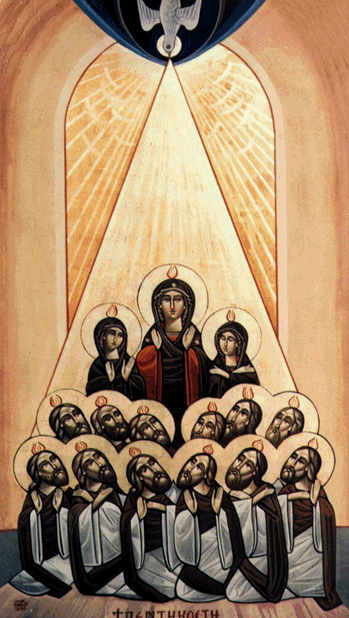
Next Friday & Saturday (14-15 September), together with my college roommate Fr Michael Butler and some of his parishioners for St Innocent Orthodox Church (OCA), I'll be attend the Called & Gifted Workshop at St Rose of Lima Catholic Church in Perrysburg, OH. What is this about you ask?
Well, let me let the folks at the Catherine of Siena Institute (who are actually leading the event) describe it for you:
I am intrigued by both the content of the workshop AND its potential application for the work of the Orthodox Church.
Every lay man and woman has been called by Christ (in his or her baptism) to a unique mission, and every lay man and woman has been gifted by the Holy Spirit in order to be able to answer that call. The Church calls these gifts of the Holy Spirit which Christians are given for the sake of others "charisms". Discerning our charisms is an important first step to discerning God's call. These gifts of the Holy Spirit are both clues as to the nature of the mission for which God is preparing us and tools with which to successfully carry out our mission. Those who take the Called & Gifted Workshop have a chance to take the Catholic Spiritual Gifts Inventory, the first gifts inventory designed especially for Catholics. They will also have the chance to begin discerning their charisms. At a Called & Gifted Workshop, you will learn:
* The role of every Catholic and of the local parish in the mission of the Church to the world.
* The critical role of charisms in the life and service of other lay Catholics and in the life of the parish or Christian community.
* The signs and characteristics of 24 common charisms.
* How discerning and using your charisms can change your life and the life of others, your parish, and the world.
Peter Leithart, a professor of theology and literature at New Saint Andrews College, the pastor of Trinity Reformed Church in Moscow, Idaho and a regular contributor to my favorite journal First Things makes on that publication's blog an interesting argument: For Christianity to again succeed in the West, we must help the culture rediscover its deep pagan roots.
He begins his essay by wondering if Christianity's very success hasn't been in a certain sense its own undoing. After all, he wonders, how can we hope to say anything of value about the sacrifice of Christ and our freedom of from the Law to contemporary men and women in Europe and North America "who have never worried about ritual contagion or the danger of contracting impurity from table companions? Does the Letter to the Hebrews resonate with people who have never seen a sacrifice, much less performed one? Can the New Testament speak to people who have lost all sympathy for primal religion?"
Looking further afield, he points out that in Africa, Christianity is growing fastest where the "primal religions" of Africa are most firmly rooted:
It's a truism among African theologians that the Church has grown most rapidly where traditional African religions are strongest. According to Ghanaian theologian Kwame Bediako, this is no accident but highlights the "special relationship" that African "primal religions" have with Christianity. Like primal African religion, Christianity displays a strong sense of human finitude and sin, believes in a spiritual world that interacts with the human world, teaches the reality of life after death, and cultivates the sacramental sense that physical objects are carriers of spiritual power. Christianity catches on there because it gives names to the realities they already know and experience.There is much Leihart says that we can learn from the experience of our brothers and sisters in the Southern Hemisphere. "If Christianity is most successful among traditional religions," he wonders along, "perhaps the Church has to reinvent primal religion before the West can be restored to Christ."
The work of René Girard provides a model. He demonstrates how Stalinist show trials, the Dreyfus affair, and the Shoah, the Armenian holocaust, the Gulag, and the Terror, all exhibit scapegoat mechanisms reminiscent of Oedipus Rex and the Scandinavian myth of Baldr. Because of the impact of Christianity, moderns can never quite put their hearts into scapegoating the way ancients did, but the vestiges of the ancient system show through. Girard has helped to move the concerns of Leviticus and the Letter to the Hebrews back to the center of theological and cultural discussion, and in so doing has unmasked the underlying primitivism of modernity.Beyond my intellectual interest, Leithart's argument resonants deeply with not only my pastoral experience in ever so post-modern northern California and the Pacific Northwest, but also in Orthodox parishes and with students on college campuses in western Pennsylvania.
Yesterday I mentioned that contemporary visions of the human person are typically drawn from the findings of the social, human and natural sciences. Sociology, psychology, as well as biology, genetics, neurology and physiology, are the contemporary anthropological touchstones. While I would certainly argue for the invaluable contribution of the empirical sciences to our understanding of what it means to be human, it is important that we avoid what Pope Benedict XVI has referred to as the tyranny of relativism that is often justified by appealing to empirical science.
The moral relativism that often accompanies empirical science is not intrinsic to its work. Relativism enters into the conversation when we assume the scientific method as a sufficient mean of knowing reality.
But empirical sciences works fundamentally by excluding those aspects of reality that do not lend themselves to quantification. In other words, scientists are concerned with reality insofar as it can be represented in numbers—scientists study those aspects of reality that can be measured.
In a rare sense we are all of us better off for the willingness of scientists to narrow their focus. By intentionally not looking at some aspects of reality in favor of concentrating on others, humanity has made extraordinary advances in almost all areas of life. Even the fact of this blog is the result of the methodological blindness of science. And speaking for myself, I certainly do not wish to return to premodern methods of farming or health care.
When we turn from natural phenomenon to the human person however, we discover that much of what is most distinctive and valuable about the human is precisely those aspects that cannot be measured and which cannot be excluded without sacrificing the very humanity of the subject. No where is this seen more clearly then in psychology.
There is a fairly well delineated body of research in the philosophy of science as well as from critical & theoretical psychology (where I tend to hang my hat) that argues that psychological diagnostics are inherently concerned with making moral distinctions. So, for example, we treat depression because, well, we ought not to be depressed or (if you prefer) we ought to be happy. Beyond that though, when a clinician makes a diagnosis he is also making an ethical decision that the person’s symptoms or complaints (or the complaints of others about the client) are more important than his other behaviors or thoughts about himself.
In other words, clinical work tends to see some behaviors/thought as a truer expression of the person than others—in effect, I am my symptoms.
The problem with this is many sided—not least among these is that modern psychological diagnosis is differential. Dependent as it is upon an empirical method that is both quantitative and reductionistic, psychology proceeds by looking at smaller and smaller aspects of the person. For this reason, psychology/psychiatry tends not to look at the person holistically (i.e., in a catholic manner).
To see how this might be a problem, let's look at the example of substance abuse and recovery.
One of my professors, Adrian van Kaam, argued that substance abuse or addicition is a form of pseudo-spirituality or pseudo-religion—basically the substance or behavior is a false god. While abstaining from the substance or behavior is certainly a good thing, it is not the best thing. Not worshiping a false god is not the same as worshiping rightly the One True God.
If as Christians our concern is developing a catholic personality, of coming to wholeness of being, then addictive behavior is only one aspect of the personality that must in someway be integrated into an ever larger vision of ourself and the world in which we live, work and love.
This integration, it seems to me, is in part what we are striving for in our ascetical life—how can we purify our passions, our desires, so that they serve the person rather than define the person. The temptation in the recovery movement is that it reduces the question of the passions (and in particular addictive passions) to either merely a concern for physical or social or moral health. But, while not wishing to minimize these concerns, these dimension don’t exhaust the meaning of the person.
Up until fairly recently, there was still some appreciation that human life moved naturally toward wholeness of being. So for example, up until very recently, substance abuse was understood under the rubrics of morality; what today we call addiction was simply drunkenness. The objection to drunkenness was not an objection to the consumption of alcohol itself, but its consumption to the point of at which the person was deprived of the use of reason and freedom. The moral prohibition against intoxication was not a rejection of pleasure, but represented an application of a general moral principle: We ought not do those things that make us less then we are (in the present case, the lose of reason and reason means we have deprived ourselves of what is distinctly human).
If for example in therapy we don’t talk about all the moral implications of substance abuse, or if we focus only on lesser, more narrowly and pragmatically oriented values, this is only a matter of compassionate prudence. The concrete needs and limits of the alcoholic or drug addiction are often such that he can’t have that broader conversation AND focus on his own maladaptive behavior.
BUT this doesn’t mean he should have that conversation with someone. There is good empirical evidence suggests that therapy, and this includes recovery, is most successful with those clients who have access to a broader context of social and moral meaning within which to integrate the insights they obtain from therapy or their recovery program. The success of Alcoholics Anonymous reflects just this need for human beings to acknowledge that their behavior is never merely private but is rather part of a larger arena of moral and social concern.
I think we go wrong when we fail to realize that human life is always embedded within a world of moral values. In other words, the question of drunkenness, or if one prefers substance abuse (and for that matter recovery) is one needs to be framed in terms of the development/formation of a catholic (whole) personality.
When we fail to keep in mind our question to develop a catholic personality aspects of our personality are taken as if they where the whole of who we are. And so, for example a person’s addictive behavior becomes to be determinative of how they (and others) understand themselves (“I’m an addict in recovery”) rather than as only one aspect of the person ("I struggle with the sin of drunkenness").
Again, it is important to bear in the distinction between what is practically necessary for a short period of time with a person in relative crisis, with what is a necessary and sufficient foundation of the whole of human life. St Gregory Nyssa tells us
The path, that leads human nature to heaven, is nothing more than separation from the evils of this world. … Becoming like God means becoming just, holy and good. … If therefore, according to Ecclesiastes (5:1), 'God is in heaven' and if, according to the prophet (Psalm 72:28) you 'belong to God,' it necessarily follows that you must be there where God is, from the moment that you are united to him. Because he has commanded that, when you pray, you call God Father, he tells you to become like your heavenly Father, with a life worthy of God, as the Lord commands us more explicitly in other passages, saying: "Be perfect as your heavenly Father is perfect!" (Matthew 5:48) ("De oratione dominica" 2: PG 44,1145ac).
To be human to ascend, to always move towards heaven and, in so doing, live a life that is every more able to embrace all that human. As part of this, there is the ability to integrate, to heal and forgive, even those aspects of the human personality that have become pathological because of their dis-location within from their proper place in human life.
With this life of increasing transcendence and integration is precisely what we are striving for in our ascetical disciplines. The ascetical life, grounded in the sacraments, is the work of gradually helping us integrate the disparate elements of our life so that the image of God is evermore clearly revealed in our own life. This integration in turn makes it possible for us recognize evermore clearly the face of Christ in our neighbor.
In Christ,
The Lord said, "No one has ascended into heaven but he who descended from heaven, the Son of man. And as Moses lifted up the serpent in the wilderness, so must the Son of man be lifted up, that whoever believes in him may have eternal life.People (and not simply non-Christians, but even many Christians) will point out that it is wrong for Christians to judge, because, "Jesus didn't judge anyone." The proponents of this position find something of an ally in St John Chrysostom. In one of his homilies of the Gospel of St John, Chrysostom reflects on the "two advents of Christ, one past, the other to come." The first coming of Jesus Christ he says "was not to judge but to pardon us." It is for this reason that Jesus says of Himself, "I have not come to judge the world but to save it" (John 12:47) as Chrysostom points out. Jesus comes to pardon us our sins "because He is merciful" and this mercy reflects what St John describes as "the unspeakable surplus" of God's "loving kindness" toward humanity.
"For God so loved the world that he gave his only Son, that whoever believes in him should not perish but have eternal life. For God sent the Son into the world, not to condemn the world, but that the world might be saved through him." (Jn 3:13-17)
Thou wilt not be saved by Him; thou shalt be judged of thyself. And why do I say, "shall be judged"? See what He says: "He that believeth on Him is not judged, but he that believeth not." What dost thou expect He is going to say, but "is judged"? "Already," saith He, "has been judged." The judgment has not yet appeared, but already it has taken place. For the Lord knoweth them that are His: He knows who are persevering for the crown, and who for the flame; knows the wheat on His threshing-floor, and knows the chaff; knows the good corn, and knows the tares. He that believeth not is already judged. Why judged? "Because he has not believed in the name of the only-begotten Son of God."Chrysostom reflecting on this point says that by this promised judgment Jesus means one of two things.
He either means that disbelief itself is a punishment of the impenitent [since], . . . is to be without [the divine] light [necessary to live happily]. . . . Or he is announcing beforehand what is to be. Even if a murderer is not yet sentenced by the judge, still his crime has already condemned him. In the same way, he who does not believe is dead, even as Adam, on the day he ate of the tree died.The very curious thing about being a sinner, is that I seem to prefer the misery of my making to the God's gift of happiness. A the beginning of Paradise Lost, John Milton summarized the psychology of sin in the words he puts in Satan's mouth after his rebellion against God:
Farewel happy FieldsIt is on the Cross Jesus unites in His own flesh pardon and judgment and, by so doing, undoes our knotted freedom that has twisted back on itself over and over again until we no longer recognize happiness.
Where Joy for ever dwells: Hail horrours, hail
Infernal world, and thou profoundest Hell
Receive thy new Possessor: One who brings
A mind not to be chang'd by Place or Time.
The mind is its own place, and in it self
Can make a Heav'n of Hell, a Hell of Heav'n.
What matter where, if I be still the same,
And what I should be, all but less then hee
Whom Thunder hath made greater? Here at least
We shall be free; th' Almighty hath not built
Here for his envy, will not drive us hence:
Here we may reign secure, and in my choyce
To reign is worth ambition though in Hell:
Better to reign in Hell, then serve in Heav'n (Book I:250-263).
Love is patient, love . . . kind. It does not envy, it does not boast, it is not proud. It is not rude, it is not self-seeking, it is not easily angered, it keeps no record of wrongs. Love does not delight in evil but rejoices with the truth. It always protects, always trusts, always hopes, always perseveres. [God's] Love never fails (1 Cor 13. 4-8, NIV).And when God's judgment comes
prophecies, . . . will cease; where there are tongues, they will be stilled; where there is knowledge, it will pass away. For we know in part and we prophesy in part, but when perfection comes, the imperfect disappears. When I was a child, I talked like a child, I thought like a child, I reasoned like a child. When I became a man, I put childish ways behind me. Now we see but a poor reflection as in a mirror; then we shall see face to face. Now I know in part; then I shall know fully, even as I am fully known. ( vv. 8-12)We oppose pardon and judgment because we know only in part, and so pardon and judgment seem in conflict to us because we are in our spiritual infancy, we are still children who need to grow up, we are still imperfect waiting (hopefully anyway) for perfection to come.
I added a new link to my Worth A Look section: Alice C. Linsley's Just Genesis. Alice is a convert to Orthodoxy (her Orthodox name is Jandy, "the Arabic name of the little Hermitess Photini," her patron).
Just Genesis is Alice's online exploration of the book of Genesis and is well worth a look.
Welcome Jandy!
In Christ,
+Fr Gregory
P.S., Owning to pastoral obligations, I have not had a chance to write since Friday--God willing I will catch up tomorrow.
+FrG
In a most interesting review of Chris Frith new book Making up the Mind: How the Brain Creates our Mental World, on sp!ked-online.com Stuart Derbyshire a senior lecturer in psychology at the University of Birmingham, England, and director of pain research at the Birmingham University Imaging Centre offers us an overview of how contemporary neuroscientist are thinking about the relationship between the brain and the mind, or, if you prefer, the relationship between human brain structure and free will.
Derbyshire makes a number of interesting points in his review. Chief among them is his criticism of neuroscientists to think of free will as epiphenomenal, or "the view that mental events are caused by physical events in the brain, but have no effects upon any physical events."
I think the most salient for any consideration of spirituality and spiritual formation is his observation of the necessary, and indeed, constitutive, relationship between human limitations and human freedom. In effect he argues, as the title of this post puts it, it is our limits, those things that constrains us, that make freedom possible.
Derbyshire though says it better than I do. He writes:
The negotiation of constraint and indeterminacy is not substantive; it cannot be located in parts of the brain, boiled down and recorded on a graph. That negotiation is an active, lived process and free will is possible because of the uniquely human ability to interrogate nature. Early human mentality would have resided in the ability to put oneself into a relationship with the environment so as to call out specific stimuli such as food or warmth. Importantly, this is no longer a relationship that is dictated by anatomy or evolutionary instinct, but rather is one that is, minimally at first, breaking free from the pre-ordained possibilities provided by evolutionary history. This new relationship to the character of things calls upon a sentience that is inside the organism, but the entire process is not a purely mental product that can be located in the brain. This early mentality is that relationship of the organism to stimuli in the environment that are set free by exploration to address specific biological needs. Within that relationship, constrained by circumstance, constrained by the biological imperatives of survival and reproduction, and constrained by historical development, freedom and agency begin. This is quite different from the engagement with stimuli driven by programmed behaviours and fully constrained by anatomical limitations. For early humans, there is a transformation from stimulus-response behaviour to inquiry.While a provocative argument to contemporary men and women--for whom the adolescent quest for freedom from all limitations and a consequent unlimited mode self expression is the ideal--this is a not a new thought for classical forms of spirituality. Rather, Derbyshire offers an anthropological observation that is unmistakably compatible with the biblical view of the human:
The fundamental mistake that . . . – and this is a common error – is to believe that agency or free will are products only of the human brain. The brain is necessary but it is not sufficient, and chasing agency into the brain will only yield disappointment or, in this case, a sense that agency is illusory. If agency is not merely a product of ordinary brains, then it follows that abnormal brains might not be the whole or only answer when there are psychiatric problems and delusions of agency such as in schizophrenia.
St Paul makes a similar point, but (since he is Paul after all) more pointedly:
"Whoever desires to come after Me, let him deny himself, and take up his cross, and follow Me. For whoever desires to save his life will lose it, but whoever loses his life for My sake and the gospel's will save it. For what will it profit a man if he gains the whole world, and loses his own soul? Or what will a man give in exchange for his soul? For whoever is ashamed of Me and My words in this adulterous and sinful generation, of him the Son of Man also will be ashamed when He comes in the glory of His Father with the holy angels." (Mark 8. 34-36)
One of the great values for our spiritual life spiritual life of asceticism is the very practical ways in which asceticism, and by this I especially mean the whole range of fasting and abstinence practices as well as the Christian tradition emphasis on sexual purity, is that it introduces us to our limits.
What then? Shall we sin because we are not under law but under grace? Certainly not! Do you not know that to whom you present yourselves slaves to obey, you are that one's slaves whom you obey, whether of sin leading to death, or of obedience leading to righteousness? But God be thanked that though you were slaves of sin, yet you obeyed from the heart that form of doctrine to which you were delivered. And having been set free from sin, you became slaves of righteousness. I speak in human terms because of the weakness of your flesh. For just as you presented your members as slaves of uncleanness, and of lawlessness leading to more lawlessness, so now present your members as slaves of righteousness for holiness. For when you were slaves of sin, you were free in regard to righteousness. What fruit did you have then in the things of which you are now ashamed? For the end of those things is death. But now having been set free from sin, and having become slaves of God, you have your fruit to holiness, and the end, everlasting life. For the wages of sin is death, but the gift of God is eternal life in Christ Jesus our Lord (Rm 12.15-23).
Thus though the new grace we may obtain is greater than what we had before, it does not put a limit on our final goal; rather, for those who are rising in perfection, the limit of the good that is attained becomes the beginning of the discovery of higher goods. Thus they never stop rising, moving from one new beginning to the next, and the beginning of ever greater graces is never limited of itself For the desire of those who thus rise never rests in what they can already understand; but by an ever greater and greater desire, the soul keeps rising constantly to another that lies ahead, and thus it makes its way through ever higher regions towards the Transcendent.In Christ,
Fr. John Zuhlsdorf of the most delightful blog, What Does The Prayer Really Say? (WDTPRS), offers us his comments and translation of a recent interview of Patriarch Alexis II of Moscow and all the Russias (photo at right). Fr. John begins by observing thatAt various times in my articles in The Wanderer, during talks and on this blog I have opined that if we are serious about an authentic ecumenical dialogue, we have to get our liturgical act together: "What must the Orthodox think when they see how we Latins conduct ourselves liturgically?" At the same time, the solemn Mass in the older use of the Roman Rite is as grand as anything the Easterners do.
He continues by reporting favorably that "the Orthodox Patriarch of Moscow and all the Russias, Alexis II, looks with favor on Pope Benedict's Motu Proprio Summorum Pontificum and the derestriction of the older form of Mass. He also speaks clearly about his view of relations with the Holy See." The interview was given after His Holiness had finished celebrating the Divine Liturgy for the Dormition of Mary (15/28 August).
Here is what Fr John's translation of what he (rightly I think) identifies as "some of the significant points" from the interview of the Patriarch by Andrea Tornielli in the Italian language periodical of Il Giornale:
"The recovery and valuing of the ancient liturgical tradition is a fact that we greet positively. We hold very strongly to tradition. Without faithfully guarding the liturgical tradition, the Russian Orthodox Church would not have been in a position to resist during the period of persecution, in the 20's and 30's in the 1900's. In that time we had many new martyrs, whose number can be compared to the epoch of the first Christian martyrs."Reading the interview, and more to the point the statements made by some in the comment section, I am struck again of the importance of a certain, necessary inward turn, as the first step toward the reconciliation of the Orthodox and Catholic Churches.
Holiness, how do you see the relationship between Rome and Moscow right now?
"It seems that Pope Benedict XVI has repeated may times that he desires to work in favor of dialogue and collaboration with the Orthodox Churches. This is positive."
For years already there has been talk of the possibility of a meeting between you and the Pope. Do you think this is possible? When?
"A meeting between the Pope and Patriarch of Moscow must be well prepared and absolutely ought not risk a reduction to a photo opportunity or to walk around together in front of television cameras. It must be a meeting which truly helps firm up the relations between the two Churches…".
You speak of it as if it were rather remote hypothesis. Why?
"Unfortunately today there are still some Catholic missionary bishops who consider Russia as missionary territory. But Russia, Holy Russia has already been enlightened with a centuries old faith which, thanks be to God, was preserved and passed on in the Orthodox Church, and is not missionary territory for the Catholic Church. This is the first point about which it is necessary that problems be clarified and smoothed in view of a meeting with the Pope. The other problem concerns 'uniatism'."
Why do the uniate communities, those which maintaining the Eastern Rite and Eastern tradition reentered in full communion with Rome, are regarded as a problem?
"The phenomenon of uniatism is troublesome because we see this tendency also in regions where it never was before, for example in the Eastern Ukraine, Belorussia, Kazakhstan and in Russia herself. When these problems are dealt with and resolved then a meeting between the Pope and Patriarch of Moscow can be considered. Then it will truly have its proper meaning."


