
If you grew up like I did, you probably have many fond memories of Bugs Bunny and his friends (& foes!). The man responsible for most of the voices was of course Mel Blanc. Here he is on the David Letterman show in 1981.
Enjoy!
In Christ,
+Fr Gregory
p.s., If you click the title of this post you can hear more of Mel Blanc's work in YouTube.
+FrG
Sunday, October 14, 2007
Because It Is Always Good to Smile :)


Thoughts on Parish Life
When I write my next book (this of course is assuming the publisher ever gets back to me about my first book!), I think I will need to mentioned the good people at Holy Assumption Orthodox Church (OCA), Canton, OH where I've been helping out the last several weeks. We've been discussing an part of an article by Fr Alexander Schmemann. You can find that article here: "The Canonical Problem." In our conversation today after Liturgy, people helped me put words to something I've been struggling with for quite a while.
In a parish where the Gospel is being preached with conviction, and people are at least somewhat committed to Christ and sensitive to the prompting of the Holy Spirit, then at any given time at some members of the community will be in crisis. Not crisis necessarily as the world understand the term to be sure.
Rather this crisis is the internal struggle that which proceeds real spiritual growth and transformation in Christ. In a word, metanoia.
It wasn't until this morning that the reality of that really struck me. At any given moment in a parish's life some people are experience a call to repentance. There are men, women and children who, having come to know themselves as sinners, are now struggle to know themselves as loved by Christ and to see themselves in light of the Resurrection. My question is this: What are the implications of this for how we structure the life of the parish?
Of course this has implication for the people who are undergoing repentance. But since we rarely (okay, never) have a sign around our necks reading "Caution! Significant Spiritual Work in Progress!" it also places a particular obligation on the rest of us in the parish. Basically it seems to me that we need to structure parish life around, well, around how we'd like to be treated when we were in those moments of crisis that are at the heart of repentance.
Especially in recent years, it has become fashionable to speak of the Church as a hospital for sinners. That's all well and good and I agree with the idea. The challenge though is figuring out what this means in practical terms.
For a while I thought that this meant calling people to repentance. This isn't wrong exactly, but I think now I was a bit off the beam. Calling people to repentance is too often confused with making people sick--getting them to feel bad about themselves and their relationship (or lack of relationship) with Christ and His Church.
Now I'm wondering if rather than calling folks to repentance, especially in sermons, if I ought not to guide people through the process of repentance. Might it not be better to outline what repentance looks like and help people see how they can walk through repentance rather than, even unintentionally, risk castigating them for being unrepentant?
The challenge of the sermon is that I must speak to everyone and so I need to not only limit myself to those themes that address what is universal applicable and useful. I must also avoid those themes that, while true, might cause harm to those who in all innocence cannot yet hear them. Or for the biblically minded among us: offer people milk not meat, that is describe the way of repentance, but not demand it from people.
God, and the ebb and flow of everyday life, seems to do a good job in reminding us that we aren't God. Looking back over my ministry as a priest I can help wonder if taking it on myself to call people to repentance hasn't done more harm then good.
What I mean is this: Those who are in the midst of repentance probably don't need me heaping coals on the fire. These folks are already in as much pain as they can handle. And since repentance also seem to come with a fair degree of self-criticism and even loathing, I don't think a strong sermon or adult ed class on why we must repent does anything but make the person feel worse about him or herself.
Much like when I'm talking with someone whose been the victim of a violent crime, I think it is better to avoid language or ideas that simply cause more pain (and yes, that's part of what we aim at when we call people to repentance--psychic or spiritual pain). If someone's heart is already sore, why add to the pain? God is already at work there, my job is to cooperate with His work, not usurp His role.
And so, by outlining the process of repentance, I can serve as a guide to those who are in crisis. This approach I think is not only more helpful generally, it also will encourage people to speak with me privately. After all, if I'm in pain already, who would I most likely want to speak to, someone who offers me a helping hand or a harsh word?
"Okay," you say, "but what about those people who haven't repented yet?"
Well, what about them? If they aren't listening to God, why do I think they'll listen to me?
Again looking back at my own ministry, I think this is where I have gone wrong: Preaching to the unrepentant. As with programs centered around the complacent Christian in our midst, structuring my ministry around the unrepentant is a waste of time. Not because there isn't a need to call them to repentance, but because that call is probably better given through the example God transforming lives of the people around them in the parish.
While in a one-on-one situation, I might be able to call someone to repentance, in a public forum I think I need to be mindful of the effect of that call on those who are already undergoing repentance. For the person who is undergoing the trials of repentance my sermon to the unrepentant is not going to encourage or sustain them as they walk through their own experience of inner darkness.
How much damage, I wonder, have I done to those bruised by repentance in my zeal to call the unrepentant to "New Life"? How easy it has been to justify giving voice to my own frustrations and anger at the obstinate and the unrepentant by an appealing to the Gospel. More frightening, how easy it is to overlook the damage I've done to the "little ones" of faith in my zeal to call the unrepentant to turn from their sins.
Thinking about my conversation this morning, I think I would, and in fact all of us would do well, to take to heart the description of the Messiah in Isaiah:
"Behold! My Servant whom I uphold,I wonder what it would look like to structure a parish around the needs of not the "powerful and wealthy", not around the "pillars of the community," or the "fervent," or even the objectively unrepentant, but rather around the needs of the "smoldering wicks" and the "bruised reeds" who need above all a guide through repentance?
My Elect One in whom My soul delights!
I have put My Spirit upon Him;
He will bring forth justice to the Gentiles.
He will not cry out, nor raise His voice,
Nor cause His voice to be heard in the street.
A bruised reed He will not break,
And smoking flax He will not quench;
He will bring forth justice for truth.
He will not fail nor be discouraged,
Till He has established justice in the earth;
And the coastlands shall wait for His law."
Thus says God the LORD,
Who created the heavens and stretched them out,
Who spread forth the earth and that which comes from it,
Who gives breath to the people on it,
And spirit to those who walk on it:
" I, the LORD, have called You in righteousness,
And will hold Your hand;
I will keep You and give You as a covenant to the people,
As a light to the Gentiles,
To open blind eyes,
To bring out prisoners from the prison,
Those who sit in darkness from the prison house.
I am the LORD, that is My name;
And My glory I will not give to another,
Nor My praise to carved images.
Behold, the former things have come to pass,
And new things I declare;
Before they spring forth I tell you of them." (42:1-9)
In Christ,
+Fr Gregory
What Kind of Reader Are You?
| What Kind of Reader Are You? Your Result: Dedicated Reader You are always trying to find the time to get back to your book. You are convinced that the world would be a much better place if only everyone read more. | |
| Obsessive-Compulsive Bookworm | |
| Literate Good Citizen | |
| Book Snob | |
| Fad Reader | |
| Non-Reader | |
| What Kind of Reader Are You? | |
Saturday, October 13, 2007
What I Learned Talking at the ESBV Conference
This afternoon I presented a paper at the meeting of the Ecumenical Society of the Blessed Virgin Mary-USA. The Society met at St Nicholas Greek Orthodox Cathedral in Pittsburgh, PA. If you click on the link above you can go to the ESBVM-USA's web page and see the conference announcement as well as the titles of the presented papers.
After I finish making some minor corrections and some expansion of a point or two, I will post my own contribution, "Apparitions in the Orthodox Tradition" for those who wish to take a peek at what I presented.
Think back on the afternoon I am not really sure how I would characterize the response of people to my presentation. Basically, I presented what I understand to be the Orthodox view of apparitions, visions, myrrh-streaming and wonder working icons. In brief, while we acknowledge that these as potential act of grace, especially in monastic literature, we tend to approach these things with great caution, skepticism and even hostility. These events, even when legitimate manifestations of God's grace, too easily lend themselves to being distorted and a source of spiritual delusion.
The desert fathers are rather clear, we must always approach the spiritual life with great sobriety. Absent this sobriety of spirit, we open ourselves up to demonic influence and a religious induced insanity (which I pointed out at least in my own experience is difficult if not impossible to overcome since the delusion undermines the very thing need to overcome it, the freed openness of the person to God's correcting grace).
Thinking about the different, if rather brief, conversations that I had that day, I noticed the same type of dangers I have seen in the Orthodox Church. A formal declaration of the orthodoxy of a practice or event outside of the normal parish experience is taken as a sufficient warrant for one's own devotion or participation. So, for example, if monasticism is an important, even essential and normative expression of Orthodox spirituality, my participation in a monastic discipline, even if I am not a monk, is not only acceptable, but above criticism.
But this simply isn't true.
The question is not simply is this or that practice or event orthodox (or Orthodox), but is it one that I am called to participate in? And if I am, to what degree ought I to participate in something outside the normal practice of the Church? Should, for example, my love of monasticism be expressed by the imitation of monastic discipline or should it simply serve as a aid to humility by it reminding me of how much more strenuous the Christian life can be lived?
Marriage, monasticism, ordination, are all good things and great gifts from God. But it is a sign of a very serious delusion if I think that I ought to participate in them simply because they are good. God calls some to marriage, others to monasticism, others to ordination. Whatever objective value they might have, the real question is what do they mean for me subjectively.
The merely formal affirmation that something is good is not a sufficient warrant for my participation. Much less does this formal affirmation give me permission to tell others that they must participate in them.
In the face of apparitions, visions, myrrh-streaming and wonder working icons, the real test is not objective, but subjective. Does my attraction or participation or devotion in or to them foster in me obedience to Christ and the life He has called me to live?
We must, I think, exercise great caution and prudence whenever we seek to go beyond what is given to us in the ordinary practice of the Church. The more I feel in myself the need to do things that, intentionally or not, mark me as special, the more likely it is that I am following my own ego.
I must also be very cautious that my faith rises above the merely formal. It is insufficient to say that this or that practice is acceptable. Failing to do so is like confusing the fact that someone might objectively be a good spouse with being a good spouse for me. Objective validity does not guarantee, much less mandate, subjective participation.
In Christ,
+Fr Gregory
Friday, October 12, 2007
Muslim clerics demand peace, or else...

Cranmer has an interesting blog entry on a call for dialog and peace between Muslims and Christians, unfortunately titled "A Common Word Between Us and You." His "Eminence" writes:
The letter sent by 138 Muslim Clerics to the Christian leaders of the world is both welcome and revealing. It is perhaps an inevitable consequence of the pluralistic nature of modern society that common ground should be found in order that followers of both Jesus and Mohammed can coexist, connect and communicate. Yet that geographical or sociological closeness gives rise to a theological and political antagonism, often blamed on war, economic inequality, and religious extremism.What is most impressive though is the analysis of the letter by the Anglican Bishop of Rochester, Dr Michael Nazir-Ali. While the whole of his analysis is worth reading, what is especially important for both Muslim/Christian dialog, but all interfaith and ecumenical conversations and projects is this point by Dr Nazir-Ali makes to the Muslim authors of the letter:
The letter is welcome because it is a joint communication from both Sunni and Shi'a scholars, and it is revealing because it is in essence a demand for submission. This is perhaps unsurprising, since the salvation of Allah is attained only through works, and the peace of Islam only through submission. By calling for unity, and setting out the parameters of 'A Common Word Between Us and You', the focus is on the lowest denominators – the love of God and love of one's neighbour. The problem is the absence of a doctrine of God, an understanding of the Trinity, and an acceptance of who constitutes one's neighbour.
The latter point is not semantic. Jesus was clear that everyone is one's neighbour, yet while Mohammed on occasion urged respect for 'the people of the Book' (ie monotheists), there is nothing but death and destruction consistently ordained for 'idolaters'. Thus this document offers nothing to the world's Hindus, Sikhs or Buddhists, whose practices presumably have to continue to be eradicated.
It is one thing to set out a grand theoretical statement, but quite another to articulate the praxis. The appeal is for all religions to work together, but Islam has set out its non-negotiable 'red lines' first. There is a veiled rebuke to Jihadists: 'And to those who nevertheless relish conflict and destruction for their own sake or reckon that ultimately they stand to gain through them, we say that our very eternal souls are all also at stake if we fail to sincerely make every effort to make peace and come together in harmony.' But the inclusion of 'for their own sake' is easily refuted by those for whom murder is in defence of Allah, and blessed martyrdom is the reward for their selfless sacrifice. The Muslim scholars further state: 'As Muslims, we say to Christians that we are not against them and that Islam is not against them - so long as they do not wage war against Muslims on account of their religion, oppress them and drive them out of their homes.' Again, the hand of friendship is extended on their terms; no mention of what may be the cause of the conflict or oppression. This basically says that peace and friendship are offered only if you cease your defence of and support for Israel; if you permit Shari'a practices in your countries; if Islam and the Qur'an are 'respected' and placed alongside your Christianity and your Bible.
'Please find out from us what we really believe. That is one of the purposes of dialogue. Ok, we may disagree about the nature of God but there are many other important areas of dialogue as well. There is justice, compassion, fundamental freedom, freedom to express beliefs, persecution of peoples. All these are matters of dialogue. Only one of them, the need for peace, is mentioned here.'
Dialog that is based first on discovering what our partners believe who seem self-evident. Sadly it isn't. Too often in not only interfaith and ecumenical work, but is pastoral work and in families, "dialog" is really parallel monologue in which we use each other as an excuse or medium for self-expression.
While self-expression is certain important and necessary (how many Christians, having little faith in Christ and no confidence in the gifts He has given them, simply out of fear refuse to speak what is in their hearts?), it can't come at the expense of love. All of the great and enduring values of contemporary liberal culture, freedom of conscience and religion, the right to free speech, of assembly and association, the valuing of private property and personal industry and responsibility, are all only possible if we move beyond parallel monologue and come to understand one another.
Yes, in the Church, Christ calls us to transcend not only our desire for parallel monologue and even the basic mutual understanding essential for a well-ordered and just civil society. But as I've pointed out before, without self-expression and mutual understanding the communion we are offered never moves from formal to actual.
Self-expression and mutual understanding are not the source of communion. Rather these good things, like all good things, are the fruit of communion: It is God the Holy Trinity, that Divine Community of Three Person in communion with each Other that is the source of creation. And it is only to the degree that I have accepted the invitation to participate in that Primordial, and Archetypal Divine Communion, that I am actually able to be self-expressive and enter into mutual understanding with others.
As we grow in our participation in the Divine Community we come to understand ever more fully that our self-expression, our dialog, and moments of mutual understandings are themselves sacraments of the Holy Trinity in Whose image and likeness we are created and to Whom , in season and out and in spite of whatever resistance we encounter, we must give all glory, honor and worship, forever and ever.
Please, if you have the time to do so, I would encourage you to read more from Cranmer's blog by clicking here: Muslim Clerics Demand Peace or Else.
In Christ,
+Fr Gregory
Patriarch Alexy II: 'The bridges between East and West'
Message to the participants of the First European Russian Forum "The Russian-speaking community and its role in the relations between Russia and the EU", October 1-2, 2007, Brussels.
We are pleased to greet the participants of the First European Russian Forum, which will consider issues concerning the life of the Russian-speaking community in Europe and its role in the relations between the EU and Russia.
In the beginning of the 21st century a large diaspora of our compatriots has emerged in the countries of Western and Central Europe. For several generations now, many Russians have been living in countries of what is now the European Union, cherishing their own religion and culture.
The Church is the guardian of not only the faith but also our language, culture, sense of brotherhood and mutual aid among Russians.
The Russian Orthodox Church has always sought to unite the Russians, who, because of predicaments of fate, have found themselves living outside the borders of their motherland. The Church remains the unfaltering guardian, not just of faith but also of our language, culture, sense of brotherhood and mutual aid among Russians scattered all over the world. Unfortunately the tragic events of the last century brought about several divisions within our diaspora. But today we rejoice that with God's help the reunification of the Church Abroad and with the Moscow Patriarchate in a special way helps our compatriots to find full "unity of Spirit in the bond of peace" (Eph. 4.3)
The Russian civilization has always seen itself as one of the bridges between East and West. Based on the truths of Orthodox Christianity, it also constitutes a unique space for different beliefs, cultures and traditions to coexist. We are convinced that this experience is called for more than ever in today's Europe where we see attempts to bring together people from different cultures and ways of life. Each national-cultural and religious community has the right to participate fully in the life of society, to make its influence on its present and future. I beg you to keep this in mind and not to feel embarrassed to talk about it.
Regardless of the existing differences, all "waves" of Russian emigration to Europe are seen as one entity. However, it still has no uniform and united, generally recognized organizational structures. Knowing this, let us remember the warning from the Holy Scriptures "Every kingdom divided against itself is brought to desolation; and every city or house divided against itself shall not stand." (Mt. 12.25)
I hope that the Forum will help consolidate the Russian-speaking community through a more consistent defense of its interests, developing its contribution to the life in various countries and strengthening ties with the motherland.
I wish the participants in the Forum fruitful deliberations of the topics before you. May your thoughts and words be invigorated by profound belief, hope for a better future, God's love, and love for the motherland and each other. The blessing of the Lord be with you all.
Thursday, October 11, 2007
Site Update
One of the challenges of keeping a blog is avoiding spam. Unfortunately making it difficult for spammers to send me unwanted email also makes it difficult for people I want to hear from to email me as well.
Anyway to make a long story short, I've added a link on the right that allows you to email me. It's right there, under my biographical statement.
The service is provided by reachby which is sort of a private message board service. If you click the link you can send me an email and (hopefully at least) it can be done in a manner that keeps evil spammers away.
And, as a bonus, in honour of the good side of Spam, I offer you the classic Monty Python sketch (with subtitles for those who have trouble understanding the Queen's English!):
Thoughts in the Early Morning Hours On Being A Spiritual Father
Prayer in the middle of the night and the early morning hours has a long and venerable place in the Christian tradition. Not only is this a common practice in monastic life, it is a practice that the fathers of the Church recommend for all Christians.
Like a number of priests I know, I will often find myself waking up in the middle of the night. More often then not we wake up less out of an ascetical commitment to prayer and more out of stress and anxiety. There are the concerns we have about our parishes spiritual and financial health, the struggles that are spiritual children are going through, concern for our family, concern for ourselves.
When I first became a priest I never imagined the anxiety and stress that goes with the office. It has lessened for me over the years, but only because through a convergence of life circumstances and personal decisions my wife and I have made, I have step back from much of the typical day to day work of parish ministry.
But still I am still in the habit of waking up in the early morning hours--the anxiety of my first parish remains with me even now almost five years after I left California.
Thinking more broadly about the health of the Church, I can't help but wonder if at least some of the challenges we face are not do to the damage done to clergy in the parish. Often I have heard someone praise this or that bishop as having a great deal of experience as a parish priest. When I hear this I can't help but wonder if really parish clergy is the best place to draw our bishops. The tradition of the Church is that bishops should have been formed in a monastic community so that they can have the spiritual formation necessary for episcopal service.
At least as we have structured things here in America, parish life does not typically lend itself to the kind of spiritual discipline and ascetical effort that, ironically enough, parish ministry requires. Rarely is the parish priest a true spiritual father to the parish.
An administrator? Yes.
A liturgist? Yes.
A fund raisers? Yes.
A social worker?Yes.
An activities director, sometimes a teacher or a paraprofessional counselor? Yes to all of these.
But rarely a father.
Early on as a mission priest I thought my job was to grow the parish.
By this rather inelegant turn of phrase I suppose I meant to add people to the parish roles.
Though it took me some time to realize it about myself, I have come to realize that I hated doing this. Growing the parish turned every conversation I had into a sales call and caused me to look at parishioners as possessions that I was always in danger of losing since, after all, I was trying to grow the parish.
It didn't help that, as the parish grew, I was reward (poorly I admit, but then this part of the problem with the mindset), typically with more work that, ironically, took me away from the parish I was trying to grow (oh, that phrase again).
And with growing the parish came stress and anxiety. Finding more people, raising money, keeping people attached to the parish, running programs became the goals.
Blah!
And then, one day I realized, people were coming to confession and asking me about their spiritual lives.
And not just Orthodox Christians, would come to me and talk about their lives. And as often as not they would come to the realization that their life could be better. Sometimes this would mean a moral change. Other times they would find the courage to go back to school, try for a new job, or move to another city. But whatever the change they would find hope and the courage to restructure their lives.
This all changed for the better my understanding of being a priest. Or maybe more accurately, it taught me what it means to actually be a priest.
In these conversations, I became (and am still becoming) a father. This means that my task is to help people discover real freedom in Christ, to help them discover themselves in Christ and then to grow in that realization.
Thinking about my life, I now realize, and these occasional bouts of sleeplessness serve to remind me that my vocation as a priest is not to grow the parish, but to form the The real joy of the priesthood, I have discovered, is bring to bear the Tradition of the Church, the sacraments and my own abilities to help the people discover who they are in Christ.
There will be some stress and anxiety that goes along with that for sure. St Paul talks about his concern for those to whom he ministers. But the debilitating stress and anxiety that many priests experience, that I experience--this comes from my attempts to be something other than a father in Christ. This failure to be father in Christ, and its attendant symptoms, reflect the poisonous intrusion of the standards of this world into the life of the Church.
The work of helping people discover who they are in Christ isn't central to the life of the Church, it is the life of the Church. For this reason we (ideally anyway) draw our bishops from the monastic life--from those men who are practiced in work of knowing themselves, and helping others come to know themselves, in Christ.
To discover who we are in Christ, we need each other; laity, clergy and hiearchs together must be committed to helping each other become who we are in Christ. This means above all changing how we think of the parish. But for this change to happen in the parish, we must all of us change personally. The change we need is a change of heart, it is only this heartfelt change that can renew the Church.
In the middle of the night, in the early morning hours, I wake up. Thinking about what I have written I realize that, finally, I understand why. My anxiety, my stress, my fear, are not mine alone--they are the common lot of what it means to have the name of Christian, but not understand what it means to be in Christ. This is, I know from the inside, a horrible way to live, not least because often people in their ignorance of themselves in Christ, rewarded for my own like ignorance.
But it does not have to be this way. God has give us the ability, the gift, to change. Not simply to do things differently, but ourselves to be different.
In Christ,
+Fr Gregory
Monday, October 08, 2007
Fourth Sunday of Luke (Luke 8:5-15)
Luke 8:5-15
A sower went out to sow his seed. And as he sowed, some fell by the wayside; and it was trampled down, and the birds of the air devoured it. Some fell on rock; and as soon as it sprang up, it withered away because it lacked moisture. And some fell among thorns, and the thorns sprang up with it and choked it. But others fell on good ground, sprang up, and yielded a crop a hundredfold. When He had said these things He cried, "He who has ears to hear, let him hear!" Then His disciples asked Him, saying, "What does this parable mean?" And He said, "To you it has been given to know the mysteries of the kingdom of God, but to the rest it is given in parables, that 'Seeing they may not see, And hearing they may not understand.' Now the parable is this: The seed is the word of God. Those by the wayside are the ones who hear; then the devil comes and takes away the word out of their hearts, lest they should believe and be saved. But the ones on the rock are those who, when they hear, receive the word with joy; and these have no root, who believe for a while and in time of temptation fall away. Now the ones that fell among thorns are those who, when they have heard, go out and are choked with cares, riches, and pleasures of life, and bring no fruit to maturity. But the ones that fell on the good ground are those who, having heard the word with a noble and good heart, keep it and bear fruit with patience.
One the other hand, and thank God for that other hand, I think that the way the Gospel readings are chosen, I think that the last line of the text is often the point. Especially when chanted, the last line of the text is offered as the crescendo, the point, to which the text is building.
For the fourth Sunday of St Luke, that final line is this: Having referred to all those who have heard the Word of God and fallen away, Jesus commends those who hear the Word "with a noble and good heart," who not only "keep" the Word, but also allow the Word to "bear fruit with patience" in their lives.
In the Gospel Christ calls us to
- Hear Him with a noble and good heart
- Keep His Word
- Be fruitful and patient in our commitment to Him
For the early Church this preparation for the Gospel was found in two sources: The Law of Moses and Greek Philosophy. There is some patristic speculation that Plato's philosophy was so sublime that he must have at some point read Moses. But in any event, there was no sense that we simply preach the Gospel apart from any preparation of the hearts of those who would hear.
This is different from the contemporary view of preaching the Gospel that assumes we need only speak Christian words and people come to faith in Jesus Christ. For example, how many of us have at one time or another been approached by some well meaning (or not so well meaning) individual who wanted to share with us from the Bible? This person might offer us any number of examples from the Scriptures in defense of his position never once bothering to wonder if we actually we accepted the Bible as an authority in our lives and in the manner that he did.
And so if we responded at all, an argument ensued (in my case anyway).
It is easy to overlook the fact that the human heart must be continually cultivated in order to first receive the Word of God and then to bear fruit. St Cyril of Jerusalem writes that "we must be like skillful farmers who patiently cleared away the thorns and uprooted whatever is hurtful" and only then, once the ground is cleared of "whatever is hurtful . . . scatter the seed in clean furrows." Failing this, the saint reminds us, if we scatter "seed in ground that is fertile in thorns, fruitful in briars and densely covered with useless stubble" we, like the farmer, suffer "a double loss."
First, he loses his seed, and second his work. In order that the divine seed may blossom well in us, let us first cast out of the mind worldly cares and the unprofitable anxiety which make us seek to be rich.And here I think is the rub: If we who are already in Christ must always seek to "cast worldly cares" how much more must those who have not yet come to believe also be willing to surrender "the unprofitable anxiety" of this world that makes them "seek to be rich"?
This casting aside of worldly cares and anxieties is precisely the goal of much Greek philosophy. In a word, Greek philosophy had as its goal the cultivation of true human happiness through a life of virtue and the contemplation of eternal truths. It sounds almost quaint to say this today, but this is the cultural and person context within which the Church first proclaimed the Gospel to the Gentiles.
And it is precisely this preparation that is lacking not only in the larger culture, but also for that reason, in most of the men and women who come to the Church, not simply later in life, but also those who were baptized as infants. What undoes us is not the absence of the Gospel's proclamation--thought that is certainly a problem in many parishes--but the preparation of the human heart in a manner analogous to the anthropological work of the Law and Greek philosophy.
It is less that we are infertile soil. If anything the American cultural soil seems to be a most hospitable place for all sorts of religious and spiritual adventures (and having lived in northern California I am intimately familiar with more than my share of this). No, we struggle with, to return to St Cyril, not only a culture, but also human hearts, that are "fertile in thorns, fruitful in briars and densely covered in stubble."
And even this would not necessarily undermine the evangelical work of the Church if we only took the time to do the preparatory work that fertile, but uncultivated, hearts and cultures required before the Seeds of the Logos could be planted and bear fruit.
Having failed to do this work (and I know I've not outlined this work for you), is it any wonder that so often, and with best of if not intentions then theological justifications, the proclamation of the Gospel even to those who are already Christian, is lacking in joy and seems so fruitless? Is it any wonder that we are often more concerned with fund raising and finance then evangelism and sanctification? Again, St Cyril has summarized well the contemporary situation:
There are men whose faith has not been proved. They depend simply on words and do not apply their minds to examining the mystery. Their piety is sapless and without root. When they enter churches, they feel pleasure often in seeing so many assembled. They joyfully receive instruction in the mysteries from him whose business it is to teach and laud him with praises. They do this without discretion or judgment, but with unpurified wills. When they go out of the churches, at once they forget the sacred doctrines and go about their customary course. not having stored up within themselves any thing for their future benefit.The saint's words then take a darker turn as he warns his listeners:
If the affairs of Christians go on peacefully and no trail disturbs them, even then they scarcely maintain the faith, and that, so to speak, in a confused and tottering state. When persecution troubles them and the enemies of the truth attack the churches of the Savior, their heart does not love the battle, and their minds throws away the shield and flees.When hear these words, I cannot help but think not simply of our rather tepid evangelical witness, or rather minimal commitment of many our faithful (ordained or lay). No my mind goes to the various scandals that have plagued the Church--East and West--these past few years. When the enemy of souls has attacked us, we have fled from battle. Or maybe, at the risk of correcting a saint, it is that we have fled the battle, we never really joined the battle in the first place.
Where is that battle ground? It is each human heart. Each heart must be cultivated to receive the Gospel. If we fail to do this with the men and women who come later in life to join us, how can we help but realize that we fail them because we have failed ourselves. Rather then clear my own heart of thorns and thistles, I simply have re-named them a "hundred fold" crop.
In Christ,
+Fr Gregory
Saturday, October 06, 2007
Finding the Kingdom of God Within
Now when He was asked by the Pharisees when the kingdom of God would come, He answered them and said, "The kingdom of God does not come with observation; nor will they say, 'See here!' or 'See there!'For indeed, the kingdom of God is within you." (Luke 17: 20-21)
Psychologically, and I think spiritually as well, we need to make a distinction between those who embrace the faith of the Orthodox Church from converts in the proper sense. Yes, becoming Orthodox from a Catholic or Protestant or Evangelical background does require a change. But as often as not what changes is less the person theological convictions (their faith) then their location on Sunday morning.
For many of the people who I have received into the Church they tell me that in the Orthodox Church they have found the faith that, as a personal matter, they have always held. The faith of the Orthodox Church simply makes sense with what they have always believed about being a Christian.
The people say this for two reason. First, yes it is in fact the case that for them Orthodoxy crystallizes an understanding of the Christian life that has floated just outside their ability to put it into words. So yes, they have "always" believed as the Church believes, they just couldn't express that belief.
Second, I think that part of the reason the people I have received tell me that they "alway believed" what the Church believes is because I take an anthropological approach to catechesis and spiritual direction. I real do believe that what is Christian is also most truly human. In other words, the Gospel is inscribed in each human heart.
Practically speaking this means that the real challenge of our spiritual lives as Christians is not to find the Gospel or the faith of the Church in books, but in our own lives. If we take this approach what we, or at least, I, discover is that there is some convergence between my experience and the what was believed "always and everywhere by everyone" in the somewhat overused and abused phrase of St Vincent of Lérins
To take this inward journey, I must begin with self-knowledge. The journey requires that I see the tracings of the Gospel, the seeds of the Logos, in my own experience. If I do, then I will discover in my own heart the Church's faith.
But this isn't all that I will find.
As I grow in self-knowledge, as I see the Gospel being written out in the lines of my own life, inscribed as I said in my own heart, I also discover that there is a far amount in my heart that, while it is equally universal, is not the Gospel. It is in only in my willingness to change my life in light of this discovery that I can real say that I have converted.
Unfortunately, too many of us are inclined to accept only a the rather small measure of the Gospel that corresponds with our experience.
For example, I've known many who came to the Orthodox Church later in life who kept conversion at arms length through an attachment to monasticism or the writing of the ascetical and neptic fathers. Others among us are quite taken with the Church's dogmatic or liturgical tradition. Still others find in the Orthodox Church an ally in their own political or moral agendas.
Let me be very clear here: None of these things are wrong in themselves. It is rather the way we use these riches to inoculate us against the Gospel's call to conversion. No matter how theological sublime, or historically sound, what unites all of these ways of avoiding conversion is an attachment to approach to Christianity roundly criticized by the Danish philosopher Søren Kierkegaard.
Kierkegaard was critical of the Christians of his own time who confused obedience to Gospel with an aesthetical sensibility. Basically, Kierkegaard argues we follow social convention as a personal choice that follows upon what we see as lovely or beautiful. The sign that our attachment to the Gospel is aesthetic is that we emphasis (either for self or others) conformity as the dominate value of the Christian life. (As an aside, how often when there is a scandal or crisis in the Church do we hear people appeal to obedience or the reputation of the Church?)
While not without its dangers like those I've outlined briefly (an superficially I fear), turning inward and finding the Gospel written in our heart is a great joy. So often Christianity feels oppressive to people because, well, it is presented in an external manner. But when we realize that God has written the Gospel on our hearts not simply in baptism but also in creation, we can grasp the great power of grace to transform and enliven.
An external "gospel" is a false one. But so is our limiting the Gospel within to only this or that aspect. God has blessed us by coming to dwell within our hearts--if we explore the home He has made within us, we will discover joy beyond what we can imagine. This journey is not without its risks, but even when we fail (and fail we will), our failure is infinitely more valuable then the rather narrow triumphs that come our way by artificially limiting the Gospel to our own preferences and to what most closely matches our own--my own--interests and inclinations.
And it is only those who take this infintely rewarding inward journey who merit the name that is second only to "Christian." It is only those who turn within and allow God to reveal Himself to them merit the name "convert."
In Christ,
+Fr Gregory
Friday, October 05, 2007
I'm Too Tired to Pray (the Way I Want)
Let me return briefly to the general theme I outlined two weeks ago--prayer and work.
The last few weeks have been EXTREMELY busy for me--in addition to a great deal of traveling, I've had to submit two conference proposals (one of which, on the Jesus Prayer for a group composed primarily of Evangelical Christian psychologists, social workers and pastoral, was accepted earlier this week). At the beginning of this week, I was in Cleavland, OH an observer at the Assembly for the Diocese of the Mid-West (OCA). And, oh yeah, my mother arrived yesterday for a visit ("Hi Mom!").
So needless to say, I have not been very faithful in my blogging.
And also, and not expectedly, I have often found myself saying this week, "I'm too tired to pray." This isn't a happy experience for me and in fact I feel quite bad when I am so tired that even television is a bit of an intellectual stretch for me.
But over the years as I've thought about my own pray life, to say nothing of finding myself at least partially responsible for the pray life of other people, I come to realize that the experience of being too tired to pray is real an invitation to deepen my own spiritual life.
Strictly speaking "I'm too tired to pray" is a comparative statement. "I'm too tired to pray"... "the way I did yesterday," or... "to pray the way I want to," or ... "to pray the way I should" (or at any rate "think I should"). In one way or another my being too tired to pray calls into question my relationship with my own pray life. It also calls into question the decision I make about how I spent my day.
Let's look at each in turn.
Christians really do need to have a daily rule of prayer or a rule of life (are the priests listening!). Without one I am simply adrift in my day. Without a firm grounding in daily prayer I am subject to all sorts of temptations. While eventually we all stumble, without the habit of daily prayer, my stumbling to temptation will eventually undermine not only my spiritual life, but my work life, my family life and if I don't get back on track in time, my salvation.
So a daily rule of prayer is a powerful part of our spiritual lives. But it can also be in its own way a great temptation. Basically once I fulfill my rule of prayer I can allow myself to think that I've done my duty to God, or worse, that I really have accomplished something that gives me bragging rights in the presence of God and my neighbors.
But of course, I don't have bragging rights at all do I?
When I find myself too tried to pray I have the opportunity to humbly accept my limitations and to remember that prayer is never really my work. Prayer is a gift, a grace that God grants me. If this or that day finds me too tired to pray, well, so be it.
The problem to keep my eyes open for is when too tired to pray becomes too busy to pray. When that happens I have slipped rather far from the Gospel life. This temptation is an especially common, and deadly, one for clergy. It is very easy for clergy to reduce our prayer life to the "objective" side of prayer: the Liturgy, the sacraments, etc.
Even if I celebrate the Liturgy, for example, with attention and devotion this is different from actually praying the Liturgy. Having spoken to a number of priests and deacons I have come to appreciate how difficult it is for many of us to actually pray at Liturgy.
Whether we say the Jesus Prayer, or turn to the Psalms, or practice some form of lectio divina, Christians must be men and women of regular, daily prayer. And this prayer must be a deep as God's grace and the circumstance of our life allow. It can be difficult sometimes, but we need to offer to God at least some small part of our day, even if it is nothing more than the desire to pray.
Prayer regulars discipline, commitment, but above all humility. When I fail to pray as I want or as I ought, I think it is good to take this an opportunity to reflect on not simply my "spiritual life," but the whole of my life. When I do this, I might discover some assumption I am making about my life, about how I use my time, and well, who knows what else, that might be useful for me as I strive to remain faithful to Jesus Christ.
In Christ,
+Fr Gregory
Third Sunday of Luke (7:11-16 )
Luke 7:11-16
11 Now it happened, the day after, that He went into a city called Nain; and many of His disciples went with Him, and a large crowd. 12 And when He came near the gate of the city, behold, a dead man was being carried out, the only son of his mother; and she was a widow. And a large crowd from the city was with her. 13 When the Lord saw her, He had compassion on her and said to her, "Do not weep." 14 Then He came and touched the open coffin, and those who carried him stood still. And He said, "Young man, I say to you, arise." 15 So he who was dead sat up and began to speak. And He presented him to his mother. 16 Then fear came upon all, and they glorified God, saying, "A great prophet has risen up among us"; and, "God has visited His people."
In orthodox (and needless to say, Orthodox) Christianity, Christ comes not simply to save something called the "soul," but that rather much more mysterious reality called the person.
We need to step back for a moment and reflect on our experience, personal and shared, to see why it is that we are right in saying that the human person, created as we are in the image and likeness of the Triune God, is mysterious and (in light of this mystery) what it means to be saved.
Think about it a moment: Each of us, is unique and irrepeatable. We share, to state it paradoxically, the quality of being unique. And yet, we somehow recognize each other as human and even are able to experience moments of empathy in which we see ourselves in one another.
Seeing ourselves in each other seems to happen most frequently in those moments of low ebb, not simply in darkness of tragedy and immense suffering to be sure, but certainly there is something about the experience of being in need that makes it possible for us to transcend our own uniqueness and come to a sense of sameness between my neighbor and myself. Indeed, it is often in moments of great need that I come to see my neighbor as really and truly my neighbor.
Ideally all this happens in a way that both preserves, and even sharpens, our uniqueness while making manifest, sometimes unbearably so, our sameness. We can like Christ in the Gospel reading to become "like a sponge for [our neighbors] tears" (St Ephrem the Syrian, Commentary on Tatian's Diatessaron). But for this to happen, we need, and again like Christ, possess our selves.
Tragically though because of sin for most of us most of the time while the suffering of others evokes from us a sense of empathy, this empathy quickly overwhelms us.
Like Christ I want to speak a word, to reach out a hand, to in some small way "set free [my neighbor's] death-fraught flesh from the bonds of death." I want like Chirst, to have "mercy upon the woman, . . . that her tears might be stopped, . . . [and see] see the cause of her weeping . . . undone" (St Cyril of Alexandria, Commentary on Luke, Homily 36). But because I am a sinner, I can't. Because my communion with God is impaired, my communion with my neighbor is also wounded and I am therefore that much less than myself.
For this reason the face of human suffering, and the renewed and deepened communion that it offers, I fail. And I don't simply fail once, but again and again. So often the face of human suffering with its invitation to experience our common humanity overwhelms me. Because of sin, our common humanity, our communion with God and one another has become terrible and in the face of the uniqueness of her suffering I drown in the tears of the widow who has lost her only son.
In my weakness rather than imitating Christ in the scene, I find myself (to borrow St Cyril's words again) in the role of the dead man's "many friends who were conducting him to his tomb." My concerned is well-intentioned, but in the final analysis it is only able to lower my friend into his tomb.
Respect for each person's uniqueness, empathy for our shared humanity, are good things. But these very basic, epistemological and psychological truths must be transformed by the grace of Christ into "the fruit of the Spirit . . . love, joy, peace, longsuffering, kindness, goodness, faithfulness, `gentleness, self-control" (Gal 5.22-23). It is only through our cultivating the fruit of the Spirit that we are able to put to death in us "the works of the flesh are evident, which are: adultery, fornication, uncleanness, lewdness, idolatry, sorcery, hatred, contentions, jealousies, outbursts of wrath, selfish ambitions, dissensions, heresies, envy, murders, drunkenness, revelries, and the like" (vv. 19-21).
These works of the flesh need to be healed since it is these that are the cause of my lost resolve in the face of human suffering. The works for flesh blind me to the mystery of the human person since each degrades the person and changes my stance toward him or her from an end into a means. Captured by the works of the flesh, standing unrepentant in my sins before the Triune God in Whose image and likeness I and you have been created, I do prefer to think that God saves souls but not that He saves persons.
Why do I prefer to think God saves souls and not persons?
There is a cleanness, a simplicity to the idea of a soul. This simplicity does not require from me an acceptance of a life of communion with other human persons in their embodied uniqueness.
The salvation of the person, the person in all his or her uniqueness however is an invitation to live a life of respectful communion. This is a challenging to me that a focus on the ethereal, timeless, disembodied soul never really quite makes.
For acknowledge and conform myself to the reality that Christ comes to save the person, that He comes to save me and you, in our full humanity, means that I must give up my gnostic vision of myself and realize that I must submit all of me to Christ and not simply pray that He will save my disembodied soul or fulfill my fine (and equally disembodied) spiritual aspirations or meet my religious needs and desires.
No Christ comes and saves not souls but persons.
And to do so, he enters fully into what it means to be, as we are, enslaved to the works of the flesh. But while Christ and I are both under sin, Christ willingly enslaves Himself to sin but without Himself sinning: "For we do not have a High Priest who cannot sympathize with our weaknesses, but was in all points tempted as we are, yet without sin (Heb 4;15).
The great sorrow of sin is that it limits me to only a small part of my own humanity. Like the alcoholic, the problem is not that I enjoy wine, but that in my addiction, I enjoy only wine. But wine enjoyed separate from the great communion of creation soon becomes something that I no longer am able to enjoy.
So Christ return us to human life it its fullness. And He does so by Himself being fully human not only formally, but concretely. Again, from St Cyril homily:
Christ raised him who descending to his grave. The manner of his rising is plain to see. "He touched," it says, "the bier and said 'Young man, I say unto thee, arise.'" How was not a word enough to raise hum who was lying there? What is so difficult to it or past accomplishment? What is more powerful that the Word of God? Why then did he not work the miracle by only a word but also touched the bier?It was, Cyril says, so that we "might learn that the Holy Body of Christ is productive for the salvation of man." In Christ, human flesh becomes "the body of life" and is "clothed with [divine] might."
Like "iron, brought into contact with fire," the sin-bound but sinless "flesh of Christ . . . has the power of giving life and annihilates the influence of death and corruption" that overwhelms us and drowns us, turning even our best intentions and noblest desires (like empathy for each other in our need) against us.
To be saved, to be in Christ, means that we are not only liberated from sin, but are united once again to one another. Again to borrow from St Cyril: Christ has entered into our sinfulness and has delivered us "from evil works, even from fleshly lusts" so that He "may unite us to the assembly of the saints."
And He saves us by giving us back to ourselves--or maybe more accurately, He returns to us the transcendent possibilities of our own humanity. We need no longer remain ourselves enslaved to the works of the flesh, we need no longer lead truncated lives, we need no longer with tears simply accompany one another to the grave.
in Christ, life every lasting is now give to us. We can love one another and need no longer fear the weight of our shared humanity.
To Christ be the Glory!
In Christ,
+Fr Gregory
Monday, October 01, 2007
Audio Updates
On Saturday I did two interviews with the Orthodox Christian "Welcome Home." The program is sponsored by the Archdiocese of Canada (OCA). According to their web site "Welcome Home"is a new radio program for those Christians seeking to learn more about:
There interviews and programs are well worth your time so please support them by clicking on their program name above. From their home page click on the show tab and scroll down to give a listen.
o our Life in Jesus Christ
o the history of the Church
o how we are to respond to God's invitation
The interviewer, Deacon Gregory Kopchuk impressed me greatly in our pre- and post-interview conversation. I look forward to working with both Deacon Gregory and "Welcome Home" in the future.
In Christ,
+Fr Gregory
Saturday, September 29, 2007
On Simplicity
The Orthodox Church here in America faces a number of fairly pressing, and for better or worse, public problems. Reciting them at the moment serves no helpful purpose since the problems we are distressed with are in fact not the problem we face; what has got our attention are only the symptoms of a deeper problem.
Let me explain.
Often in our spiritual life God allows the enemy of souls to tempt us. Not infrequently, God will allow us to fall in the face of those temptations. But God never does this from malice. Rather our failure in spiritual warfare is meant for our salvation--typically to humble us.
How might God being humbling us? What might we be missing or overlooking in our shared life in Christ?
Thinking about the overall health of the Church here in America I realize by how little regard we have for simplicity. Looking back over the history of monasticism--both in the East and the West--I am struck by how often monastic leaders and reformers--Anthony, Benedict, Basil, Bernard, Francis, Dominic, Theodore, Sergius of Radonezh, Herman of Alaska, to name only a few in no particular order--have all stressed the centrality of poverty and humility in monastic life.
In a word, these great leaders in the spiritual life valued simplicity.
If monastic witness is essential to the health of the Church we might do well to listen to the witness that is offered to us down through the history of the Church. Here in America Church life--East and West, Orthodox, Catholic, Protestant and Evangelical--is rarely characterized by economic, social or personal simplicity of life.
Instead Christians in America, of whatever tradition, are all too often rightly perceived as arrogant, triumphalistic and (and this is the real charge), WEALTHY. Our different Christian communities are divided theologically, but it seems we are united in our desire for more and more wealth and the many things (material and social) that wealth can purchase for us.
Lost in all of this is the mission of the Church: The salvation not simply of souls, but of the world. It is our great privilege and responsibility as Christians to return to God the world He has created and which, by our sin, we have defaced. Above all else, to be a Christian is to have accepted Christ call to be missionaries, to preach each in our own unique way "the Gospel to all creation" (compare, Mark 16.15). Our unparalleled material wealth, our politic freedoms, all of these are given to us by the Father through the Holy Spirit so that we can fulfill Christ's command to us.
But we have failed to use wholeheartedly, generously, really sacrificially, what we have been give. This is why I think we in the Orthodox Church have to suffer scandals born of the rather petty desires of men. God is humbling us and calling us to repentance.
To say we are called to repentance is to say something that at least those who are professionally committed to Christ all already know. It is also to say anything we all can easily dismiss due to its lack of specific content. So let me play the fool and say that in the current situation our repentance must take the form of a simplification of Church's life in both its personal and communal forms.
When I served in the Pacific Northwest I was often taken aback by the success of so-called non-canonical Orthodox groups. Reflecting on their success I have come to realize that--whatever else might have been the case--there was an integrity to their witness because of their relative poverty. Yes, there were a great number of other problems with all of these groups--but they embraced the very simplicity of life that I think is essential to the health of the Orthodox Church here in America.
This view, by the way, is not mine alone. It was first voiced by the late Fr Alexander Schmemann in series of essays published in the mid-1960's (for an overview see Fr. Robert Arida's"Problems of Orthodoxy in America: A Retrospective of Father Alexander Schmemann's Analysis of Orthodox Spirituality In America"). In the third and final of these articles sub-titled "The Spiritual Problem," Schmemann offers his solution to the problem I outlined above. He writes:
Finally the third essential dimension of the religious restoration in the parish is the recovery of its missionary character. And by this I mean primarily a shift from the selfish self-centeredness of the modern parish to the concept of the parish as servant. We use today an extremely ambiguous phraseology: we praise men because they "serve their parish", for example. "Parish" is an end in itself justifying all sacrifices, all efforts, all activities. "For the benefit of the parish" . . . But it is ambiguous because the parish is not an end in itself and once it has become one—it is, in fact, an idol condemned as all other idols in the Gospel. The parish is the means for men of serving God and it itself must serve God and His work and only then is it justified and becomes "Church". And again it is the sacred duty and the real function of the priest not to "serve the parish", but to make the parish serve God—and there is a tremendous difference between these two functions. And for the parish to serve God means, first of all, to help God's work wherever it is to be helped. I am convinced, and it is enough to read the Gospel just once to be convinced, that as long as our seminaries are obliged, year after year, literally to beg for money, as long as we cannot afford a few chaplains to take care of our students on college campuses, as long as so many obvious, urgent, self-evident spiritual needs of the Church remain unfulfilled because each parish must first "take care of itself"—the beautiful mosaics, golden vestments and jeweled crosses do not please God and that which does not please God is not Christian whatever the appearances. If a man says "I won't help the poor because I must first take care of myself" we call it selfishness and term it a sin. If a parish says it and acts accordingly we consider it Christian—but as long as this "double standard" is accepted as a self-evident norm, as long as all this is praised and glorified as good and Christian at innumerable parish banquets and "affairs", the parish betrays rather than serves God.This is hardly new information is it? But it is Good News!
We need to commit our lives to Christ and in the current circumstances that means we must simplify our lives. God is humbling His Church and we would do well not only to understand that, but bring our lives into obedience with the simplicity of life that God has called us to live.
In Christ,
+Fr Gregory
Thursday, September 27, 2007
More Thoughts On Ministering to Baptized Seekers
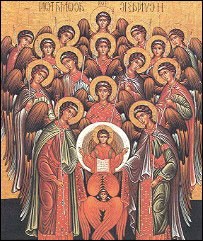 At right: Icon of the Bodiless Powers of Heaven.
Over on Intentional Disciple, Sherry W offers some thought provoking observations by Christopher Ruddy:
I acknowledged then and acknowledge now that church-world tension, but I think it is wrong to conflate that unavoidable tension with a Donatist desire for a purer church. A church that is not in some sort of substantial tension with the world is either corrupt or deluded.Hard words, but I think words that, as an Orthodox Christian, I need to give serious consideration.
Several months ago I was at a meeting with a number of priests when one of the brothers asked why it is that the Church (which in context meant the bishops and the administrative powers that be) never seemed to quite respond in a proper or timely fashion to sexual or financial misconduct in the Church. At the time I did not offer an answer. But as I've thought about his question (which is also one that other's ask and which I ask myself) I've come to realize that when people act in a manner that I perceive as irrational, I have that perception because I don't understand their rational, I don't understand the why of their behavior.
Let me make this clear: When I say your behavior is irrational, I mean that I don't understand your reason(s) for acting as you do.
This isn't to take a stance on the validity of the other person's motivation. It is only to point out that the judgment that someone's behavior is irrational or incomprehensible at a minimum reflects my lack of empathy for their situation.
This empathy it seems to me is the key to understand why it is that for many Orthodox Christians the tensions between the Church and the world simply does not exist. Why is it that, in large numbers, we prefer to structure the Church around the needs and desires of the complacent rather than, as I pointed out earlier, around the seekers in our midst?
Again, Ruddy's observation are helpful:
[A] concern for identity and orthodoxy cannot be reflexively reduced to a fear-driven desire for purity and security. One can be confident and open, as I believe [Pope] Benedict [XVI] is, in the face of a difficult, even hostile situation. His words and actions as pope give little evidence of a fearful, cramped man. On an impressionistic level, he looks relaxed and happy; he wears the yoke of his office lightly and does not seem burdened as Paul VI was.At the core, our acceptance of complacency as the practical norm around which we structure the life of the Church in America, reflects our habitual fearfulness. Both individually and as communally, we lack the confident openness that Ruddy sees in Pope Benedict XVI.
In its place Ruddy identifies two different, but equally unhelpful responses that I think embody and foster in us a fearful disposition of heart: "sectarianism" and "cooptation."
It is easy to say that complacency in the Orthodox Church largely follows along with an emphasis on maintaining a given ethnicity as normative for the community's life. Yes, I think it is true that in these communities, the Church has in large part been co-opted by, and put at the service of, the agenda of a particular ethnic identity. But even among converts it is rather easy to assume that the agenda of the world is identical with the Gospel.
There are many people who come to us from a cultural or theological or liturgical conservative background. There interest in becoming Orthodox is often less from a sense of vocation and more in the hope of finding a refuge and even an ally from liberalism and an ally in their own conservative agenda.
There is a similar parallelism to be seen in the sectarian temptation. "Old hippies," so the joke goes in my old northern California stomping grounds, "never die. They just become Russian Orthodox." American spirituality has always had strong utopian, and hence sectarian, tendencies. It is very easy to see in the Orthodox Church the vehicle for those utopian desires. Especially when it is mixed with an emphasis on ethnicity, one finds a ready made way to opt out of the larger culture.
What I'm saying is this: At least for the Orthodox Church in the United States, sectarianism and co-option can, and often do, exist hand in hand. When we succumb to one, we also give credibility to the other. And again, but grow out of and foster in us a fearful disposition of heart.
Compare this to what Ruddy says ought to be the case:
God's people are elected, called out (literally, an ek-klesia) through no merit of their own, precisely in order to exist for others, to reveal to the world God's will for all peoples. Election and openness go hand in hand, they call for each other. Donatists and their heirs get election, but forget openness. Some Catholics [and Orthodox Christians] today get openness, but forget election. Thinking of the church as a contrast society--and living as such--helps one to see how brilliant intensity and broad openness can coexist.It is worth noting that just as sectarianism and co-option exist hand in hand so do election and openness. Let me go further, election/openness are the cure for the sectarianism/co-option dynamic that afflicts not only the Church, but is the common lot of fallen humanity.
The call to repentance is call to participate evermore fully in the life of the Most Holy Trinity and thereby transform sectarianism/co-option into a communion that embraces the whole of the cosmos. Again, as Ruddy express it:
We are all mediocre, God-beloved people called to conversion and to divine life in community. No one is perfect, and one of the strengths of Catholicism [We are all mediocre, God-beloved people called to conversion and to divine life in community. No one is perfect, and one of the strengths of Catholicism [and Orthodoxy] is precisely its mediocrity, its anti-elitism, its willingness to welcome all who are willing to come.Ironically, even the sectarian, for all his zeal, is also mediocre and will also always and "repeatedly fall short of that standard, doesn't take away from the intensity of that call, which 'costs not less than everything,' as T.S. Eliot put it."
Overcoming the fear that breeds sectarianism and co-option is the work of conversion and as such of the whole Church. This is why the Church--East and West--grounds the Christian life in the grace of the sacraments. We cannot lift ourselves out of the fear we are in--it requires God bring us into the light of His Life. Christian live an eschatological life, a life that both participates in, and bears witness to, the New Heaven AND the New Earth:
Then I saw a new heaven and a new earth, for the first heaven and the first earth had passed away, and there was no longer any sea. I saw the Holy City, the new Jerusalem, coming down out of heaven from God, prepared as a bride beautifully dressed for her husband. And I heard a loud voice from the throne saying, "Now the dwelling of God is with men, and he will live with them. They will be his people, and God himself will be with them and be their God. He will wipe every tear from their eyes. There will be no more death or mourning or crying or pain, for the old order of things has passed away." He who was seated on the throne said, "I am making everything new!"(Rev 21.1-5)The sacraments are the means by which we come to participate in this New Heaven and this New Earth. While it is easy to say that we should minister to the seekers in our midst and not cater to the complacent, we can't forget that the goal of our ministry is the Kingdom of God and not the seekers as such.
Yes, t is not only easy to say that we should minister to the seekers in our midst, it is the right thing to do. But, and this is key, just as we ought not to allow the complacent Christian to set a limit on the ministry of the Church, so too we cannot allow the seeker to circumscribe the Church's ministry.
What God offers us in Jesus Christ and through the sacraments in not new things, but old things made new by grace. Whether we are complacent or a seeker, God desires to renew us--to make us new. And whether I am a complacent Christian or a seeker, it is this newness that I fear above all else.
The great tragedy of being a sinner is that I am not terrified that God will NOT give me my heart's true desire, but that He will. What I most deeply desire is God, but when I am offered Him, I am like the prophet Isaiah:
In the year that King Uzziah died, I saw the Lord sitting on a throne, high and lifted up, and the train of His robe filled the temple. Above it stood seraphim; each one had six wings: with two he covered his face, with two he covered his feet, and with two he flew. And one cried to another and said: " Holy, holy, holy is the LORD of hosts; The whole earth is full of His glory!" And the posts of the door were shaken by the voice of him who cried out, and the house was filled with smoke. So I said: " Woe is me, for I am undone! Because I am a man of unclean lips, And I dwell in the midst of a people of unclean lips; For my eyes have seen the King, The LORD of hosts" (Is 6.1-5).Like Isaiah, I need to have my lips cleansed by the burning coal of the Eucharist and, only then, offer myself to be sent in His Name to say what He would have me say to whom He would have me speak:
Then one of the seraphim flew to me, having in his hand a live coal which he had taken with the tongs from the altar. And he touched my mouth with it, and said:Yes, we must focus our ministry on the baptized seekers in our midsts. While we never could, it is becoming increasingly clear that we can no longer cater to the complacent Christians among us.
" Behold, this has touched your lips;
Your iniquity is taken away,
And your sin purged."
Also I heard the voice of the Lord, saying:
" Whom shall I send,
And who will go for Us?"
Then I said, "Here am I! Send me."
And He said, "Go, and tell this people:
' Keep on hearing, but do not understand;
Keep on seeing, but do not perceive.'
" Make the heart of this people dull,
And their ears heavy,
And shut their eyes;
Lest they see with their eyes,
And hear with their ears,
And understand with their heart,
And return and be healed" (Is 6.6-10)
But in this we can never forget that our ministry to the baptized seekers in our midst does not exempt them, or us, to being undone. Nor does such a ministry excuse us from remembering that those who don't hear the Gospel, or who hear and don't understand, are in that situation for reasons that are not at all clear to us.
All I have to offer is the Living God and I cannot offer God unless I first encounter Him and am myself undone.
As I hope I showed above sectarianism and co-option are our constant temptations and we cannot allow ourselves the facile assumption that, however essential, structuring the ministry of the Church around the baptized seekers in our midst exhaust what it means to be obedient to the will of the Living and Thrice-Holy God in Whose Presence even the angels hid their eyes.
In Christ,
+Fr Gregory
http://tinyurl.com/2ox7ez
Wednesday, September 26, 2007
A Last Lecture
This last lecture by Carnegie Mellon University professor Randy Pausch. Dr Pausch a computer science prof at Carnegie Mellon, gave his last lecture on September 18. He was upbeat, funny, fit - even doing push-ups on the stage. But he knew, as did his audience, the his recently diagnosed pancreatic cancer will end his life in a matter of months.
The lecture is uplifting and I am not a little ashamed of myself for my own whining.
In Christ,
+Fr Gregory
Hat tip to Monastic Musing.
From Google Video:Almost all of us have childhood dreams: for example, being an astronaut, or making movies or video games for a living. Sadly, most people don't achieve theirs, and I think that's a shame. I had several specific childhood dreams, and I've actually achieved most of them. More importantly, I have found ways, in particular the creation (with Don Marinelli), of CMU's Entertainment Technology Center (etc.cmu.edu), of helping many young people actually *achieve* their childhood dreams. This talk will discuss how I achieved my childhood dreams (being in zero gravity, designing theme park rides for Disney, and a few others), and will contain realistic advice on how *you* can live your life so that you can make your childhood dreams come true, too.
Tuesday, September 25, 2007
Ever Wonder What I Sound Like?
The OCA parish where, together with Fr Peter Pawlack, I am currently serving as interim pastor has a great website: Holy Assumption Church. In addition to a many great links and information about the Orthodox Church, they also have my rather iffy attempts at preaching. You can hear Fr Peter and me by clicking on the Homilies link.
Please pray for Fr Peter, the good people at Holy Assumption and me as we work together to enter into the next phase of the community's life in Christ.
In Christ,
+Fr Gregory
So What Are You Going To Do?
An interesting post this morning by on the First Things' blog On the Square Charles J. Chaput, O.F.M. Cap., the Roman Catholic archbishop of Denver . The part I quote is from a talk given in September at an Indianapolis men's conference for Legatus, a Catholic men's group. Their mission is one that Orthodox Christians would do well to emulate. From their web page:
Our threefold purpose is to:
Study: Ongoing education is at the heart of Legatus. We are matching members, who have a thirst for knowledge, with the most profound and convincing body of religious knowledge in the history of human thought.
Live: Translating the teachings of Christ and the social teaching of the Church into practical applications helps our members become eminently pragmatic about their faith.
Spread: Legatus is the Latin word for "ambassador". Our members don't typically wear their faith on their shirtsleeves. They spread the faith through good example, good deeds and high ethical standards.
With that, let me now direct your attention to Archbishop Chaput's concluding remarks.
In Christ,
+Fr Gregory
So what are you going to do? How are we going to convert this world? I want to suggest an answer from history.
Did you ever wonder how the early Church did it? I mean, how did a handful of very ordinary men, disciples of an obscure man executed as a criminal, wind up changing the world—conquering an empire and founding a whole new civilization on the cornerstone of that executed man's life and teachings? And they did it in just a few centuries, without armies, and usually in face of discrimination and persecution.
Never before had a religion taught that God loved people personally and that God's love began before the person was even born. Abortion and birth control were rampant in the Roman Empire. Christians rejected both of them from the beginning. Athenagoras, a Christian layman, explained why in an open letter he addressed to Emperor Marcus Aurelius. He said: "For we regard the very fetus in the womb as a created being, and therefore an object of God's care."
Before Christianity came on the scene, no religion had ever taught that God could be found in our neighbor. The world largely ignored the poor, the hungry, the stranger, and the imprisoned. And it still does. And yet Jesus said that we find God in our love for these least brethren of ours.
Christian love is not weak or anesthetic. It's an act of the will. It takes guts. It's a deliberate submission of our selfishness to the needs of others. There's nothing "unmanly" about it, and there's nothing—and I mean nothing—more demanding and rewarding in the world. The heart of medieval knighthood and chivalry was the choice of a fighting man to put himself at the service of others—honoring his lord, respecting the dignity of women, protecting the weak, and defending the faith even at the cost of his own life.
That's your vocation. That's what being a Christian man means. We still have those qualities in our hearts. We are not powerless in the face of today's unbelieving civilization. We can turn this world upside down if only we're willing to love—the kind of Christian love that is vastly more powerful than just a sugary feeling; the kind of love that converts men into something entirely new; the kind of love that bears fruit in a man's zeal, courage, justice, mercy, and apostolic action.
So I leave you with this: Be men who love well. Be the Catholic men God intended you to be. Be men of courage and fidelity to your God, your wives, your families, and your Church. Put your belief into practice. Do everything for the glory of God, even the little things you have to do each day. Love those who don't love you. Love—expecting nothing in return. Love—and those you love will find Jesus, too. Love—and through your actions, God will change this world.
Monday, September 24, 2007
Second Sunday of Luke (6:31-36)
Second Sunday of Luke
6:31-36
And just as you want men to do to you, you also do to them likewise. But if you love those who love you, what credit is that to you? For even sinners love those who love them. And if you do good to those who do good to you, what credit is that to you? For even sinners do the same. And if you lend to those from whom you hope to receive back, what credit is that to you? For even sinners lend to sinners to receive as much back. But love your enemies, do good, and lend, hoping for nothing in return; and your reward will be great, and you will be sons of the Most High. For He is kind to the unthankful and evil. Therefore be merciful, just as your Father also is merciful.6:31-36
The older I get the more I love St Augustine and find amazing comfort and insight in his words.
What I find most attractive in Augustine's work is his incomparable genius and skill in understanding and articulating the Christian life in all its glorious and paradoxically specificity. Reflecting on Christ's command to us, the bishop of Hippo says that Christians "are . . . prohibited both from loving the world and, if we understand rightly, are commanded to love it" as well because, as Jesus tells us in this Sunday's Gospel, we are to "love [our] enemies."
And who are are enemies he asks but "the world, which hates us"?
How are we to find our way through these two, seemingly, contradictory commandments? We are called by Christ to not love "what the world itself loves," that is to say we are not to love the faults that the world love. Rather,we are to love what "the world hates, namely, the handiwork of God and the various comforts of His goodness." The great sorrow of the world is that the "world loves the fault . . . and hates its nature. . . . [Perversely the world] loves and hates itself."
We overlook I think how easily our own self-hatred obscures from our vision God's love and mercy for us. Let me rephrase that please: In my self-hatred, I have blind myself to God's mercy and love for me, and for my neighbor. The content of this self-hatred is less wickedness, and more (as Augustine suggests throughout his writings and sermons) my disordered love of self--I love the very faults in myself that obscure my nature. I have, perversely, fallen in love with the pale imitation of myself that I have cobbled together out of the bits and pieces of my own experience and the half-truths I have heard throughout my life from society and other people. And it is this false image of myself that I have grown to prefer to the person I am in God's eyes.
St Ambrose says that the "law commands . . . revenge . . . . [But the] Gospel bestows love for hostility, benevolence for hatred, prayer for curses, help for the persecuted, patience for the hungry and [the] grace of reward" for those who, having stumbled, repent, rise from their sins and strive again to be faithful. So, if this is what the Gospel offers me, why do I not run towards it? Why don't I believe the Gospel that Christ proved through His death on the Cross?
This morning I read in the letters of Elder Joseph the Hesychast that in ancient times
[If] you reviled the idols, they would stone you or put you to a miserable death. Now in our times, every passion has taken the place of an idol. And if you reprove or criticize the passion that you see overcoming each person that all shour, "Stone him, because he has reviled our gods."I do not believe because I have replace the God of Abraham, Isaac and Jacob, with the rather little god I have made out of my passions.
Even though these little gods disappoint me, even though I know they will disappointment me and leave me humiliated, I worship them out of fear. There is something comfortable of worshiping a god of my own creation, that I can place right there on the shelf above my desk. To worship a god of my own creation makes me a god myself--I become what I fear and so become fearsome myself.
And again, the Church stands in stark contrast to all of this, the real question is how do I leave behind my fear and enter into love?
"How," St Cyprian asks, will you love your enemies and prayer for your adversaries and persecutors?" He continues:
We see what happened in the case of Stephen. When he was being killed by the violence and stones of the Jews, he did not ask for vengeance but forgiveness for his murderers. . . . [The] first martyr for Christ . . . was not only a preacher of the Lord's suffering but also an imitator of His most patient gentleness.One of the great challenges of the Christian life is moving toward the good not out of the perverse self-hatred that Augustine identifies, but out of a real attract to what is good and with a sense, however immature and unformed, of our own worth as God's beloved child. Taking our cue from Cyprian, maybe we would do well, especially at the beginning of our spiritual life or at those moments when our spiritual life seems to be at a low ebb, if we simply imitated Stephen.
It seems to me that, whatever it might be in full flower, being merciful means to renounce vengeance. And if I can't quite renounce it? Well at least I should not want to want it. Though often out of fear or pride, I do not want to be punished or humiliated or shamed. No matter how deep my sin, I do not want to have someone take vengeance on me.
The beginning of mercy, the first step of fulfilling Christ's command in the Gospel is this: Let us not seek vengeance against those who have hurt us. If we, if I, can at least do no harm, I give goodness the chance to be planted, to root itself and to grow in my heart and yours.
In Christ
+Fr Gregory
Subscribe to:
Comment Feed (RSS)


