Monday, November 24, 2008

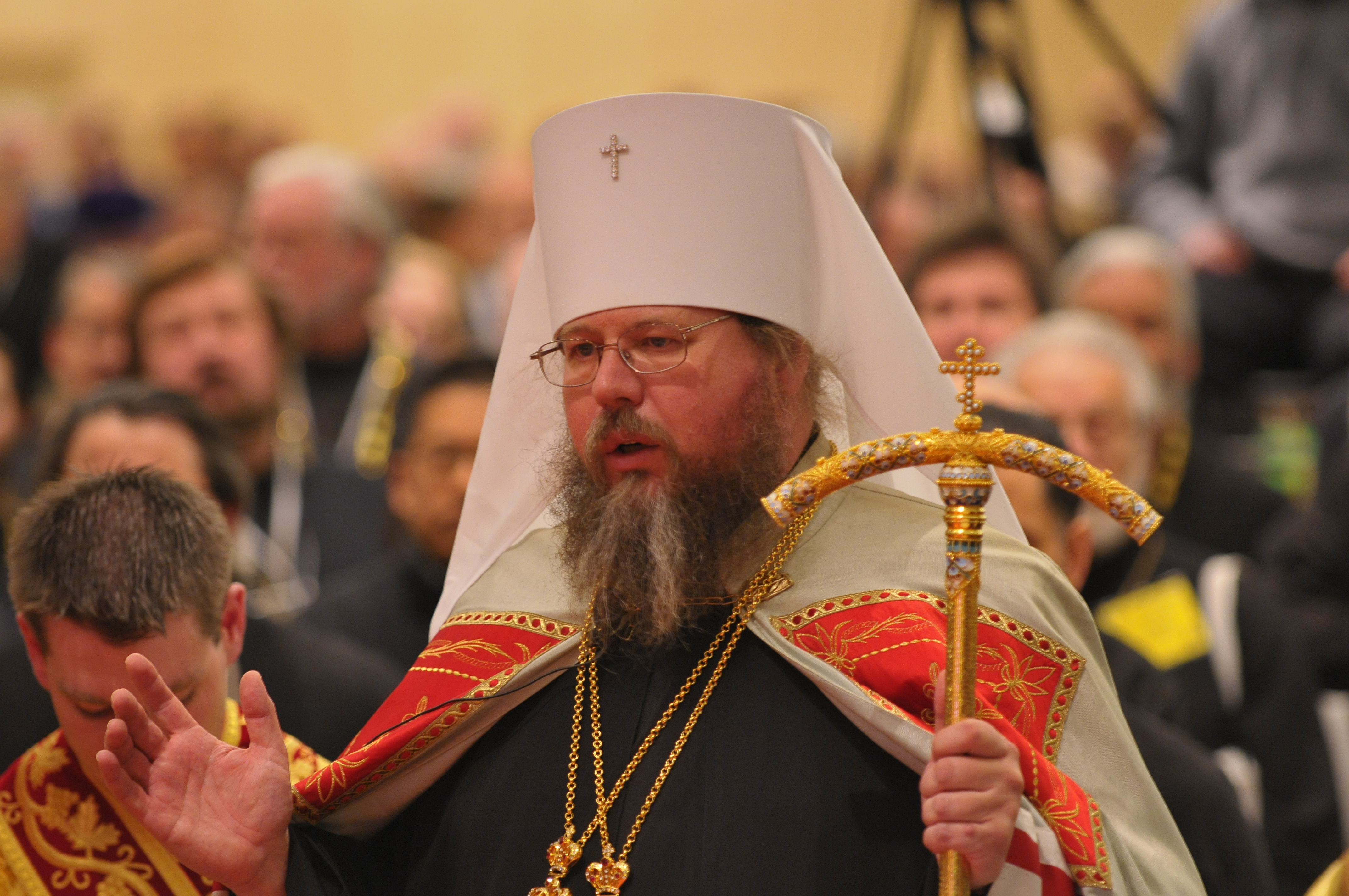
Thoughts on the New Metropolitan

My respect and affection for Metropolitan Jonah are both deep and sincere (we served together in northern CA for about 7 years--he was a frequent visitor to my home when I was in Redding and I a frequent visitor to St John's Monastery).

That said, I think that--whatever his many gifts, Metropolitan Jonah can't make things right in the OCA on his own. As I said at the beginning of the OCA mess, we are wrong to think the problems facing the Church are just the result of a few bad apples. Likewise, the road to spiritual, pastoral and financial health is one that requires we all take responsibility for the life of the Church and commit ourselves personally to Christ and the Gospel.

We run into problems when we forget that our calling, our vocation given to us in baptism, is to proclaim Christ and Him crucified--we are all of us apostles and evangelists of the Good News and not of Orthodoxy as such. The tradition of the Orthodox Church--Liturgy, theology, icons, and asceticism--is not an end in itself--rather it is the context out of which we proclaim the Gospel.

I think of late we have heard too much about Orthodoxy and too little of Christ and the Gospel. Kerygma and Dogma are not opposed, as St Basil the Great reminds us--but neither are they the same thing. For all the converts we've received and new churches and monasteries that we've built, our focus has been too inward--too much of dogma--and too little outward--preaching the kerygma:

"Go into all the world and proclaim the good news to the whole creation" (Mk. 16:15).

"God decided, through the foolishness of our proclamation to save those who believe" (1 Cor. 1:21).

"We proclaim Christ crucified" (1 Cor. 1:23).

"For we do not proclaim ourselves; we proclaim Jesus Christ as Lord" (2 Cor. 4:5).

We will undermine our own hope in His Beatitude, and worse we will betray Christ, if we fall back into our old habits of being focused on ourselves and our own needs. We should by all means root ourselves ever more firmly in the Tradition of the Church but only so we can move with boldness and proclaim the Gospel. Again, we have spent too much time preaching Orthodoxy and too little Christ and Him crucified.

We ought not to make the mistake of preaching Jonah and not Jesus.

In Christ,

+Fr Gregory

Reblog this post [with Zemanta]

Sunday, November 23, 2008

Love is First A Turning Away from Anger & Harshness

Sunday, November 23, 2008: 23rd SUNDAY AFTER PENTECOST (9th of Luke): Afterfeast of the Entry Into the Temple. St. Amphilochius, Bishop of Iconium (394). St. Gregory, Bishop of Agrigentum (6th-7th c.). Repose of Rt. Blv. Great Prince Alexander Nevsky, in schema Aleksy (1263). St. Mitrophán, in schema Makáry, Bishop of Vorónezh (1703). Martyr Sisinius, Bishop of Cyzicus (3rd c.). Martyr Theodore of Antioch (4th c.).


(Above: Rembrandt's, The Rich Fool)


Then He spoke a parable to them, saying: "The ground of a certain rich man yielded plentifully. And he thought within himself, saying, 'What shall I do, since I have no room to store my crops?' So he said, 'I will do this: I will pull down my barns and build greater, and there I will store all my crops and my goods. 'And I will say to my soul, "Soul, you have many goods laid up for many years; take your ease; eat, drink, and be merry."' But God said to him, 'Fool! This night your soul will be required of you; then whose will those things be which you have provided?' So is he who lays up treasure for himself, and is not rich toward God.
Glory to Jesus Christ!

There is, as I sometimes forget, a seeming harshness to the Gospel. We see that harshness in the parable that we hear in the parable of the rich fool from St Luke's Gospel.

Look what happens in the parable, judgment is simply pronounced. There is no dialog, no discussion, or exploration of options. There is none of those little ways we have of avoiding, or at least softening, the truth of our situation. Jesus is brutally straightforward: The rich man is self-satisfied fool who has placed his faith in himself, in his own abilities and the wealth he has accrued. But when seen in the Divine Light, all these things are revealed as without substance. "There is no there, there," as Gertrude Stein once said in a rather different context.

At this point though we must exercise great caution; we ought not to think that the harshness we hear in the parable and in our Lord's words reflect any anger in God. Speaking of how God calls the sinner to repentance, St Ephrem the Syrian says that

Our Lord gives most of his assistance with persuasion rather than with admonition. Gentle showers soften the earth and thoroughly penetrate it, but a beating rain hardens and compresses the surface of the earth so that it will not be absorbed. "A harsh statement evokes anger" [see, Prv 15.], and with it comes injury. Whenever a harsh word opens a door, anger enters in, and on the heel of anger, injury.
The harshness, the anger, we hear in the parable belongs not to God, but to the rich fool. Or, as St John Chrysostom has it, "All things depend on our decision, certainly also to raise anger or to soothe."

Thinking about the parable, and how the fathers understand anger, I begin to ask myself what it is about the rich man, about his heart, that becomes a source of damnable anger?

I think that the answer is to be found in the rich man's trust in himself. His self-confidence is a confidence that he purchases at the expense, as St Cyril of Alexandria reminds us, of charity. Let me be clear here, it is not wrong to have confidence in the talents and gifts God has given you. But this is not the situation of the rich man; (again from St Cyril) he

does not look to the future. He does not raise eyes to God. He does not count it worth his while to gain heaven. He does not cherish the poor or desire the esteem it gains. He does not sympathize with suffering. It gives him no pain nor awakens his pity. Still more irrational, he settles for himself the length of his life, as if he could reap this from the ground. . . . "O rich man," one may say, "You have storehouses for your fruits, but where will you receive your many years? By the decree of God, your life is shortened."
His self-confidence, his trust in himself, comes at the expense of trust in God and compassion for his neighbor. I suspect that, in the beginning, his lack of trust in God was, as it is for many of us, more passive than active, more a matter of a certain flaccid thoughtlessness rather than vigorous malice. So to with how we respond to our neighbor. Rarely do we hate our neighbor or wish him ill. My lack of pity typically reflects carelessness on my part than any hardness of heart.

But slowly my lack of trust in God, my lack of compassion for my neighbor can, and does, becomes an active distrust and even an open hostility toward others whether human or divine. More at first from carelessness than malice, I come to see God and neighbor as opponents, as obstacles to the expression of my will and the fulfillment of my desires. It is this carelessness, that the fathers of the desert called acedia, or (to use a more modern terms), a forgetful indifference to the spiritual life and a preference for my own will. In a word, the rich man's folly is the fruit of the sin of sloth.

And what the desert fathers call acedia the philosopher Emmanuel Levinas calls "the natural atheism of the soul." Or, to use another of Levinas's images, acedia sees life as a "warm bath," comfortable, without demands, but also without challenges and progress and which is lived in isolation from all others, be they God or neighbor.

But for all that it fosters in us a spirit of passivity and isolation acedia is also the well-spring of anger and harshness. I cannot live passively and in isolation. Eventually the ebb and flow of daily life will challenge my delusions. It is in that moment of challenge that the anger in my soul will flare to life and, even if I do not utter a harsh word, I will entertain harsh and horrible thoughts against my neighbor and even against God.

The rich man in the parable is a fool; he sees God and neighbor as opponents, as thieves and enemies. But, as it often is in the spiritual life, there is hidden within even the darkest sin a hint of grace and mercy. Try as he might the enemy of souls can never quite obscure the path back to God—and how could it be otherwise? Since he has always been a liar; he never creates, but only corrupts; he can never reveal the truth, but rather always works furiously, and purposelessly, to obscure what God has made manifest, in creation, in Christ and in each and every human heart.

And if this is true generally, it is especially true in the parable of the rich fool.

If my spiritual death is a dying by degrees, well, so too is our salvation something that is accomplished by grace and equally small changes. By divine grace and our own small acts of gratitude toward God and compassion for our neighbor in need we can be healed of the anger and harshness that grips our lives. And we can even in this way be healed of the passive indifference to the spiritual life we call acedia. And all of this can be done here and now, in even the most ordinary and humble circumstances of everyday life.

How are we to begin? Humbly, by small steps that we take right now.

"Love sinners," St Isaac the Syrian to us, "and do not despise them for their faults. Remember that you partake in an earthly nature, and do good to all. Let your manner be always courteous and respectful to all. For love does not know anger or lose its temper or find fault with anyone out of passion." He continues by telling us that we must "not reprove anyone," that we must "avoid laying down the law," and "shun impudence in speech," and above all we must "Be subject to all in every good work, except to those who" like the rich fool in the parable, "love possessions or money."

To God be the Glory!

In Christ,

+Fr Gregory
Reblog this post [with Zemanta]

Friday, November 21, 2008

Missio Dei & Pietism

Whatever ever else we might say about "missio Dei," it is I think an attempt to overcome the deep strains of pietism that have become the norm in American Christianity (including Orthodox Christianity). The Greek Orthodox ethicist Christos Yannaras has written extensively on pietism as an "ecclesiological heresy." In his book The Freedom of Morality, he writes that:

Pietism made its appearance as a distinct historical movement within Protestantism, at the end of the seventeenth and beginning of the eighteenth centuries, around 1690-1730. Its aim was to stress "practical piety," as distinct from the polemical dogmatic theology to which the Reformation had initially given a certain priority. Against the intellectualist and abstract understanding of God and of dogmatic truth, pietism set a practical, active piety (praxis pietatis): good works, daily self-examination for progress in virtues according to objective criteria, daily study of the Bible and practical application of its moral teaching, intense emotionalism in prayer, a clear break with the "world" and worldly practices (dancing, the theatre, non-religious reading); and tendencies towards separatism, with the movement holding private meetings and distinguishing itself from the "official" Church.

Rightly he points out that in pietism, "experience" (very narrowly defined as a particular kind of experience) becomes paramount. "For pietism, knowledge of God presupposes the "rebirth" of man [i.e., a "born again" experience --web ed.], and this rebirth is understood as living up to the moral law of the Gospel and as an emotional experience of authoritative truths. Pietism presents itself as a mystical piety, and ultimately as a form of opposition to knowledge; as "adogmatism," in the sense that it ignores or belittles theological truth, or even as pure agnosticism cloaked in morality."

Though pietism arose in Protestantism, it has had a great effect of "the spiritual life of other churches, to this day" including he argues the Orthodox Church. As a result, and in "combination with humanism, the Enlightenment and the 'practical' spirit of the modern era-- the spirit of 'productivity' and 'efficiency'-- pietism has cultivated throughout Europe [and the US] a largely 'social' understanding of the Church, involving practical activities of public benefit, and it has presented the message of salvation primarily as a necessity for individual and collective morality."

We see the consequences of this in the increasingly common "utilitarian institutional mentality" that has come to infect "has led many churches and Christian confessions" resulting in what Yannaras describes as "a fever of anxiety." Lost in all this is the "miracle of repentance," of even the remembrance that we can experience a "transfiguration of sin into loving desire for [a] personal communion with God." As a result the " Gospel message is 'made void'," having been "emptied of its ontological content" in our desire to honor "the principle of keeping up appearances." And when appearance matters most of all " the Church's faith in the resurrection of man is made to appear vacuous," and we no longer understand that the Church is the epiphany that makes manifest that in Christ we are offered salvation "from the anonymity of death."

For Yannaras, the symptom of what has been lost—not simply in Western Christianity but also (as his criticism make clear) also in the East—is that rather than being prophetic events that announce the victory of Christ not simply over death, but over death in me, "the sacraments takes on a conventional, ethical character." And so, for example, "Confession turns into a psychological means of setting individual guilt-feelings at rest" the reception of Holy Communion a "reward for good behavior-when it is not a scarcely conscious individual or family custom bordering on magic" And, as I can attest from my own pastoral experience, even Baptism is robbed of its eschatological and soteriological content becoming instead "a self-evident social obligation, and marriage [as Fr Alexander Schmemann never tired of point out simply] a legitimization of sexual relations without regard to any ascetic transfiguration of the conjugal union into an ecclesial event of personal intercourse or communion."

Missio Dei is an attempt, I think, to rediscover a living sense of what Yannaras calls the "ontological truth of Church unity and personal communion" that has become ever more elusive in Protestant Christianity. But again, pietism has also had an effect on the pastoral life of the Orthodox Church such that the three forms of "sectarian" Orthodoxy I summarized above are simply taken as the norm, and even a desirable way of forming the life of the parish.

I would wonder, by way of conclusion, if missio Dei might not be a fruitful avenue of ecumenical conversation between Protestant and Orthodox Christians?

As always, your comments, questions, and criticisms are not only welcome, but actively sought.

In Christ,

+Fr Gregory

Tradition as Hermeneutic and Mission

Fr Deacon Steven Hayes raises some interesting points in response to my earlier re-posting on the notion of "mission Dei." In response to my observation that Holy Tradition is (or should be) a hermeneutic by which we come to understand ourselves and the world of persons, events and things, Father writes: "That's what I understand by "Orthodox worldview" or Orthodox "fronima" -- trying to understand the world and other people and things around us in the light of the Orthodox Christian faith." I certainly agree with on this. In fact part of why I became Orthodox was because I became convinced that, as embodied creatures, human beings only know anything in light of a shared narrative, a tradition. This being the case, which narrative I followed, which tradition in which I stood, became very important for me.

Looking around I found that the Tradition of the Orthodox Church helped me make the best sense of myself and my own experiences. But this wasn't all. In addition to it subjective value (i.e., the value of Holy Tradition "for me") I also saw the objective value of the Tradition of the Church. Holy Tradition is a rich source of insight to help me understand the world of persons, events and things in which I found myself.

But Fr Steven also helped put into words my own discomfort with "missio Dei" as it has come to be articulated in the Emergent Church movement. Specifically and again returning to the words of the good deacon, "The problem I have with 'missio Dei' is that I can't see what else it could be. The proponents of 'missio Dei' seem to think it is a new thing, something no one has ever thought of before. But it seems to me that it is something that underlies all Orthodox assumptions about mission – 'as the Father sent me, so I am sending you'. It seems axiomatic." He then I think puts his finger right on the matter when he says perhaps the problem he (and I) have with "mission Dei" is that "Protestant ecclesiology is different."

Let me offer some random and somewhat unstructured thoughts on the theme Deacon Steven raises.

Maybe it's an American thing, but here in the States one often see Holy Tradition approached as an objective standard to be fulfilled rather than a hermeneutic. While these are not necessarily in opposition (and in my experience they are not only not opposed, they converge), it is not uncommon to see people here approach the Tradition in a neurotic fashion—as an abstract, rarified image to which people must conform—rather than a light that illumines human life and shows the traces of grace in the life of the person or community.

As a pastoral matter, this results in the life of the parish being constructed according to a personal ideology. By this I mean that when we fail to see the hermeneutical character, we build our lives around an idea that we have abstracted from the Tradition. As a consequence, we end up valuing some elements of Holy Tradition and our lives over others. In a word, our life often internally coherent, is not catholic (kata, +holos), or whole.

Typically this lack of wholeness takes one of three forms:

  1. A tacit, and sometimes explicit, assumption that the parish is for "our" people. "Our" people might be either a members of a particular traditional ethnic community (Greeks, Russians, Arabs, etc.)
  2. A group that prides itself on being "not-ethnic." This is often, though by no means exclusively, a community composed of converts. Interestingly, in the OCA (and I assume this is so inn other jurisdictions) one finds cradle Orthodox for whom anything of their own ethnic tradition is consistently minimized or rejected
  3. Among some communities there is a frank imitation of monastic life. In these communities, the life of the community does not so much center around liturgy as much as it is reduced to liturgy. I should point out that, as with the other two examples, the attachment to monasticism is ideological. Monastic life is a great blessing for the Church. Those communities that purport to adopt a monastic model

In all three of these deformative approaches to Tradition and the life and mission of the Church, our vision becomes increasingly narrow and sectarian, our style of relating to one and other becomes increasingly chaotic and authoritarian (the first symptom of this is the administrative life of the community decays).

As always, your comments, questions, and criticisms are not only welcome, but actively sought.

In Christ,

+Fr Gregory

Let us never forget the Ottoman genecide against the Armenians, Greeks, Kurds and Assyrians.

Attention Everyone, PLEASE CIRCULATE TO ALL YOUR FAMILY, FRIENDS, ETC. AND URGE THEM TO VOTE YES NOW!!!

MSNBC is doing a survey whether the Armenian Genocide should be recognized or not. As of a few minutes ago the numbers showed Yes 20%, No 80% !

The Turks have mobilized a global campaign to shift results towards "No" but we can let them. The Armenian Genocide is a historical fact, along with other many other crimes against humanity of behalf of the Turks, and it should be recognized.

Please vote ' YES ' at the below link and send it to everyone you know.

http://www.msnbc.msn.com/id/21253084

Despina Axiotakis
General Secretary
Cyprus Federation of America
Phone: 201-444-8237
Fax: 201-444-0445
e-mail: cyprusfederation@aol.com
Cell: 201-981-5764

Reblog this post [with Zemanta]

Thursday, November 20, 2008

Five Rules for a Spiritual Father - Vultus Christi

Since we've been taking about confession the last few post, I thought these words from Father Mark's (a Roman Catholic priest in the Tulsa, OK diocese) blog Vultus Christi would be of interest. Orthodox readers might take pause slightly at Father's reference to the Immaculate Heart of Mary, but (that aside) his advice is very and should be the baseline for what is expected of priests.

In Christ,

+Fr Gregory


1. Before meeting anyone for spiritual counsel, humble yourself profoundly before God, acknowledging your inability to do the least good for souls without Him. "Separated from me," says the Lord, "you have no power to do anything" (Jn 15:5). "We have a treasure, then, in our keeping, but its shell is of perishable earthenware; it must be God, and not anything in ourselves, that gives it its sovereign power" (2 Cor 4:7).

2. Offer this spiritual work as an act of love to Our Lord Who says: "Believe me, when you did it to one of the least of my brethren here, you did it to me" (Mt 25:40).

3. Efface yourself as much as possible so that Christ alone may act. You are but the humble friend and servant of the Divine Bridegroom. "The bride," that is the soul, "is for the Bridegroom; but the bridegroom's friend, who stands by and listens to Him, rejoices too, rejoices at hearing the Bridegroom's voice . . . . He must become more and more, I must become less and less" (Jn 3:29-30).

Talk and act in the name of Jesus Christ and in utter dependence on His Spirit. "If any man speak, let him speak, as one who utters oracles of God. If any man minister, let him do it by the power, which God supplies: that in all things God may be honoured through Jesus Christ" (1 P 4:11).

4. Seek not to attach souls to yourself. Beware of hidden motives of a self-serving natural order. Trusting in the grace of the Holy Spirit, orient those who come to you ad Patrem, towards the Father alone, Who reveals Himself in the Eucharistic Face and in the Heart of Jesus Christ.

5. Consecrate each and every soul who comes to you to the Immaculate Heart of Mary, Mother of Mercy and Mediatrix of All Graces. Exercise your spiritual paternity in synergy with her motherhood. "And His Mother said to the servants, 'Do whatever He tells you'" (Jn 2:6).

Confession and Evangelism: The Indifferent Penitent

Now that the All-American Council is behind me and before I need to focus on the Called & Gifted Workshop my parish is hosting the Friday and Saturday, let me return to my thoughts on the role of Holy Confession and the evangelism of the faithful.

Though not without their own challenges, I find ministering to the regretful penitent and the angry penitent easier—and frankly less frustrating—than the indifferent penitent. That said, let me put aside my own personal struggles and ask you to reflect with me on the experience of being indifferent.

A bit of cliché (often heard in youth and young adult ministry) though it is, it is true I think that the opposite of love is not hate but indifference. To nurture indifference for someone is not to hate them, but rather to invalidate them. We are mistaken if we imagine indifference—either in others or in ourselves—as neutrality or passivity. Indifference is rather an active refusal to see the good, the true, or the beautiful in something or someone. Remember, simply because something is, it is good and so calls me to transcend my plans and preoccupations.

An indifferent response to the Gospel is certainly related to indifference in the general sense. Especially in confession though there is an added quality that the priest ought not to overlook in either the penitent or himself. Specifically, indifference embodies a rupture in the delicate, and dynamic, relationship between the subjective and objective dimensions of life.

Culture, tradition, language, are the tools that help me to first discover and then express myself. Self-knowledge and self-expression, in other words, are always both personal and social. Or, as one of my altar boys told me one Sunday when I asked him why he dyed his hair jet black, "I wanted to be an individual like all my friends."

In my experience, the indifferent penitent does not see the Gospel or the Tradition of the Church as being in the service of their own self-discovery and self-expression. Not only that, they often see these as in opposition to their own self-discovery and expression.

The confessor must help the person find the natural place of conversion between the person and the Gospel. To paraphrase James Fowler (a psychologists who studies faith development), the confessor must help the indifferent penitent find his own personal story in the larger Christian story AND find that larger Christian story as it is written in the smaller story of his own life.

Let me explain.

It is hard for me to read the Psalms, which I do most mornings and evenings, without recognizing myself, my own experiences and struggles, in the words of King David. Reading the Psalms I discover the story of my life in words that Jews and Christians have been praying for centuries. This means that Psalms are not foreign to me. Yes, they are David's story. And yes as in traditional Orthodox biblical hermeneutics, the Psalms I can see in them the prayers of Christ, it is He Who referred to in Psalm 1 for example, as the "blessed" Man Who follows not the counsel of the wicked. But they are also my story, the express my feelings, my thoughts in times of sorrow and persecution and joy.

Not only that though. In time I come to see the Psalms in me. The Psalms are also a part of me—I realize that the great struggles of David and Jesus are also played out in my life.

Through his questions and observations this is what the confessor needs to help the indifferent penitent come to see. This is not telling the person that that he must conform to the Gospel (which is unlikely to be received well if the penitent see the Gospel as foreign to his experience) as to some external norm. Rather, the confessor must listen carefully to the themes in the person's confession (scant though information might be) until he (the confessor) can hear the points of convergence between the penitent and the Gospel.

Clearly this requires more than a little skill and insight on the part of the confessor. Next week, after my parish's Called and Gifted Workshop this weekend, I will conclude this series by offering some thoughts about what qualities and skills the priest might bring to the prophetic ministry of Holy Confession.

In Christ,

+Fr Gregory

Reblog this post [with Zemanta]

Wednesday, November 19, 2008

From Psychblog: “7 Reasons Leaders Fail”

Especially as the Orthodox Church in America moves into a new era, I thought the following post on why leaders fail might be of interest. I am especially intrigued by the comment that while there has been a fair amount of research done on the psychology of leadership, we have neglected research into why people follow--the psychology of followership, if you will, is not well researched or understood it seems.

In any event, I offer the below for your consideration, questions and comments.

In Christ,

+Fr Gregory


Around two-thirds of workers say the most stressful aspect of their jobs is their immediate boss, their line manager (Hogan, 2006). While this will come as no surprise to most, this statistic suggests a massive number of unhappy working relationships. So, does this mean that leadership is failing on a massive scale? Well, not exactly...

A recent article published in American Psychologist beautifully explains why so many people experience their managers as piping hot geysers of stress (Vugt, Hogan & Kaiser, 2008). What emerges is that bosses aren't inherently bad people (mostly), but that the modern culture of work sets them up to fail. Here are the seven main reasons I've picked out from this article for why leaders fail:

1. Strict hierarchies.
For Mark Van Vugt of the University of Kent and colleagues a large part of the problem with many modern organisations is their hierarchies. Leaders are at the top of the chain and are assumed to have all the answers, so they make most of the decisions. In reality knowledge and expertise is spread across people in organisations. But it's the leaders who must be seen to lead and so followers get frustrated because their superior knowledge and expertise is frequently ignored. This leads to:

Leaders often don't make any better decisions than followers, and frequently make worse ones. This is another consequence of strict hierarchies. Rather than setting up leaders to fail, Van Vugt et al. (2008) argue it's better to agree that leaders are not always the best people to make the decisions. Spreading the responsibility around, or using more participatory strategies for decision-making is often more effective. But this isn't the way things generally work, part of the problem is:

3. Huge pay differentials.
Followers often hate their leaders because of the huge difference in their salaries. It's hard to feel any sympathy for someone whose pay is stratospheric (average CEO pay is 179 times that of average workers). And, because more pay means more status, leaders can quickly come to believe they really deserve the God-like status their pay suggests, resulting in their thinking they have all the answers and that they have the right to treat their employees less than fairly. In the bosses' defence, though, there are:

4. Impossible standards for leaders.
Perhaps because of the huge pay and incredible demands, followers expect their leaders to be almost superhuman. The leadership literature identifies a whole range of personal qualities thought important for a good leader. These include integrity, persistence, humility, competence, decisiveness and being able to inspire the troops. While a leader may be high on one or two of these, they are unlikely to have the full set. Followers are almost bound to be disappointed by what is, after all, another fallible human who is just trying to:

5. Climb the greasy pole.
If the boss is nice to you, it's a bonus, because it's not required for them to get on in the organisation. Leaders are promoted by those higher than them, not those below them - so it's only necessary for bosses to impress their bosses. This is a recipe for disaffection amongst the followers. Talking of which, forget the psychology of leadership, what do we know about the:

6. Psychology of followership?
One of the best points Van Vugt et al. make is that although it's leadership that has been most extensively studied and discussed, most of us end up as followers. So really the psychology of followership is more important than leadership. What is it that makes us follow someone else? And, more subversively: do we need leaders? For example, some research shows that when people know what they're doing, they resent having leadership imposed on them. Generally, though, there's little known about followership, and how to avoid:

7. Alienation.
As a result of the strict hierarchies, huge pay differentials, poor decision-making, greasy-pole climbing and feeling powerless to change huge bureaucracies, followers naturally develop feelings of alienation, and alienation kills motivation and productivity, along with any hope of job satisfaction.

Talk is cheap
By implication the way to rectify these perceived problems is to do the reverse. Don't instigate rigid hierarchies, discourage huge pay differentials, democratise decision-making and don't set impossible standards for leaders. Some organisations are already managing this - presumably those in which followers don't find their bosses the biggest sources of stress - but most are not.
Of course talk is cheap and recognising the problem is quite different to knowing what to do about it, or having the courage to do it. Anyone wanting to make these types of changes across an organisation would have to be a really great leader - and there are truly few of those around.

What do you think?
Do you recognise these problems in your organisation? Has anyone tried to do anything about it? Are there other major reasons leaders fail?


Reblog this post [with Zemanta]

Sunday, November 16, 2008

Video of the Election Metropolitan Jonah

The Pittsburgh Post Gazette has a very well done video summary of the election of Metropolitan Jonah.  You can see the video here: Orthodox Church in America selects new Metropolitan.

BE AT PEACE WITH YOUR OWN SOUL

Be at peace with your own soul
then heaven & earth will be at peace with you.

Enter eagerly into the treasure
house that is within you,

And you will see the things that are in heaven,
for there is but one single entry to them both.

The ladder that leads to the Kingdom
is hidden within your soul...

Dive into yourself and in your soul
and you will discover the stairs
by which to ascend.

Saint Isaac of Syria

In Christ,

+Fr Gregory

Saturday, November 15, 2008

"Star Wars" - an a cappella tribute to John Williams

I have not posted a Saturday "Just for Fun" entry in quite a while. And so let me correct that now.

In Christ,

+Fr Gregory


For lyrics and mp3, click here: http://www.moosebutter.com/lyrics.php/3

Friday, November 14, 2008

On Friday We Remember the Cross

Back in the day, I was quite the fan of the Catholic lay Franciscan and musican, John Michael Talbot. Since on Friday we remember the Cross of Our Lord, God and Savior Jesus Christ, I thought would offer this video by JMT.

In Christ,

+Fr Gregory

h/t: Vivifact!

Wednesday, November 12, 2008

Bishop Jonah of Fort Worth Elected Metropolitan of All America and Canada

By the grace of God, the newly consecrated Bishop JONAH of Fort Worth, TX was elected this morning in Pittsburgh, PA as the Metropolitan of the Orthodox Church in America.

His Beatitude and I served together as missionary priests in northern California for several years.

It is with great joy that I was able to be present for His Beatitude's election. I would encourage everyone to listen to Metropolitan's words that he addressed last night to the All-American Council. I have posted the news release from the OCA web page.

May the Lord Our God grant to His Beatitude, the newly elected elected Archbishop of Washington and New York and Metropolitan of All America and Canada, many years!


In Christ,


+Fr Gregory

PITTSBURGH, PA [OCA Communications] -- On Wednesday, November 12, 2008, His Grace, Bishop Jonah of Fort Worth was elected Archbishop of Washington and New York and Metropolitan of All America and Canada at the 15th All-American Council of the Orthodox Church in America.

His Grace, Bishop Jonah Elected Metropolitan of All America and CanadaHis Beatitude, Metropolitan Jonah was born James Paffhausen in Chicago, IL, and was baptized into the Episcopal Church. While still a child, his family later settled in La Jolla, CA, near San Diego. He was received into the Orthodox Church in 1978 at Our Lady of Kazan Moscow Patriarchal Church, San Diego, while a student at the University of California, San Diego. Later, he transferred to UC Santa Cruz, where he was instrumental in establishing an Orthodox Christian Fellowship.

After completing studies at UCSC, James attended St. Vladimir's Seminary, graduating with a Master of Divinity degree in 1985 and a Master of Theology in Dogmatics in 1988.

He went on to pursue studies towards a Ph.D. at Graduate Theological Union in Berkeley, but interrupted those studies to spend a year in Russia.

In Moscow, working for Russkiy Palomnik at the Publishing Department of the Moscow Patriarchate, he was introduced to life in the Russian church, in particular monastic life. Later that year, he joined Valaam Monastery, having found a spiritual father in the monastery's Abbot, Archimandrite Pankratiy. It was Archimandrite Pankratiy's spiritual father, the Elder Kyrill at Trinity-St. Sergius Lavra, who blessed James to become a priestmonk. He was ordained to the diaconate and priesthood in 1994 and in 1995 was tonsured to monastic rank at St. Tikhon's Monastery, South Canaan, PA, having received the name Jonah.

Returning to California, Fr. Jonah served a number of missions and was later given the obedience to establish a monastery under the patronage of St. John of Shanghai and San Francisco. The monastery, initially located in Point Reyes Station, CA, recently moved to Manton in Northern California, near Redding. During his time building up the monastic community, Fr. Jonah also worked to establish missions in Merced, Sonora, Chico, Eureka, Redding, Susanville, and other communities in California, as well as in Kona, HI.

In the spring of 2008, the Holy Synod of the Orthodox Church in America elevated Fr. Jonah to the rank of Archimandrite and he was given the obedience to leave the monastery and take on the responsibilities of auxiliary bishop and chancellor for the Diocese of the South.

Bishop Jonah's episcopal election took place on September 4, 2008, at an extraordinary meeting of the Holy Synod of Bishops. Earlier in the summer, his candidacy was endorsed by the Diocese of the South's Diocesan Council, shortly after Bishop Jonah had participated in the diocese's annual assembly.

Bishop Jonah was consecrated Bishop of Forth Worth and Auxiliary Bishop of the Diocese of the South, at St. Seraphim Cathedral, Dallas, TX, on Saturday, November 1, 2008. Consecrating hierarchs included His Eminence, Archbishop Dmitri of Dallas and the South, Locum tenens of the Metropolitan See; His Grace, Bishop Tikhon of Philadelphia and Eastern Pennsylvania; His Grace, Bishop Benjamin of San Francisco and the West; and His Grace, Bishop Alejo of Mexico City and the Exarchate of Mexico.

Metropolitan Jonah will be installed by the OCA's Holy Synod of Bishops at St. Nicholas Cathedral, Washington, DC, on December 28, 2008.

May the Lord bless His Beatitude, Jonah, newly-elected Metropolitan of All America and Canada with many years of fruitful service in His Holy Vineyard.

Eis polla eti, Despota!

Listen to Metropolitan Jonah's address to the All-American Council from Tuesday, November 11, 2008.

Listen to the Divine Liturgy and Metropolitan Jonah's homily from Wednesday, November 12, 2008.
Reblog this post [with Zemanta]

Tuesday, November 11, 2008

OCA’s All-American Council: Balancing the Spiritual, Administrative and Financial

Later this week, I will finish my series on confession. This week, that is Monday 10 November through Thursday 13 November I am in Pittsburgh, PA (our old adopted hometown) for the 15th Annual All-American Council (AAC) of the Orthodox Church in America (OCA).

Our agenda here this week is three-fold.

First, we have the general business of the Church—spiritual, administrative and financial. To borrow from Heidegger's discussion of Dasein, these matters are the part of the facticity of the human. While our attitude or approach to them may change, the life of any human person or community involves these three. Again, what changes is not the presence or absence of spiritual, administrative or financial concerns, but whether we respond to them well, that is in a manner that allows the mystery of the human, and thus the Light of the Triune God in Whose image we are created, to shine through. To the degree that this light is manifest, then to that degree we have become a bit more who we are already.

Second, we are concerned with the election of a new Metropolitan. It will be this man's task to serve as first among equals on the Holy Synod of Bishops. He will also be responsible for leading and guiding the OCA as we strive as a community to be a faithful witness to the Gospel and a source of unity for the various Orthodox Churches here in America.

Third, and what is maybe most focal in people's awareness here is the need to resolve the recent financial crisis and its attendant matters.

In his opening address last evening the locum tenum of the Metropolitan See of the OCA, Archbishop Dimiti, bishop of Dallas, TX, pointed out that the OCA is a young Church—albeit a young Church that stands within an old tradition. The financial misdealing, how people have responded to this matter, the lack of trust that this has engendered in the Church is (potentially at least) a moment of purification for the Church and an opportunity to re-evaluate and re-commit ourselves communal and personally to what God would have from us.

Placing the discernment of our vocation at the center of the AAC is I think a wise choice. Yes, it is certainly not without its own risks—chief among them that we leave unexamined and unresolved our administrative and financial shortcomings in preference for inspiring, but ultimately fruitless, reflection on the spiritual dimension. And for many, this flight from the more mundane aspects of life is the great attraction not simply of the Orthodox Church but religion. Again to return to Heidegger, the human is always fleeing from itself, from the limits of its own life.

But when we flee our limits, we flee also our potential and the in the end the great and good gift of our own humanity.

Listening to people talk about how many in the Church have suffered a loss of trust in bishops, how we have at times seen each others as opponents and enemies of each other and of Christ and His Church, I find myself returning to the thought, from whence have mistrust and animosity come if not from the human heart?

While not wishing to deny that each man's sin is his own, it seems to me this mistrust, this animosity, is not something that was caused by misconduct in the Church. Rather misconduct is the means by which my own lack of trust, my own negative feelings and fear of others, has been made manifest. These feelings are not caused by external events—external events are (and to borrow from Heidegger) the condition of possibility that allows for the revelation of my own lack of trust.

It is from the mistrust in my own heart, my own lack of faith that allows me—though does not cause me—to see you not as a gift of God for my salvation and the salvation of the world, but as an obstacle and enemy bent on my harm.

Again, each man's sin is his own. But my response to your sin is also mine. The manifest sinfulness of others is for me a challenge. Will I despair, will I give myself over to the lack of faith, hope and charity that lies silently within my own heart. Or will I instead acknowledge before God and you that for me to be human is impossible without you by my side? I cannot be who I am without you, since after God I am dependent on my neighbor and the whole web of human and social relationships that we strive to live under the form of our administrative and financial lives.

We have, O Lord, not lost our way, but have lost Your Way substituting our own will for Yours. Through Your great mercy and love for us, You have allowed us to stumble and fall and so see our need not only for You but for one another. Grant us in these coming days to find the humility, the strength and courage not only to reach out a helping hand to each other, but also to grasp that hand humility, the strength and courage to take the hand that is offered.

In Christ,

+Fr Gregory

Sunday, November 09, 2008

An Orthodox Bishop Talks Politics

John Couretas over at that most excellent blog of the American Orthodox Institute has a post this morning on recent comments by Bishop Savas of Troas (GOA) on His Grace's blog "Sava on a Rolla." Let me let John speak for himself:

Did God ordain an Obama victory? You get that impression from Sava on a Rolla, the blog of Bishop Savas of Troas. In a post titled, "This is the Day that the Lord has made!," the chancellor of the Greek Archdiocese celebrates the victory of President-elect Barack Obama in terms that can only be described as divine:

Do I expect miracles from the President-Elect? Am I confusing the man with the Messiah? Of course not. But neither is he the Antichrist, as some of his opponents would have you believe. Americans did a good thing yesterday, an inspired thing. They didn't voice their opinion, they shouted it. A new day has dawned, a day that the Lord has most emphatically made. Are you as delighted as I am? Send up thanks to the Lord our God! Are you for any reason unhappy? Pray to the same God for our President-Elect's enlightenment.
I don't know. It's almost like reading the Genesis account of Creation. OK, the Bishop's guy won, and he has every right to celebrate. Then he goes — to put it nicely — really over the top.

You can read the rest of John's comments here.

Below for your thoughts are my comments posted on AOI:

John,

Thank you for your post and comments on Bishop Sava's blog.

The election of Sen Obama as the 44th president of the United States is, I think, a mixed good. Certainly, it is noteworthy that within Mr Obama's lifetime we have traveled as a society from the shame of Selma (a shame I should add was not limited to the South) to the election of an African-American as president. In addition to this, I think his election will have a generally positive effect on how we are viewed throughout the world, especially (though not exclusively) in Europe.

I agree with His Grace that "The Body Politic is another body altogether" from the Church. I agree as well that the "only way the [Body Politic] can approximate the [Body of Christ] is if the goal of government were to fulfill the law of Christ, which is to 'bear one another's burdens' (Gal 6:2). 'Have you seen your neighbor?' asks one of the Desert Fathers of the Church, and continues, 'You have seen your God.' Blasphemy? Reread St John's 1st Epistle."

Where I disagree with him, and agree with John, is his contention that "The goal of government ought not to be to protect us from one another, to teach us to treat the other as competition or nuisance or threat, but to help us to help one another." Here His Grace conflates a number of points in a manner that obscures rather illumines an Orthodox Christian response to government–secular or ecclesiastical.

To dismiss out of hand the policing function of the government is simply not biblical. St Paul is clear, the government is entrusted with the sword not only to punish wrong doers but also for the common good (see Rm 13.1-7).

Immediately after discussing the God-ordained authority of the government (a government hostile to Christians in general and Paul in particular) and the obligation of the Church to submit to that authority, the Apostle then begins to delineate in verses 8-10 the obligation of Christians to love their neighbor. Government, rightly ordered, I would argue, allow us the freedom and affluence to care for one another. While not perfect, there is no better example of this the US government.

While governments can and do have a role in the care of especially the weak, they do this first and foremost through the establishment of an society in which its citizens are (relatively) free from the predators among us (which I why abortion cannot be legalized–it is a threat to the life of one of the weakest among us).

This first step is admittedly a negative one–but the policing powers of the State or no less essential for being protective and preventative.

Following on its police powers, the State much ensure the equal treatment under the law of all it citizens. This means not only passing and enforcing laws against criminal conduct, but also contract law and the somewhat more mundane concern of government for commerce, weights and measures.

None of this of course will make us virtuous. But the American systems does not aim at cultivating virtue it the citizenry. Rather the US Constitution presuppose virtuous citizens and strives (however imperfectly at times) to provide them with the political freedoms need to exercise virtue without fear.

Where the American experiment seems to be breaking down is our transfer of virtue from the private realm to the governmental. We have come to expect the State to be virtuous so that we don't have to be.

The genius, and weakness, of the American experiment it that the government presuppose strong, healthy private (as distinct from governmental) mediating structures –the family, the church, newspapers and businesses–that stand between the person and the government and serve to foster virtue it the citizenry.

But these smaller, mediating structures, have more and more abdicated their responsibilities as corporate citizens–what does the Orthodox Church do for example to counter the range of social ills in her midst–unwed mothers, divorce and dead beat dads to name only three–that plague society as a whole?

I agree with those who say that Pro-Life Christians are sometime narrow in our focus. But that narrowness of vision is not the exclusive property of the religious right. The religious left also seem disinclined to foster virtue as well.

(For example, what percentage of the Orthodox Church's resources go to care for the poor? What percentage of the GOA's budget is given to the poor? What do we say to men who abandon their children and the mother of their children?)

There is much in Bishop Sava's words to reflect on. But I am worried that his post reflects a fundamental misunderstanding of the American experiment and the Church's obligation as a corporate citizen in the Republic.

Again, thank you for your important ministry.

In Christ,

+Fr Gregory

Receive That Which Has Already Been Given

Sunday, November 9, 2008: 21st SUNDAY AFTER PENTECOST (7th of Luke) —Onesiphorus and Porphyrius of Ephesus (3rd-4th c.). Ven. Matrona, Abbess, of Constantinople (ca. 492). Ven. Theoctiste of the Isle of Lesbos (881). Ven. Onísifor (Onesiphorus) the Confessor, of the Kiev Caves (Near Caves—1148). Martyr Alexander of Thessalonica (4th c.). Martyr Anthony of Apamea. Ven. John the Short, of Egypt (5th c.). Ss. Eustolia (610) and Sosipatra (ca. 625), of Constantinople. St. Nectarios Kephalas, Metropolitan of Pentapolis. Ven. Euthymius, Founder of Dochiariou Monastery (Mt. Athos—10th c.), and Ven. Neophytus, Co-founder of the Monastery. Icon of the Most-Holy Theotokos, "SHE WHO IS QUICK TO HEAR."

And behold, there came a man named Jairus, and he was a ruler of the synagogue. And he fell down at Jesus' feet and begged Him to come to his house, for he had an only daughter about twelve years of age, and she was dying. But as He went, the multitudes thronged Him. Now a woman, having a flow of blood for twelve years, who had spent all her livelihood on physicians and could not be healed by any, came from behind and touched the border of His garment. And immediately her flow of blood stopped. And Jesus said, "Who touched Me?" When all denied it, Peter and those with him said, "Master, the multitudes throng and press You, and You say, 'Who touched Me?' "But Jesus said, "Somebody touched Me, for I perceived power going out from Me." Now when the woman saw that she was not hidden, she came trembling; and falling down before Him, she declared to Him in the presence of all the people the reason she had touched Him and how she was healed immediately. And He said to her, "Daughter, be of good cheer; your faith has made you well. Go in peace." While He was still speaking, someone came from the ruler of the synagogue's house, saying to him, "Your daughter is dead. Do not trouble the Teacher." But when Jesus heard it, He answered him, saying, "Do not be afraid; only believe, and she will be made well." When He came into the house, He permitted no one to go in except Peter, James, and John, and the father and mother of the girl. Now all wept and mourned for her; but He said, "Do not weep; she is not dead, but sleeping." And they ridiculed Him, knowing that she was dead. But He put them all outside, took her by the hand and called, saying, "Little girl, arise." Then her spirit returned, and she arose immediately. And He commanded that she be given something to eat. And her parents were astonished, but He charged them to tell no one what had happened.

(Luke 8:41-56)

For St Ambrose of Milan the woman with the issue of blood is an image of the Church of the Gentiles—of us who, before we came to faith in Christ, "lost all the gifts of nature and squandered the inheritance of life." He continues by saying that we did this, we squandered what wealth we had as we ran vainly from one hoped cure after another.

Thinking about Ambrose's observation, it is important to keep in mind that he is not of individual believers in the Church who came from outside Judaism. No, he is speaking about the whole of the non-Jewish people, the whole of the Gentile nations—who by grace must grafted on to the Jewish People (see Rms 11.16-24). As with the Apostle Paul, for Ambrose there can be in Christ no "me" or "you" or "them," only "we" and "us."

This isn't a denial of human uniqueness—far from it since this would be a denial of not only human responsibility but the love of God for each human person. It is rather a rather stark reminder that because I am social being what I do, always do as a member of some type of community.

Either, therefore, together we reach out for healing, for forgiveness and reconciliation in Christ with the Father and one another or we don't. And if we don't we simply continue to squander the gifts we've been given personally and as a community in our futile attempts to find life and health and hope and forgiveness and reconciliation and love separate from Christ.

This second path, the squander's way, is not really an option that we can choice. Because of Adam's sin this is where the human community already finds itself each and every single day, day in and day out. Not that love and forgiveness, to take two quick examples, are absent from the lives of fallen humanity. Love and forgiveness can be found outside the Church, but they are damaged. They do, but apart from Christ they remain still-born, a source of joy, but also something that drains us and wears us down.

And if this second path is always already with us when we were apart from Christ, it is always also with us even now that we are in Christ. This second path, the way of death, is always present as a temptation.

If we succumb to this temptation, if we return to that path that Adam laid out for us by his sin, we die.

But even here, even in death we are not abandoned. As with the little girl in the Gospel, the daughter of Jarius, Christ comes to restore us to life. Christ comes not to the immoral but to the dead; He comes, as the later Fr Alexander Schmemann once put the matter, not to make a bad people good, but a dead people alive.

This transition from death to life hinges not simply on the grace of God, but on our own willingness to understand, accept and act on the truth that no one is saved alone.

Yes salvation comes to me and to you.

Yes Jesus is my Lord and Savior, even as he is yours.

But, I am saved, because you are saved, because we are saved.

He is my Lord and Savior, because He is yours, because He is ours.

If we lose sight of this, if we forget or act as if we are not saved together, or as if the grace given you somehow comes at my expense, then in that moment we become again like the woman with the issue of blood. We become unclean, ever weaker, and more frustrated chasing one false hope after another.

But again, even when we fall, there is Christ. A life of false hope need not be our lot. What the Apostle Paul says of himself, he says for all of us, personally and as a community, "I have been crucified with Christ; it is no longer I who live, but Christ lives in me; and the life which I now live in the flesh I live by faith in the Son of God, who loved me and gave Himself for me." "(Galatians 2:20)

Reflecting on his imprisonment by the Soviet government, Alexander Solzhenitsyn writes in The Gulag Archipelago,

It was granted me to carry away from my prison years on my bent back, which nearly broke beneath its load, this essential experience: how a human being becomes evil and how good. In the intoxication of youthful successes I had felt myself to be infallible, and I was therefore cruel. In the surfeit of power I was a murderer, and an oppressor. In my most evil moments I was convinced that I was doing good, and I was well supplied with systematic arguments. And it was only when I lay there on rotting prison straw that I sensed within myself the first stirrings of good. Gradually it was disclosed to me that the line separating good and evil passes not through states, nor between classes, nor between political parties either - but right through every human heart - and through all human hearts. This line shifts. Inside us, it oscillates with the years. And even within hearts overwhelmed by evil, one small bridgehead of good is retained. And even in the best of all hearts, there remains . . . an uprooted small corner of evil. Since then I have come to understand the truth of all the religions of the world: They struggle with the evil inside a human being (inside every human being). It is impossible to expel evil from the world in its entirety, but it is possible to constrict it within each person.

No matter how deep the darkness in a person's heart or a community, no matter how much evil seems to have succeeded, we must not forget that Christ lives in us and that together we live in Him. For too long it seems that God's People have lived as if this were not true, as if there was some other standard besides Christ. In giving us Himself, Christ has given us everything—all that is necessary has been proved for us. All that is lacking is that which He cannot give us, our free consent to him. All that is needed is that, like the woman with the issue of blood, like Jarius and his wife, that together we reach our hand to Him and receive that which He has already give us: Himself and each other.

In Christ,

+Fr Gregory

Reblog this post [with Zemanta]

Friday, November 07, 2008

Confession & the Evangelism of the Faithful: Confessing the Angry Penitent

The confessor, I think, has to bear in mind that anger is not simply rooted developmentally in earlier vices but in a profound shift in the penitent's self-understanding. To put the matter simply, the penitent had a relatively narrow, but functional, vision of himself that has now proven to be false. This sudden shift in awareness is frightening and in evokes in the person a profound and radically unsettling sense of betrayal. "The person I always thought I was," so a more self-aware penitent might say, "has now proven itself to be false. I am not who I thought I was. I don't know who I am. All I know is that I have been lying to myself about who I am. My life is a lie."

We ought not to underestimate the terror that the person feels as his accustomed frame of reference for himself as well as the world of persons, events and things, is shattered by a confrontation with the Gospel. It is a psychologically and spiritually simplistic of us not to hear the real sense of existential disruption embodied in St Paul's words in Ephesians:

This I say, therefore, and testify in the Lord, that you should no longer walk as the rest of the Gentiles walk, in the futility of their mind, having their understanding darkened, being alienated from the life of God, because of the ignorance that is in them, because of the blindness of their heart; who, being past feeling, have given themselves over to lewdness, to work all uncleanness with greediness. But you have not so learned Christ, if indeed you have heard Him and have been taught by Him, as the truth is in Jesus: that you put off, concerning your former conduct, the old man which grows corrupt according to the deceitful lusts, and be renewed in the spirit of your mind, and that you put on the new man which was created according to God, in true righteousness and holiness. (4:17-24)

The change that Paul alludes to here is not like learning how to operate a new camera or trying to comprehend a difficult idea. No, Paul's words point to a radical transformation of how I view not only myself, but also God, my neighbor and creation. I am no longer in control, the world of persons, events and things are revealed as radically NOT at my disposal and NOT subjected to my own self-centered desires.

Or, to put it more simply, anger is my response to the realization that I am not God.

It is precisely this conflict that the proclamation of the Gospel provokes. And it is this conflict that the spiritual father must respond to in confession. How might he do this?

Again, Paul offers us an idea.

Therefore, putting away lying, "Let each one of you speak truth with his neighbor," for we are members of one another. "Be angry, and do not sin": do not let the sun go down on your wrath, nor give place to the devil. Let him who stole steal no longer, but rather let him labor, working with his hands what is good, that he may have something to give him who has need. Let no corrupt word proceed out of your mouth, but what is good for necessary edification, that it may impart grace to the hearers. And do not grieve the Holy Spirit of God, by whom you were sealed for the day of redemption. Let all bitterness, wrath, anger, clamor, and evil speaking be put away from you, with all malice. And be kind to one another, tenderhearted, forgiving one another, even as God in Christ forgave you. (4:25-32)

The confessor, as he does with the regretful penitent, needs to attend to the traces of grace in the penitent's life. With the angry penitent, however, this means (1) pointing out as Paul does the comforting presence of God in the person's life and (2) being willing in word and deed to model with the penitent God's comforting response to his fear.

It is tempting simply to respond to penitent's anger and overlook the concrete fears that inspire the anger. But this, I think, is a mistake. Confessors have a unique opportunity to help people give voice to their fears. More than that though, we have the great calling of giving voice to God's comforting presence in life of the fearful person not only though sentimental sermonizing, but by embodying in word and deed a kind and gentle presence at that moment in a person's life when he least believes kindness and gentleness are possible for him.

In my next post, I want to reflect with you on what is for me the most challenging person to minister to, the indifferent penitent.

For now, and as always, your comments, questions and criticism are not only welcome, but actively sought.

In Christ,

+Fr Gregory

Confession & the Evangelism of the Faithful: Understanding the Angry Penitent

You may be wondering why it is important to consider how spiritual fathers minister to different classes of penitents in confession. While it might be useful for clergy, why would lay people care?

The simple answer is this: Confession is an essential part of the spiritual life of the all the faithful—laity and clergy. While we ought not to reduce the spiritual life to our participation as penitents in confession, it is important to keep in mind that confession is one very important part of what we are preparing to do. Confession is in a real sense a goal or teleos of all of the Church evangelistic and educational ministry. We are forming people not simply for various ministry, but for confession. In fact I would argue that as an essential part of the Church's prophetic ministry confession is the ordinary context within which we all of us come to understand ever more fully what the Father in Christ and through the Holy has called us to do.

Nowhere is this more apparent than in the angry penitent.

We are accustomed to thinking of anger in terms of affect, of emotion. But in the Church's spiritual anthropology, and I'm thinking here especially of St John Cassian, affect is only one possible manifestation of anger.

Before it is emotion, it is according to Cassian a vice, a habit of thought and action that he describes as a "somber disorder" in the soul. Just as "regret" is the absence of gratitude (and specifically, gratitude to God for one's life), anger (again according to Cassian) is the absence of "discernment of what is for our own good, . . . [ and of] spiritual knowledge." ("Eight Vices," Philokalia, vol I, p. 82)

When gripped by anger we unable to "fulfill our good intentions, nor [can we] participate" in divine life. All of is rooted in a blinded intellect that has become "impervious to the contemplation of the true, divine light." (p. 82)

The angry person then is not only ineffectual in his attempts to do good, he behaves in a manner that is ultimately, and sometimes proximately and even immediately, self-destructive. And all of this because "No matter what provokes it, anger blinds the soul's eyes, preventing it from seeing the Sun of Righteousness." The saint continues,

Leaves, whether of gold or lead, placed over the eyes obstruct the sight equally, for the value of gold does not effects the blindness it produces. . . . [Anger] whether reasonable or unreasonable, obstructs our spiritual vision." (p. 83)
As well as a description of anger, Cassian offers us an understanding of both its developmental roots and consequences. Cassian, as with many of the writers found in the Philokalia, holds to a dynamic understanding of the human person that anticipates in broad strokes the later finds of developmental psychology.

In "Eight Vices," we learn that anger is the rooted in gluttony, unchastity and avarice. Of these three, it is gluttony which is the developmental origin of anger. In a nutshell, what is for the infant a virtue, or at least a necessity is for the adult a vice. And it is from anger that there develops other, increasingly more serious vices: dejection, listlessness, self-esteem (less in the modern sense and more in the sense of autarkic self-aggrandizement of pathological narcissism or even sociopathy), and pride.

But it is anger I think that is the lynchpin between the (relatively) minor sins gluttony, unchastity and avarice and the increasingly more deadly sins which follow. At its core anger arise when the person's desires are frustrated. Anger is the announcement that I have encountered, and rebelled against, the limits of my own life and most now decide either to accept the limits imposed upon me or withdrawn into a life of increasingly deadly and death deal fantasy.

In my next post, I want to reflect with you briefly on how as a confessor I respond to the angry penitent (at least in my better, more grace-filled moments).

For now, and as always, your comments, questions and criticism are not only welcome, but actively sought.

In Christ,

+Fr Gregory


Reblog this post [with Zemanta]

Thoughts on Praying for the President

Gael, left a comment on my brief post asking God's blessing on President-elect Obama. You can read the comment here.

I'm assuming his comments above are meant to be humorous. Though given the heat of the recently finished presidential election campaign, it is understandable that they are not.

If they are not, I should point out that praying for the President as the servant of God is taken from the Orthodox Christian invocation asking God to bless someone that is used at the end of the Divine Liturgy.

Whether one agrees with his policies or not, whether his policies are compatible with the Gospel or not, Orthodox Christians--indeed Christians of any tradition--are required by God to pray for civil authorities.

And yes, President-elect Obama is God's servant. He may or may not understand himself as such and if he does he may or may not understand rightly, much less act rightly upon, what is required of him--but he is still God's servant as our we all.

That said, some of his policies (I'm thinking particularly about his support of abortion and stem cell research) are evil and within the realm of what I can do I will oppose them. Let me go further, I would hope that all Orthodox Christians--indeed all Christians--would oppose Mr Obama's policies on abortion and stem cell research.

Are there other policies with which I disagree? As a priest, I feel myself obligated by my office to limit my public political comments to only those things about which the Orthodox Church has spoken clearly. This means that in the realm of what is often called prudential matters--economics, or the general range of domestic or foreign policy matters--though I have my own view, but I remain silent about them.

Senator Obama has been elected the 44th President of the United States. Insofar as I or any of us can do so in good conscience and without violating the teaching of the Church, we should support the new administration at the very least with our prayers. Are there policy areas in which Orthodox Christians are bound to oppose the new administration? Yes certainly (particularly in matters of abortion and stem cell research) and again at a minimum with our prayers.

Finally, as for some of the rhetoric used by Mr Obama and his support--yes it often sounds messianic, but then American political rhetoric often does. And why are we suprised? Americans are, fundamentally, a religious people. Our nation was founded on an ideal drawn as much or more from Christianity as from any Enlightenment philosophical speculations.

Where I think the fault line lies in American politics is not between those who use and those who do not use religious rhetoric--but between those whose use of it I agree with and those whose use of it I find objectionable.

Let me go further, I do not object to the use of religious rhetoric by Mr Obama and his supporters--I welcome it as I did when it was used to such good effect by President Reagan. For all that it has become unfashionable, even among Christians, to do so it is important to remember that we are all of us called by God to fulfill certain roles in life. No the objection I have is not to the use of religious rhetoric by either the left or the right. It is rather to our unwillingness as a nation to take seriously the implications of that rhetoric--and again this is a problem I see on both the left and the right.

So God grant His servant President-elect Obama many years and may He also grant him, the wisdom need to govern and through his administration peace and prosperty to the people of the United States so that we may excel in every good work.

In Christ,

+Fr Gregory

Wednesday, November 05, 2008

Confession & the Evangelism of the Faithful: the Regretful Penitent

My last post spoke about the place of education in the evangelism of the faithful. I argued that in the pastoral life of the Church education is not merely intellectual, but at the service of helping people see the outlines of the Gospel in their own hearts. This in turn can lead to a moment of crisis that typically leads in turn to in one of three ways: regret (a global sorrow for one's life), anger (a spiritual blindness or some other negative emotion often directed at the spiritual father, and ultimately God), and indifference (in which the person ignores or minimizes what is heard). I also said that these three responses are, or at least can be, grist for the mill in Holy Confession. In this and the following two posts, I want to look briefly at how I handle each response as a confessor.

Again, just remind people, my response will not involve what people have told me in confession. And again as I said last time, I do not think that the information I will offer is only for priests. People are often better able to approach confession with a open heart, more trust and less anxiety if they have some sense of what is, and is not, expected of them. Especially when people first come to me for confession I will tell them what is going to happen and the "ground rules." Chief among these ground rules is that they are free not to answer any question I ask them and not act on any advice I might may offer. I respect the freedom of the penitent to reveal as much, or a little, of his or her struggle as they wish. But I address the character of the confessor in a later post.

Now, to regret…

The regretful penitent comes to confession lamenting his or her past. Note that what I said here was "past" and not simply "sins." Merely looking back on one's life with sorrow is not the same as repentance though it is certainly may be a part of repentance. But a global regret for one's past is (I think) fundamentally unhealthy.

In both the East and the West the final morning service is the Office of Lauds—of the praise of God. The Church's liturgical tradition embodies what is I think a rather wise point of spiritual psychology. Repentance, as distinct from simple regret, bears fruit in the praise of God. The ability and willingness to praise and thank God sincerely is one of the key signs that the penitent has repented from his or her sins.

The fruit of repentance is gratitude, joy, and a lively awareness of God grace and mercy even in the darkest moments of one's life.

Likewise, the absence of gratitude toward God and an unwillingness, or even hostility, to considering the hidden mercy of God in the midst of one's sinfulness is a sign that the penitent has come to confession not with repentance for healing but mere regret.

My understanding and subsequent response to the regretful individual—and make no mistake, regret is always part of living as an individual, living not in communion with God and neighbor but within a world of one's own making—is guided by something I read by St John of Kronstadt.

The saint reminds the priest, that when hearing confessions he is not a judge but a witness to God's mercy. This means that both in word and deed, the priest most first remind the person, as St John writes in his own preparation for confession, of "the abundance of the Mercy of God." The harshness, the lack of gratitude (and the fear that typically accompanies it) reflects a more fundamental lack of an awareness of God's mercy. It is this lack that the confessor is called to respond to by his own gentleness.

But why is this gentle witness necessary?

For better or worse, people draw their view of God from their experience of the priest. For person whose self-image is framed by regret, the priest, by his kindness and acknowledgement of the goodness of the person, offers to the penitent the possibility of a new way of understand not only God, but also self and others. The confessor is called to model in confession what it means to love God and neighbor with one's whole heart and mind.

Even when correction is necessary it is important that it be given gently and with a clear and sincere indication on the part of the confessor that what is offered is offered not to shame the person but to comfort and heal. It is important as well that the priest makes clear that the penitent is free to act or not on the advice. Advice, like an epitimia (penance), is best offered rather than imposed.

But the witness to mercy must be more.

Any witness in the Church is necessarily prophetic. It is here where I think that confession becomes most challenge for confessor and penitent. As a witness of mercy the confessor is called by God is called to discern the presence of divine mercy in the life of the penitent. Building on what I said a moment ago, this means going beyond merely reminding the person that God is merciful. Bearing witness to God's mercy builds on, but necessarily transcends, the confessor being kind and gentle.

With the regretful penitent, I listen carefully to the life story that is told in confession. What I am listening for are those moments in the person's life where they may have overlooked the mercy of God for them. (As an aside, and without prejudice to "divine grace, which always heals that which is infirm and completes that which is lacking," I think my own training in the theory and practice of psychoanalysis has been a great help. After all, what is the unconscious but all that which is in our experience and yet, paradoxically, unknown to us?)

Bearing witness to the hidden presence of God and His mercy in the life of the penitent not only helps the person move from regret to repentance, it is also I think (to return to our more general topic) essential for the evangelism of the faithful. While education, or rather the lack of education, is a problem in the pastoral life of the Church, as I argued yesterday this is much more than simply an absence of information about God. The regretful penitent makes it clear to me that I (and all of us) suffer from is the lack of awareness of the mercy of God for me (God pro me, as Dietrich Bonhoeffer has it) in the concrete circumstance of my life.

In and through confession the discerning confessor, leaning as he does on the grace of ordination and his own personal talents and gifts, is called to give voice to the presence of mercy. Failure to do so in any confession, but especially in the case of the merely regretful penitent, leaves the penitent just outside the gates to the Kingdom of God.

It also robs the confessor of what I have found to be one of the great joys of priestly ministry—the transformation of mere regret into repentance (metanoia or a Godly sorrow) in which regret becomes thanksgiving for the gift of life and this not only in the penitent's heart but also my own.

For now, and as always, your comments, questions and criticism are not only welcome, but actively sought.

In Christ,

+Fr Gregory

Reblog this post [with Zemanta]

Many Years!

"It's been a long time coming, but tonight, because of what we did on this day, at this defining moment, change has come to America," President-elect Barack Obama told 125,000 ecstatic supporters gathered in last night in Chicago's Grant Park to celebrate his victory as President of the United States.


May the Lord our God grant to His servant, President-elect Barack Obama and his wife Michelle and their children Malia Ann and Sasha many years!

In Christ,

+Fr Gregory
Reblog this post [with Zemanta]